

On this page
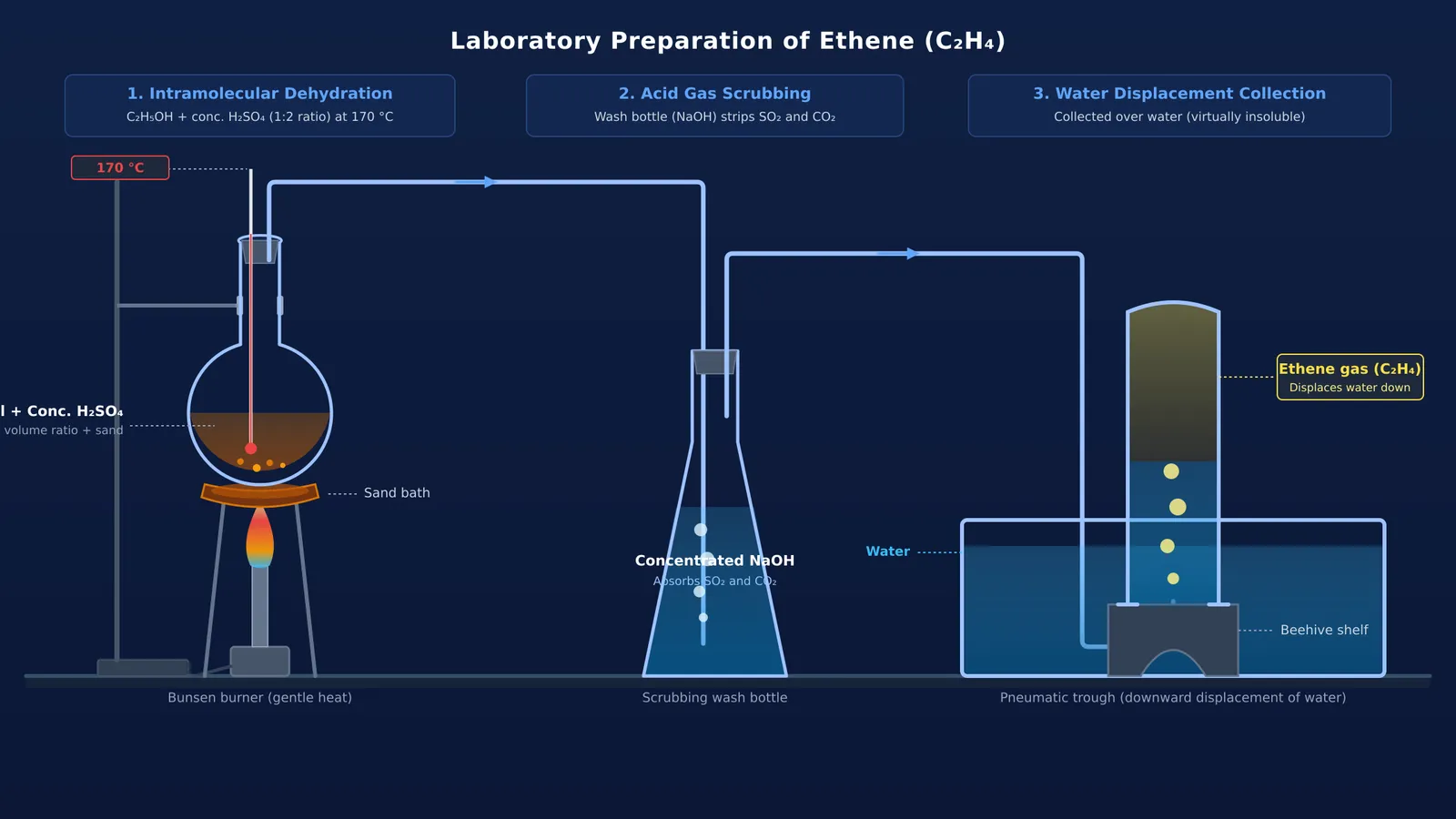
In the ICSE Class 10 Chemistry syllabus prescribed by the CISCE curriculum, the laboratory preparation of ethene (ethylene) is the core method for preparing an unsaturated alkene from an alcohol. The reaction dehydrates ethanol (C₂H₅OH) using excess concentrated sulphuric acid (H₂SO₄). Understanding the reaction conditions, purification steps, and collection method helps students master practical viva questions and board examination papers. You can see how this fits into the wider syllabus in our ICSE Class 10 chemistry paper breakdown.
What is the chemical reaction for preparing ethene from ethanol?
The preparation is an elimination reaction in which concentrated sulphuric acid removes a water molecule from ethanol. As detailed in the Chemguide dehydration guide, the overall reaction requires heating the mixture to approximately 170 °C:
C₂H₅OH → C₂H₄ + H₂O
In school textbooks, this reaction is written in two stages:
Formation of ethyl hydrogen sulphate (at 100 °C): C₂H₅OH + H₂SO₄ → C₂H₅HSO₄ + H₂O
Decomposition to ethene (at 160 °C to 170 °C): C₂H₅HSO₄ → C₂H₄ + H₂SO₄
Concentrated sulphuric acid acts as a catalyst by initiating protonation, and as a dehydrating agent by removing water. The acid is regenerated at the end. For related transformations, see our guide on Class 10 reactions of ethanol and ethanoic acid.
Why must ethanol be heated to 170 °C with excess sulphuric acid?
Temperature control is essential. According to the Chemguide elimination mechanism, primary alcohols undergo intramolecular elimination at 170 °C to yield the alkene. If heated to only 140 °C with excess ethanol, as explained in Chemguide's ether synthesis mechanism, intermolecular substitution occurs instead, producing diethyl ether:
2 C₂H₅OH → C₂H₅-O-C₂H₅ + H₂O
To favour ethene over ether, laboratory manuals following the CISCE curriculum specify excess acid in a 1:2 volume ratio of ethanol to concentrated sulphuric acid. Excess acid ensures individual alcohol molecules are rapidly dehydrated rather than condensing together. For how carbocation intermediates affect higher alcohols, see our explainer on dehydration of alcohols and alkene regioselectivity.
How is ethene gas purified and collected in the laboratory?
The gas leaving the flask contains impurities. Hot concentrated sulphuric acid oxidises a fraction of the ethanol, charring it to black carbon. As explained in the Chemguide dehydration overview, the acid is reduced to sulphur dioxide (SO₂) while carbon oxidises to carbon dioxide (CO₂):
C + 2 H₂SO₄ → CO₂ + 2 SO₂ + 2 H₂O
To remove these acidic gases, the crude mixture is bubbled through a wash bottle containing concentrated sodium hydroxide (NaOH) solution:
SO₂ + 2 NaOH → Na₂SO₃ + H₂O
CO₂ + 2 NaOH → Na₂CO₃ + H₂O
Purified ethene is collected over water in an inverted gas jar by downward displacement of water. As documented in Wikipedia's ethylene reference, ethene has a low water solubility of 131 mg/L at 25 °C, making water displacement ideal. Air displacement is avoided because ethene forms flammable and explosive mixtures with air and has a vapour density of 14, nearly identical to air's average vapour density of 14.4 (a relative vapor density of 0.97).
How do you test ethene gas with bromine water?
The standard test for unsaturation is the bromine water test. When ethene bubbles into reddish-brown bromine water, the colour rapidly disappears, producing a colourless liquid. As documented by the Chemguide electrophilic addition reference, ethene undergoes electrophilic addition across the double bond to yield 1,2-dibromoethane:
CH₂=CH₂ + Br₂ → CH₂Br-CH₂Br
This reaction happens at room temperature without sunlight. Saturated alkanes like ethane do not decolourise bromine water in the dark. Ethene also decolourises cold alkaline potassium permanganate (Baeyer's reagent), turning from purple to colourless with a brown manganese dioxide (MnO₂) precipitate. For students mastering hydrocarbon reactions, the Fermi Concept Library covers every concept in physics, chemistry, biology, mathematics and computing, each with its own lesson and its place in the map.
What safety precautions prevent accidents like flask suck-back?
Boiling concentrated sulphuric acid requires strict precautions under the CISCE examination standards:
Heat on a sand bath: Heating the flask on a sand bath ensures uniform temperature distribution and protects the glassware from cracking.
Add boiling chips: Adding clean sand or aluminium sulphate prevents violent bumping and frothing of the boiling acid mixture.
Prevent suck-back: Always remove the delivery tube from the water trough before turning off the Bunsen burner. If the flame is extinguished while the tube is submerged, cooling gas contracts, creating a partial vacuum that draws cold water back into the hot acid flask, shattering it.
When you need step-by-step guidance through reaction conditions and board numericals, the Fermi Problem Library provides worked problems with a solver that explains the reasoning rather than just printing an answer.


