

On this page
When you need to synthesize an alcohol, the method you choose depends entirely on the structure you want to build. Are you aiming for a primary (1°), secondary (2°), or tertiary (3°) alcohol? By matching your starting material—whether an alkene, a carbonyl, or a Grignard reagent—to the right chemical reaction, you can control exactly where the hydroxyl group ends up.
In organic chemistry, and especially for exams like JEE Main and NEET-UG, knowing the reagents is only half the battle. You also need to know the regiochemistry—which carbon the OH group bonds to. Here is how the main methods of alcohol preparation compare, from Markovnikov additions to carbonyl reductions.
How do you prepare alcohols from alkenes?
Alkenes are a common starting point for making alcohols, but the reagent you choose changes the final position of the OH group. Because alkenes have a carbon-carbon double bond, water can be added across it in a hydration reaction.
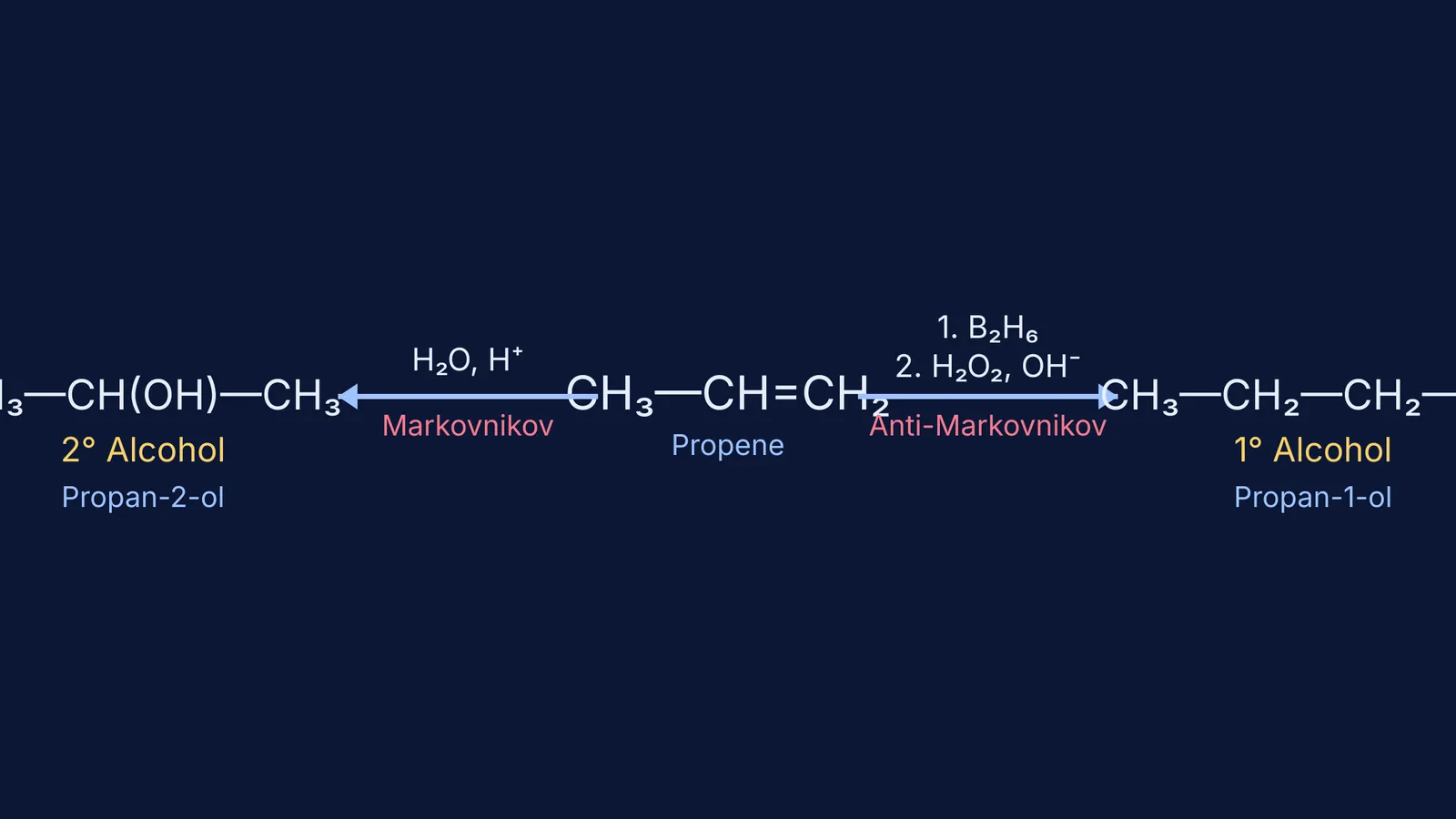
Acid-catalysed hydration: Adding water to an alkene in the presence of an acid catalyst (like dilute sulphuric acid) follows Markovnikov's rule. The hydrogen atom attaches to the carbon that already has more hydrogens, placing the hydroxyl group on the more substituted carbon. For example, hydrating propene yields propan-2-ol, a secondary alcohol. (If you need to reverse this process, you can look at the dehydration of alcohols to form a major alkene.)
Hydroboration-oxidation: If you need the OH group on the less substituted carbon, hydroboration-oxidation is the preferred alternative. First reported by Herbert C. Brown, whose work earned the 1979 Nobel Prize in Chemistry, this two-step reaction first adds borane (B₂H₆) and is followed by oxidation with hydrogen peroxide (H₂O₂) in a basic medium. As we cover in our guide to how hydroboration-oxidation gives anti-Markovnikov alcohols, this sequence turns propene into propan-1-ol, a primary alcohol.
Which method gives primary, secondary or tertiary alcohols from carbonyls?
Carbonyl compounds, which include aldehydes, ketones, carboxylic acids, and esters, can be directly converted to alcohols through chemical reduction. The class of alcohol you obtain depends completely on the starting carbonyl compound:
Reduction of aldehydes: Using standard reducing agents like sodium borohydride (NaBH₄) or lithium aluminium hydride (LiAlH₄), aldehydes are reduced to primary alcohols. Catalytic hydrogenation (using H₂ gas over a palladium or nickel catalyst) will achieve the same result.
Reduction of ketones: Under the same reducing conditions, ketones yield secondary alcohols because the carbonyl carbon is bonded to two other carbon atoms.
Reduction of carboxylic acids and esters: Carboxylic acids are highly resistant to reduction and require strong agents like LiAlH₄ to successfully form primary alcohols. Because LiAlH₄ is an expensive and highly reactive reagent, acids are often first converted to esters in the laboratory. The resulting esters are then easily reduced to primary alcohols using catalytic hydrogenation.
If your goal is to completely remove the oxygen atom from the carbon skeleton rather than stopping at a hydroxyl group, you would bypass these methods and instead use the Clemmensen or Wolff-Kishner reduction.
For students mapping these reactions out, visualizing the mechanism can be the hardest part of exam prep. The Fermi Concept Library holds a lesson for every concept in chemistry, helping you see precisely where the electrons flow in these oxidation and reduction pathways.
How does Grignard addition work?
When you need to build a larger carbon skeleton while simultaneously forming an alcohol, the Grignard reaction is a powerful tool. Discovered by Victor Grignard, who was awarded the 1912 Nobel Prize in Chemistry for the breakthrough, a Grignard reagent (RMgX, where X is a halogen) adds to a carbonyl group to form a new carbon-carbon bond.
Because the Grignard reagent acts as a nucleophile, it attacks the electrophilic carbon of the carbonyl. The structure of your starting carbonyl dictates the outcome:
Formaldehyde (methanal) + Grignard reagent: Yields a primary alcohol. Formaldehyde has no alkyl groups attached to the carbonyl carbon, so the addition of one R group from the Grignard reagent produces a 1° structure.
Any other aldehyde + Grignard reagent: Yields a secondary alcohol. The aldehyde already has one R group; adding a second from the Grignard reagent creates a 2° structure.
Ketones + Grignard reagent: Yields a tertiary alcohol. Ketones start with two R groups, and the incoming Grignard reagent provides the third, resulting in a 3° alcohol.
This makes the Grignard addition unique among these methods: it is the easiest way to produce tertiary alcohols from a carbonyl precursor while also extending the length of the carbon chain.
How do you choose the right preparation method?
When faced with an organic synthesis problem, ask yourself two fundamental questions to choose the right preparation method:
Did the carbon chain grow?
If the product has more carbon atoms than your starting material, you almost certainly need a Grignard reaction.
Where is the OH group located?
Primary (1°): Use hydroboration of a terminal alkene, reduction of an aldehyde, carboxylic acid, or ester, or react a Grignard reagent with formaldehyde.
Secondary (2°): Use acid-catalysed hydration of a terminal alkene, reduction of a ketone, or react a Grignard reagent with any aldehyde other than formaldehyde.
Tertiary (3°): Use acid-catalysed hydration of a branched alkene, or react a Grignard reagent with a ketone.
If you are stuck on a multi-step reaction sequence, the Fermi Problem Library will walk you through it step by step. It explains exactly why one reagent was chosen over another rather than just printing the final product. By practising these decision pathways, you can confidently navigate any alcohol preparation question you encounter.


