

On this page
Heat something and its mass stays the same while its volume grows, so its density falls. Board and JEE problems use ρ' ≈ ρ(1 − γΔT). Here is where it comes from, how big γ is, and when it breaks.
How does density change with temperature?
For small temperature changes, the change in volume is proportional to the original volume and to the temperature change: ΔV = γVΔT, where γ is the coefficient of volume expansion. OpenStax University Physics Volume 2 writes this as dV/dT = βV, with β = 3α for a solid that expands equally in all directions. Many Indian textbooks and JEE problems write it as γ.
Now follow the mass:
Before heating: ρ = m/V.
After heating: V' = V(1 + γΔT), and m does not change.
So ρ' = m/V' = ρ/(1 + γΔT).
When γΔT is much smaller than 1, the binomial approximation 1/(1 + x) ≈ 1 − x gives ρ' ≈ ρ(1 − γΔT).
The error in step 4 is about (γΔT)², which is why the shortcut is safe for solids and most liquids over tens of degrees.
How big is γ for common materials?
Liquids expand far more than solids. The table of representative values in OpenStax University Physics, section 1.3 gives these volume coefficients, all per °C:
Iron or steel: 35 × 10⁻⁶
Aluminium: 75 × 10⁻⁶
Mercury: 180 × 10⁻⁶
Water: 210 × 10⁻⁶
Glycerin: 500 × 10⁻⁶
Gasoline (petrol): 950 × 10⁻⁶
Ethyl alcohol: 1100 × 10⁻⁶
Air and most gases at atmospheric pressure: 3400 × 10⁻⁶
So when a solid and a liquid are heated together, the liquid's density usually falls faster.
Worked examples: putting numbers into ρ(1 − γΔT)
All coefficients below come from the OpenStax table.
Example 1: petrol on a hot afternoon. Petrol warms by 20 °C, with γ = 950 × 10⁻⁶ per °C. Then γΔT = 0.019, so the shortcut says density falls by 1.9%. The exact factor is 1/1.019 = 0.9814, a drop of 1.86%. The two answers differ by about 0.04 percentage points, close to (0.019)², as predicted.
Example 2: a steel sinker in glycerin. A steel block hangs fully submerged in glycerin, and both warm by 20 °C. Upthrust equals the weight of displaced liquid, V'ρ'g, so it scales as (1 + γ for steel × ΔT)(1 − γ for glycerin × ΔT) ≈ 1 − (500 − 35) × 10⁻⁶ × 20 = 1 − 0.0093. The upthrust falls by about 0.93%, so the spring balance reading goes up.
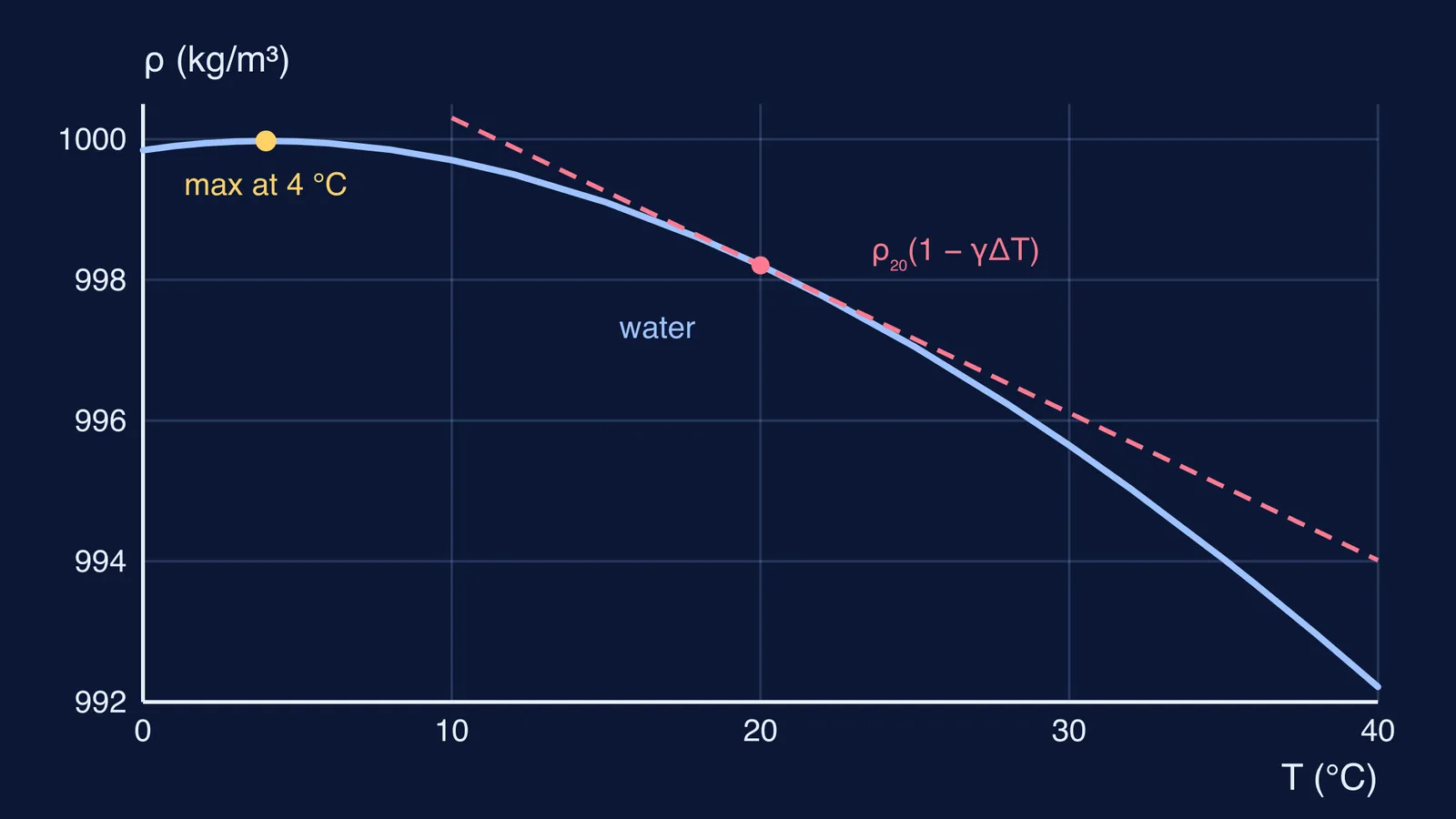
Example 3: water from 20 °C to 40 °C. The recommended table for water density by Tanaka and colleagues in Metrologia, which covers 0 °C to 40 °C, gives 998.21 kg/m³ at 20 °C and about 992.2 kg/m³ at 40 °C (Tanaka et al., 2001). Using γ = 210 × 10⁻⁶ per °C, the shortcut gives 998.21 × (1 − 0.0042) ≈ 994.0 kg/m³. The gap is not an algebra mistake: water's γ is not constant. From the same formula, it is roughly 0.9 × 10⁻⁴ per °C near 10 °C, 2.1 × 10⁻⁴ near 20 °C and 3.0 × 10⁻⁴ near 30 °C. For big ranges, use an average γ.
Why does water get denser when heated from 0 °C to 4 °C?
Water is the main exception. OpenStax notes that water has its maximum density at 4 °C and expands as it cools from 4 °C to 0 °C. The Tanaka et al. formula puts the peak at 3.983 °C, at 999.975 kg/m³. Between 0 °C and 4 °C, water's γ is negative, so heating makes it denser. This is why a pond freezes from the top while 4 °C water stays at the bottom.
A checklist for thermal expansion and density problems
Write ρ' = ρ/(1 + γΔT) first, then decide whether to approximate.
Use γ (volume), not α (linear). For solids, γ = 3α.
For water, check whether the range crosses 4 °C.
For a sinker or floating body, track both the body's volume and the liquid's density.
If options differ in the third significant figure, divide exactly.
Where to practise next?
If the container expands too, read real and apparent expansion of liquids. To measure density, see how to find density by weighing in air and water, and for upthrust, does buoyant force change with depth in a liquid.
When a problem mixes expansion with buoyancy and you are unsure which density changes, the Fermi Problem Library has worked problems with a step-by-step solver that explains the reasoning rather than printing an answer. If the binomial step or γ = 3α still feels shaky, the Fermi Concept Library gives each concept its own lesson and shows its place in the map.


