

On this page
If you push a ball into a swimming pool, you can feel the water pushing back. The deeper you push the ball into the water, the harder it seems to fight you. This everyday experience leads to one of the most common misconceptions in physics: the idea that buoyant force increases with depth.
Educational researchers call this the "More A leads to More B" intuition, a concept explored by physicist Andrea diSessa. Our brains naturally assume that if water pressure increases as we go deeper, the upward force must also increase. A 2012 study by Çepni and Şahin found that many middle-school students incorrectly believe a floating object experiences more buoyancy in a deep ocean than in a shallow pond.
But what does the physics actually say?
Does buoyant force change with depth?
For a fully submerged solid object in an incompressible liquid like water, the buoyant force does not change with depth.
According to Archimedes' principle, the buoyant force on an object is equal to the weight of the fluid it displaces (Khan Academy). The formula is F = ρVg, where ρ is the density of the liquid, V is the volume of the displaced liquid, and g is the acceleration due to gravity.
Because water is an incompressible fluid, its density (ρ) remains constant whether you are 1 metre below the surface or 100 metres down. Assuming the object itself is solid and does not compress, its volume (V) also remains constant. With neither density nor volume changing, the upward thrust remains exactly the same. You can explore how different volumes affect this using a buoyancy and density simulation.
Why does pressure increase but upthrust stay the same?
The confusion arises because students conflate absolute pressure with buoyant force. It is absolutely true that hydrostatic pressure increases the deeper you go.
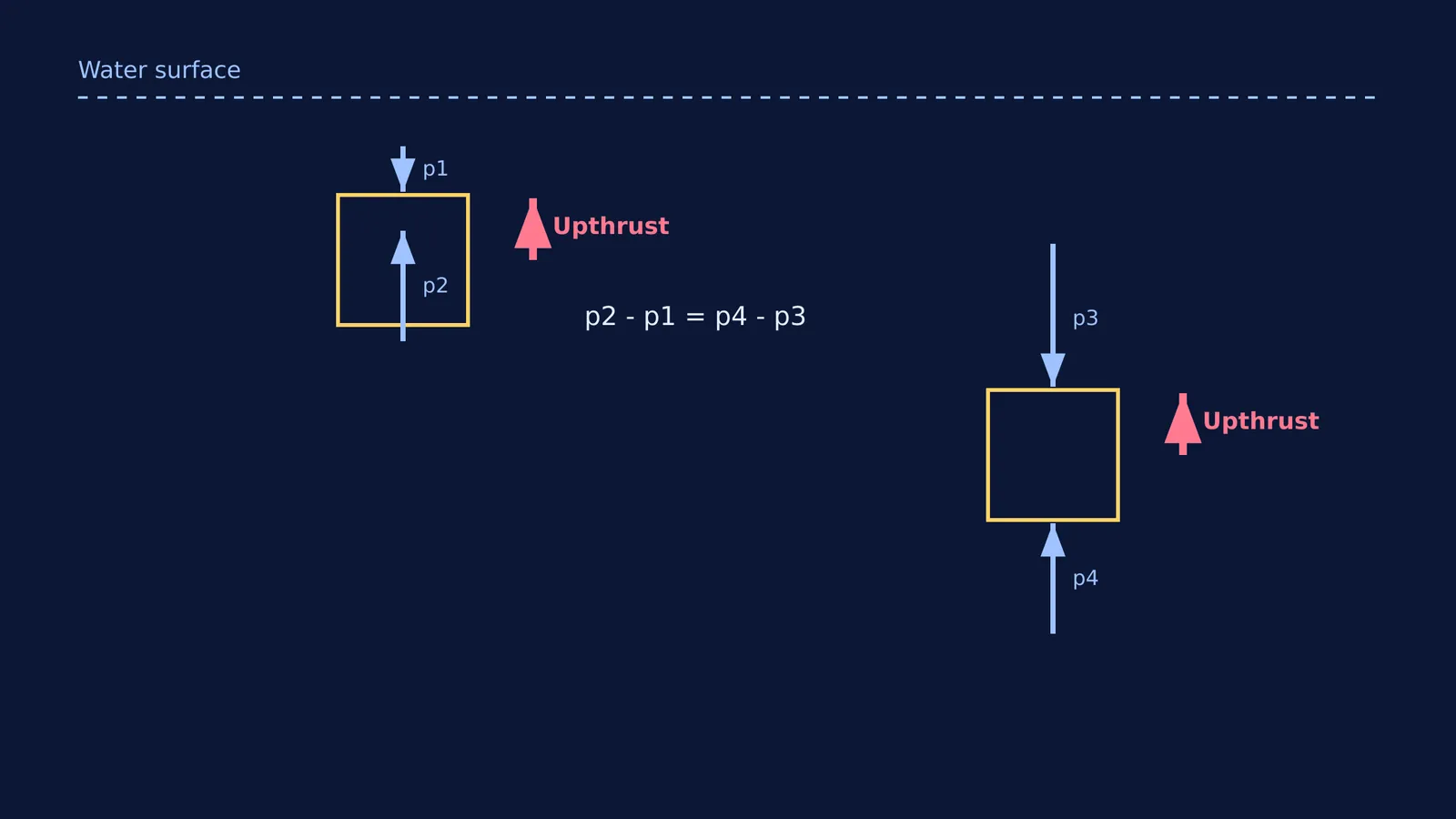
However, buoyancy is not caused by the absolute pressure at a given depth. It is caused by the *difference* in pressure between the top and the bottom of the object.
Imagine a solid metal cube submerged in water.
The water pushes down on the top face of the cube.
The water pushes up on the bottom face of the cube.
Because the bottom face is always slightly deeper than the top face, the upward pressure is always slightly greater than the downward pressure. This net upward force is the upthrust.
If you sink the cube 50 metres deeper, the downward pressure on the top face increases drastically. But the upward pressure on the bottom face increases by the *exact same amount*. The difference between the two pressures—which depends only on the height of the cube—stays completely unchanged. (You can see a similar depth-pressure relationship when calculating how an air bubble doubles in volume as it rises).
What if the fluid or object is compressible?
There is one important exception where upthrust does change with depth: when the fluid or the object itself is compressible.
If you take a foam ball or a balloon and pull it deep underwater, the immense hydrostatic pressure will squeeze it from all sides. As the object is crushed, its volume (V) decreases. Because it now displaces less water, the buoyant force acting on it decreases. This is why scuba divers wearing thick neoprene wetsuits lose buoyancy as they dive deeper; the water pressure compresses the trapped air bubbles in their suits.
Similarly, if the fluid is a compressible gas like the Earth's atmosphere, the density (ρ) of the fluid changes with altitude. A weather balloon experiences less buoyant force as it rises into thinner air. But for solid objects in liquids, the force is constant.
How do you avoid the deep water trap in exams?
When tackling hydrostatics questions in the JEE or NEET, use this simple checklist before assuming buoyancy changes:
Is the object fully submerged? If it is only partially submerged and being pushed down, upthrust increases *until* it is completely underwater. Once submerged, it plateaus.
Is the liquid incompressible? Liquids like water and oil are treated as incompressible. Their density does not change with depth.
Is the object rigid? Solid blocks of wood, steel, or plastic will not change volume.
If the answer to all three is yes, the buoyant force is locked in. If you are struggling with these conceptual traps, you can try some varied examples in the Fermi Problem Library, where a step-by-step solver explains the reasoning.


