

On this page
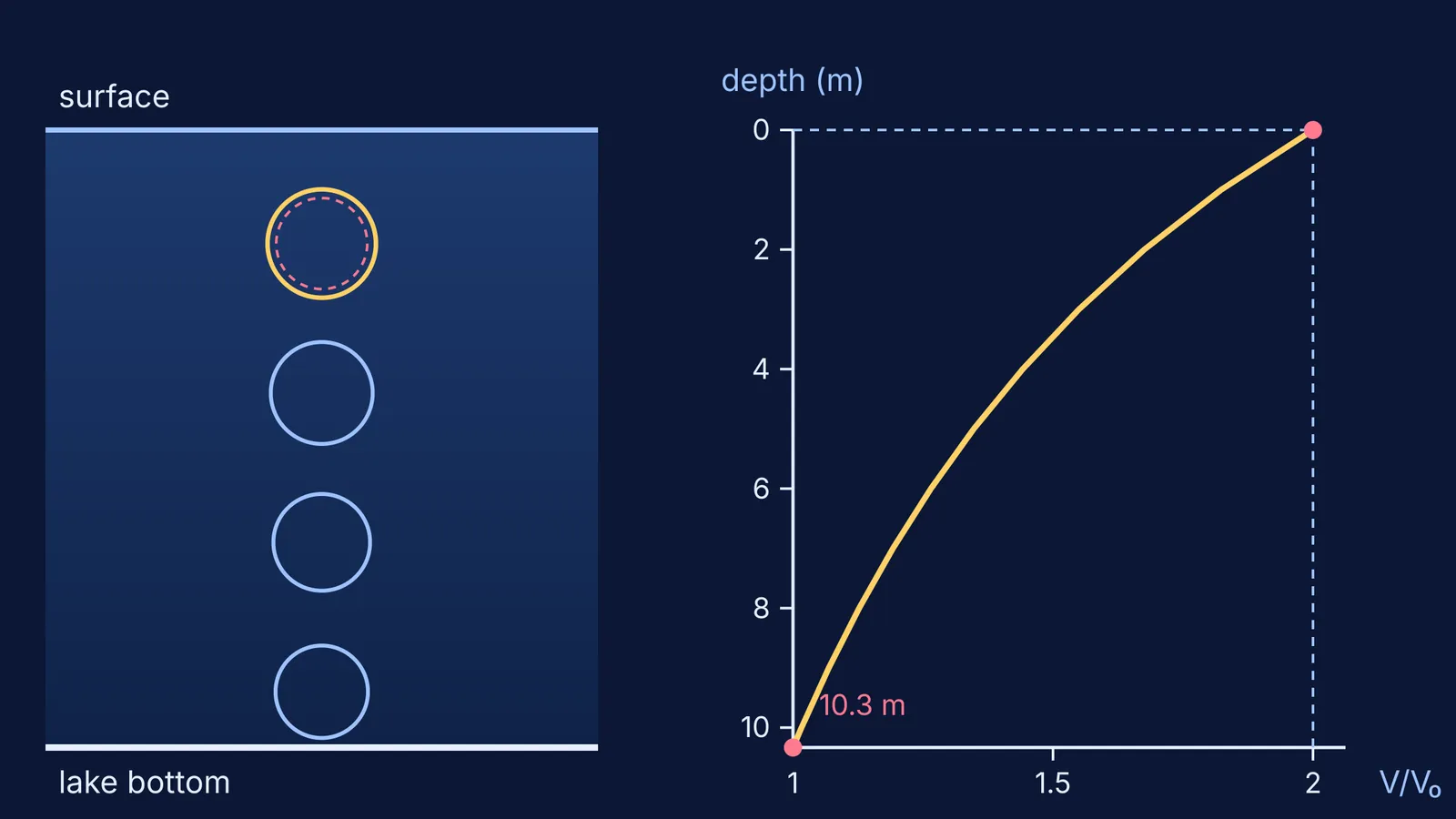
An air bubble leaves the bottom of a lake and its volume doubles (or triples, or its radius doubles) by the surface. How deep is the lake? You need Boyle's law, pressure at depth and one habit: always use absolute pressure.
How deep is the lake if a bubble doubles in volume?
Boyle's law says that at constant temperature and a fixed amount of gas, absolute pressure and volume are inversely proportional, so P1V1 = P2V2 (OpenStax University Physics, Vol. 2).
The pressure at depth h in a liquid of density ρ is P = P0 + ρgh, where P0 is the atmospheric pressure at the surface (OpenStax University Physics, Vol. 1).
Put them together. At the bottom the bubble has volume V and pressure P0 + ρgh. At the surface it has volume 2V and pressure P0.
Write Boyle's law: (P0 + ρgh) × V = P0 × 2V.
Cancel V: P0 + ρgh = 2P0.
Solve: ρgh = P0, so h = P0 / ρg.
So the lake is as deep as the water column that matches atmospheric pressure.
Why does atmospheric pressure equal about 10 m of water?
The standard atmosphere is defined as exactly 101,325 Pa (NIST CODATA). Standard gravity is exactly 9.80665 m/s² (NIST CODATA). The density of water at 4 °C is 1.000 × 10³ kg/m³ (OpenStax).
Divide: h = 101,325 / (1000 × 9.80665) ≈ 10.33 m. NOAA puts the same rule another way: pressure rises by one atmosphere for every 10.06 m of seawater, which is a little shorter because seawater is denser (NOAA Ocean Service).
Many problems simply say "take atmospheric pressure as 10 m of water". Use what the question gives you. If it says H = 10 m, then the doubling lake is 10 m deep, not 10.3 m.
With that shortcut, Boyle's law becomes (H + h) × V1 = H × V2, so h = H × (V2/V1 − 1). If you want more practice with depth and gauge pressure on their own, our post on pressure at depth and gauge pressure problems works through them.
What changes if the water is warmer at the top?
Real lakes are often colder at the bottom. Then Boyle's law alone is not enough; you need the combined gas law, P1V1/T1 = P2V2/T2, with temperature in kelvin and pressure as absolute pressure (OpenStax).
Take a bottom temperature of 4 °C (277 K) and a surface temperature of 27 °C (300 K), with H = 10.33 m and V2 = 2V1.
Write (H + h) × V1 / 277 = H × 2V1 / 300.
Rearrange: H + h = H × 2 × 277 / 300 = 1.847H.
Solve: h = 0.847 × 10.33 ≈ 8.7 m.
The lake is shallower: warming does part of the expanding, so less has to come from the pressure drop. A deeper answer usually means a flipped temperature ratio.
How do you solve the other versions of this question?
Use h = H × (V2/V1 − 1) with constant temperature and H = 10.33 m, the NIST standard atmosphere as a water height (or whatever the paper gives).
Volume triples: h = H × (3 − 1) = 2H ≈ 20.7 m.
Radius doubles: volume goes as r³, so V2/V1 = 8 and h = 7H ≈ 72.3 m. This is the version that catches people who treat radius like volume.
Volume grows by 50%: h = H × 0.5 ≈ 5.2 m.
Reverse question (lake depth given, find the volume ratio): V2/V1 = (H + h) / H. A 31 m lake gives about 4 times the volume.
For more gas-law questions with the same unit traps, see ideal gas problems: gas laws, Dalton's law and the units trap. The story behind P1V1 = P2V2 is in Robert Boyle: the air pump and the law of gases.
Which mistakes cost marks on bubble problems?
Run through this checklist before you write the final answer.
Did you use absolute pressure (P0 + ρgh), not gauge pressure (ρgh)? Gauge pressure at the surface is zero, which breaks the equation.
Did you use kelvin for every temperature?
Did you convert radius or diameter ratios to volume ratios by cubing them?
Did you use the value of atmospheric pressure the question gave you?
Does the answer make sense? Warm surface water should make the lake shallower, and a bigger expansion should mean a deeper start.
If you keep reaching the right equation and the wrong number, it helps to see each line checked. The Fermi Problem Library has worked problems with a step-by-step solver that explains the reasoning rather than printing an answer. If the idea of absolute pressure itself feels shaky, the Fermi Concept Library gives each concept in physics its own lesson and its place in the map.


