

On this page
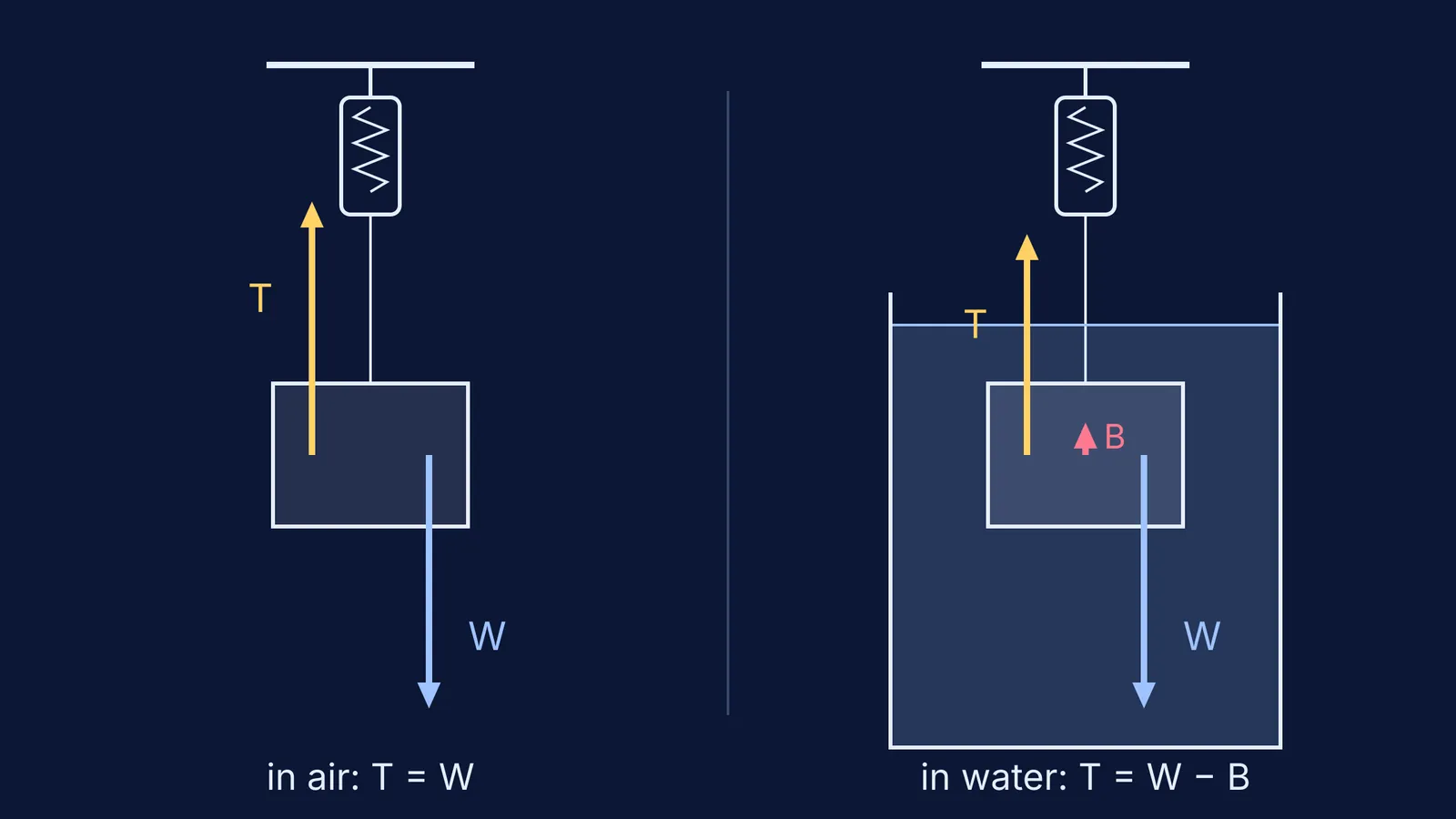
Hang a stone from a spring balance, lower it into a bucket, and the reading drops. That drop is the whole method. It tells you the stone's volume without a ruler or a measuring cylinder, and from there its density takes one division.
Why does a solid weigh less in water?
Archimedes' principle says: "The buoyant force on an object equals the weight of the fluid it displaces" (OpenStax College Physics 2e, section 11.7). The fall in the balance reading, the loss of weight, is exactly that buoyant force. For the force picture, see our explainer on why objects weigh less in water.
Fully under water, the object displaces its own volume, so the loss of weight is the weight of an equal volume of water. Divide and the volume cancels:
Relative density = weight in air ÷ loss of weight in water.
OpenStax defines specific gravity (another name for relative density) as "the ratio of the density of an object to a fluid (usually water)" and notes that it is dimensionless (OpenStax, section 11.7). More on that in why relative density has no unit.
How do you find the density of a solid by weighing it in air and water?
Hang the solid from a spring balance and note the reading in air, W1.
Lower it fully under water, clear of the sides and bottom, with no air bubbles on it. Note the reading, W2.
Work out the loss of weight, W1 − W2.
Relative density = W1 ÷ (W1 − W2).
Density = relative density × 1000 kg/m³.
Worked example: a block reads 7.8 N in air and 6.8 N in water. The loss is 1.0 N, so the relative density is 7.8 ÷ 1.0 = 7.8, and the density is 7800 kg/m³. The OpenStax density table lists iron or steel at 7.8 × 10³ kg/m³ (OpenStax, section 11.2), so the block is consistent with iron or steel.
OpenStax uses the same idea on an ancient Greek coin of mass 8.630 g that shows an apparent mass of 7.800 g in water: the coin's density works out to 10.4 g/cm³, "very close to that of pure silver" (OpenStax Example 11.10). Grams or newtons both work; the units cancel.
How do you find the relative density of a liquid?
Use one solid that sinks in both liquids. Weigh it in air (W1), in water (W2) and in the liquid (W3). The two losses are the weights of equal volumes of the two liquids, so:
Relative density of liquid = (W1 − W3) ÷ (W1 − W2).
Take the iron block again. In an unknown liquid it reads 7.01 N, a loss of 0.79 N. Divide by the 1.0 N loss in water and you get 0.79, which matches ethyl alcohol at 0.79 × 10³ kg/m³ in the OpenStax table.
What changes when the object is hollow?
The formula always gives the average density of whatever is hanging from the balance, cavity included. That is the trap in hollow-object questions.
Worked example: an iron ball has a mass of 780 g in air and an apparent mass of 580 g in water. Take iron's relative density as 7.8 (OpenStax table).
Loss = 200 g, so the ball's outer volume is 200 cm³ (1 g of water fills 1 cm³).
Volume of iron actually present = 780 ÷ 7.8 = 100 cm³.
Cavity = 200 − 100 = 100 cm³.
The formula W1 ÷ (W1 − W2) would give 780 ÷ 200 = 3.9. That is the ball's average, not iron's value.
How do you solve problems with two metals mixed?
This is the classic crown question. Suppose a 1000 g ornament made only of gold and silver has an apparent mass of 940 g in water. Its volume is therefore 60 cm³. Using gold at 19.32 and silver at 10.49 g/cm³ from the OpenStax table, let x be the mass of gold:
x ÷ 19.32 + (1000 − x) ÷ 10.49 = 60
Solving gives x ≈ 811 g of gold and about 189 g of silver. Check: 811 ÷ 19.32 ≈ 42.0 cm³ and 189 ÷ 10.49 ≈ 18.0 cm³, which add to 60 cm³. This assumes the volumes simply add and there is no hidden cavity.
What mistakes cost marks in relative density questions?
Dividing by W2 instead of by the loss, W1 − W2.
Taking a reading with the object only partly under water.
Treating a hollow or mixed object's result as the material's value.
Rushing the small reading. If the 1.0 N loss above is misread by 0.05 N, the answer moves from 7.8 to about 7.4 or 8.2.
For practice, try these Archimedes' principle numericals on loss of weight. If your answer keeps coming out wrong, the Fermi Problem Library has worked problems with a step-by-step solver that explains the reasoning rather than printing an answer.
Next time you see a weight-in-water question, write the loss of weight first. Everything else follows from it.


