

On this page
In science, almost every measurement carries a unit: speed has metres per second, force has newtons, and density has kilograms per cubic metre. But when students encounter relative density in Class 9 or competitive physics exams, the number appears completely bare. Gold has a relative density of 19.3, aluminium is 2.7, and mercury is 13.6, with no trailing unit symbols. For many students preparing for CBSE or JEE, writing a unit next to relative density is an instinctive reflex that costs avoidable marks. Understanding why relative density has no unit reveals how dimensional analysis works and provides a clear method for converting back to absolute density.
Why does relative density have no unit?
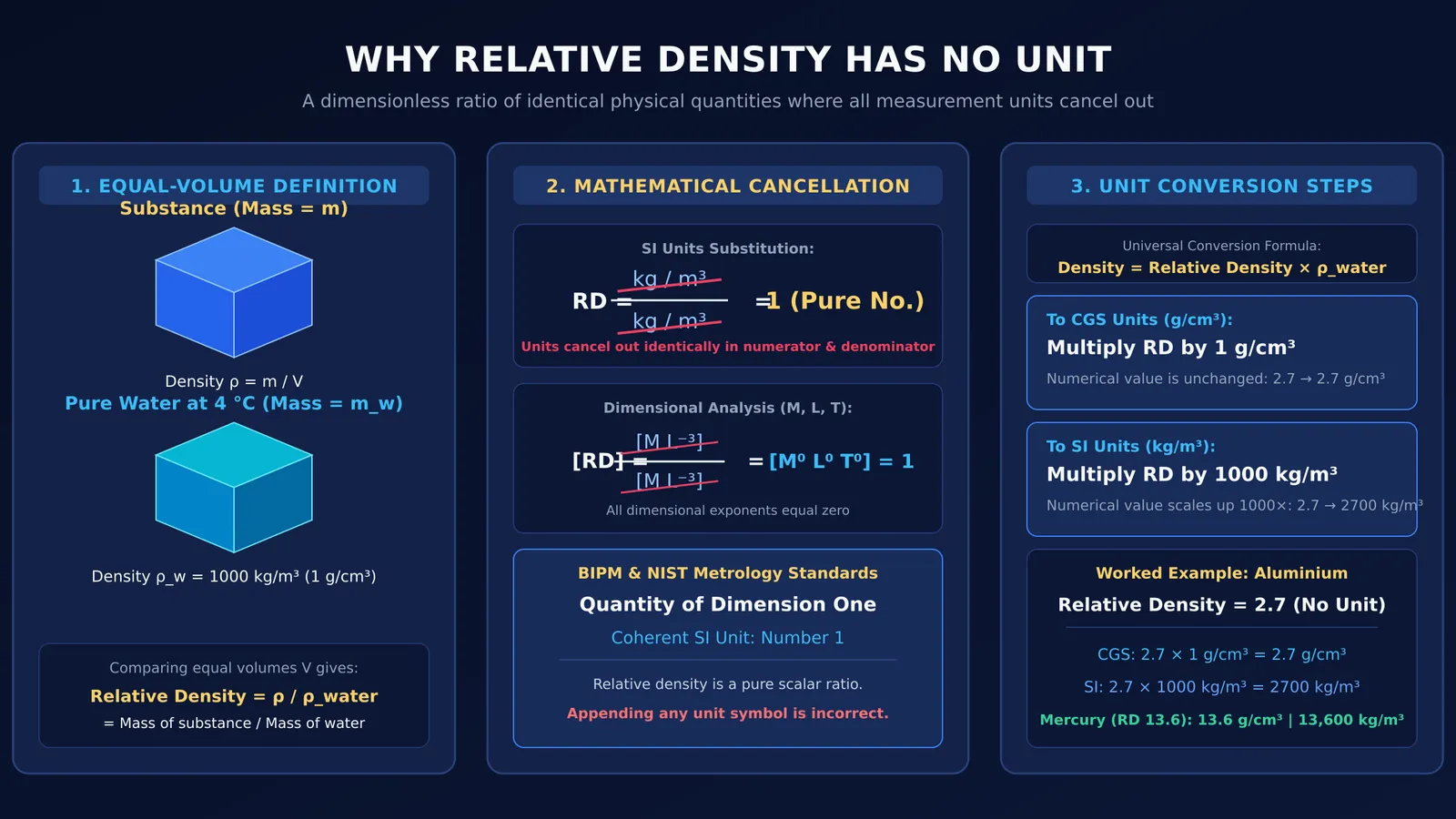
According to the official NCERT Science curriculum, relative density (historically termed specific gravity) is defined as the ratio of the density of a substance to the density of water at 4 °C. The mathematical definition is:
Relative density = Density of substance / Density of water
Because density represents mass per unit volume (density = mass / volume), both the numerator and the denominator share the exact same physical dimensions. If you measure both densities in the International System of Units (SI), you divide kilograms per cubic metre by kilograms per cubic metre (kg/m³ / kg/m³). If you measure both in the CGS system, you divide grams per cubic centimetre by grams per cubic centimetre (g/cm³ / g/cm³).
In both cases, the identical units cancel out, leaving a pure scalar number without physical dimensions. The International Bureau of Weights and Measures formalises this in the BIPM SI Brochure (9th edition), classifying relative density as a quantity of dimension one whose coherent SI unit is simply the number 1. Similarly, the NIST SP 811 Guide notes that relative density is dimensionless and cautions against appending units to it.
How does dimensional analysis prove relative density is unitless?
Dimensional analysis evaluates how fundamental physical quantities combine. In mechanics, the fundamental base dimensions are mass [M], length [L], and time [T].
Because density is mass divided by volume, its dimensional formula is:
[Density] = [M] / [L³] = [M L⁻³]
When you substitute these dimensions into the relative density formula:
[Relative density] = [Density of substance] / [Density of water] = [M L⁻³] / [M L⁻³] = [M⁰ L⁰ T⁰] = 1
All dimensional exponents equal zero. This mathematical cancellation confirms that relative density is an absolute comparison between two quantities of the same kind, similar to refractive index or strain. You can explore how base dimensions establish derived equations in our guide to converting a quantity between unit systems using dimensions and our breakdown of the seven SI base units.
When you study dimensional formulas and fluid mechanics, the Fermi Concept Library arranges every concept in physics with its own lesson and place in the map so you can trace how base units combine into derived quantities.
How do you convert relative density to g/cm³ and kg/m³?
Because relative density compares a substance to water, you convert relative density into absolute density by reversing the division. In standard problem-solving across the NCERT Science curriculum, multiply relative density by the density of water in the target unit system:
Density of substance = Relative density × Density of water
As documented in the NIST SP 811 Guide, pure water at 4 °C has two standard numerical values:
In CGS units: 1.000 g/cm³ (or 1 g/mL)
In SI units: 1000 kg/m³ (or 10³ kg/m³)
This relationship yields a simple two-step conversion framework:
To find density in CGS (g/cm³): Multiply the relative density by 1 g/cm³. The numerical value does not change. For example, aluminium has a relative density of 2.7, so its CGS density is 2.7 × 1 g/cm³ = 2.7 g/cm³.
To find density in SI (kg/m³): Multiply the relative density by 1000 kg/m³. For aluminium, its SI density is 2.7 × 1000 kg/m³ = 2700 kg/m³.
Consider another practical example with mercury, which has a relative density of 13.6:
Density in CGS = 13.6 × 1 g/cm³ = 13.6 g/cm³
Density in SI = 13.6 × 1000 kg/m³ = 13,600 kg/m³
This direct conversion is vital in hydrostatics, such as finding an unknown density with two immiscible liquids in a manometer. If you want to practice multi-step fluid mechanics problems without stumbling over unit systems, the Fermi Problem Library offers worked problems with a step-by-step solver that explains the reasoning rather than printing an answer.
What are the most common exam traps with relative density?
Examiners frequently design questions that exploit common intuitions about units and density. Watch out for these four pitfalls:
The phantom unit mistake: As emphasized in the NIST SP 811 Guide, dimensionless quantities should never carry physical units. Writing "relative density = 2.7 g/cm³" on an exam sheet costs marks; relative density is 2.7, whereas density is 2.7 g/cm³.
The 1000-factor error in SI calculations: When calculating buoyant force (weight of displaced liquid = ρ × V × g) or hydrostatic pressure (P = ρ × g × h), you must use SI units. Substituting 2.7 instead of 2700 kg/m³ produces an answer off by a factor of 1000.
Sinking and floating criteria: In the NCERT Science curriculum, buoyancy depends on whether an object is more or less dense than the fluid. A relative density less than 1.0 means the substance floats (ice has a relative density of 0.92). A relative density greater than 1.0 means it sinks.
Assuming relative density changes across unit systems: While density is 2.7 in CGS and 2700 in SI, relative density remains 2.7 across every measurement system.
Keeping the distinction between a unitless ratio and a dimensioned density clear ensures you never drop easy marks on units again.


