

On this page
When you lower a heavy stone into a bucket of water, it suddenly feels lighter. If you measure it with a spring balance, the reading drops the moment the stone slips beneath the surface.
This is the core of Class 9 fluid mechanics. The liquid pushes up on the object, cancelling out part of gravity's pull. By measuring exactly how much weight is "lost", you can work out both the volume of the object and its relative density, without ever needing a measuring tape.
What does Archimedes' principle state?
Archimedes' principle states that the upward buoyant force exerted on a body immersed in a fluid is equal to the weight of the fluid that the body displaces (Wikipedia).
Every object takes up space. When you drop a solid block into a beaker of water, it has to push water out of the way to make room for itself. The surrounding fluid pushes back. This upward push is called upthrust or buoyant force.
Why does the fluid push back? As you go deeper into a liquid, the pressure increases. The water pushing against the bottom of a submerged block is at a greater depth than the water pushing down on the top of the block. This difference in pressure creates a net upward force. No matter what shape the object is, this net upward force exactly matches the weight of the fluid that was displaced.
How do you calculate loss of weight?
In a typical exam numerical, you are given the "true weight" (what the spring balance reads in air) and the "apparent weight" (what it reads when the object is suspended in the fluid).
The difference between the two is the loss of weight: Loss of weight = True weight in air − Apparent weight in fluid
According to Archimedes' principle, this loss of weight is not a trick of the scale. It is a real force: Loss of weight = Upthrust = Weight of displaced fluid
If you get stuck connecting these formulas across a long assignment, the Fermi Problem Library has worked problems with a step-by-step solver that explains the reasoning rather than printing an answer.
Worked example: Finding volume and relative density
Let's look at a complete numerical problem.
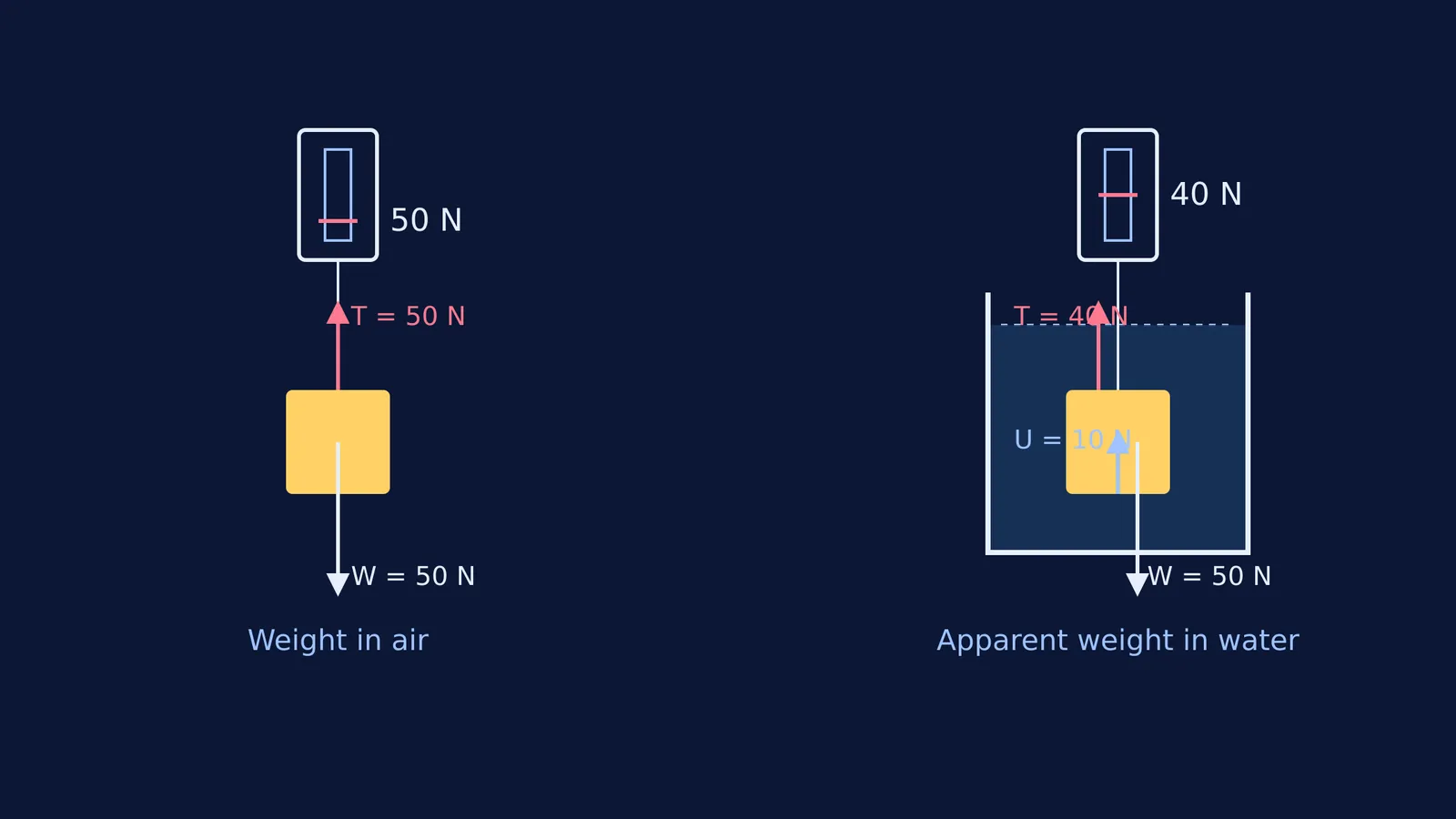
A solid metal block weighs 50 N in air. When it is completely submerged in water, the spring balance reads 40 N. What is the volume and relative density of the block? (Take the density of water as 1000 kg/m³ and *g* = 10 m/s²).
Step 1: Find the upthrust The block appears to lose weight in the water. Loss of weight = 50 N − 40 N = 10 N Upthrust = 10 N
Step 2: Find the volume The upthrust equals the weight of the displaced water. The formula for the weight of a fluid is: Weight of fluid = Volume × Density of fluid × *g*
Since the block is completely submerged, the volume of the displaced water is exactly equal to the volume of the block. 10 = Volume × 1000 × 10 10 = Volume × 10,000 Volume = 10 / 10,000 = 0.001 m³
Step 3: Find the relative density Relative density compares how heavy a substance is compared to an equal volume of water. At roughly 4 °C, liquid water reaches its maximum density of 999.972 kg/m³ (Wikipedia), though school problems round this to 1000 kg/m³.
Because relative density is a ratio of weights for the same volume, there is a powerful shortcut formula for experiments: Relative density = True weight / Loss of weight in water Relative density = 50 N / 10 N = 5
The block is exactly 5 times denser than water. (Because it is a ratio, relative density has no units).
What happens if the object floats?
Our worked example used a heavy metal block that sinks completely. But what if the object floats, like a block of wood?
For a floating object, the upthrust is exactly equal to the true weight of the object in air. The object sinks just deep enough to displace a weight of water equal to its own weight. Because the upthrust cancels gravity entirely, the apparent weight of a floating object is zero.
Once you see that "loss of weight" is just another name for the weight of the water pushed aside, hydrostatics problems become straightforward. Start by subtracting the two scale readings, and let the upthrust guide the rest of the working.


