

On this page
In physics labs, lowering a solid object into water while it hangs from a spring balance is a classic experiment. You watch the dial spin backwards, registering a lighter weight the deeper the object goes. This familiar classroom setup demonstrates the mechanics of buoyancy, but it often leaves students wondering about the invisible forces at play beneath the surface.
Why do objects weigh less in water?
When an object is immersed in a liquid, it experiences two opposing forces simultaneously. Gravity constantly pulls the mass downward, giving the object its true weight in the air. However, the fluid pushes back upward against the bottom of the object. This upward push is called the buoyant force, and it directly counters gravity, which reduces the object's apparent weight. The exact amount of weight lost is not random, but is tied directly to the physical space the object takes up in the liquid.
How does Archimedes' principle explain apparent weight loss?
Archimedes' principle states that the upward buoyant force exerted on a body is equal to the weight of the fluid it displaces. This means you can predict the exact spring balance reading before the block even touches the water. If you know the volume of the block and the density of the fluid, you can calculate the weight of the displaced liquid.
When students struggle to picture these opposing forces in their head, the Fermi Simulation Lab provides interactive environments where you can alter fluid density and watch the force vectors change in real time. Seeing the arrows for gravity and buoyancy adjust dynamically helps bridge the gap between abstract formulas and physical reality.
Worked Example: Predicting a spring balance reading in water
Let's look at a practical calculation based on the Wikipedia example for buoyancy. Suppose you are performing this experiment in your school lab with a heavy stone.
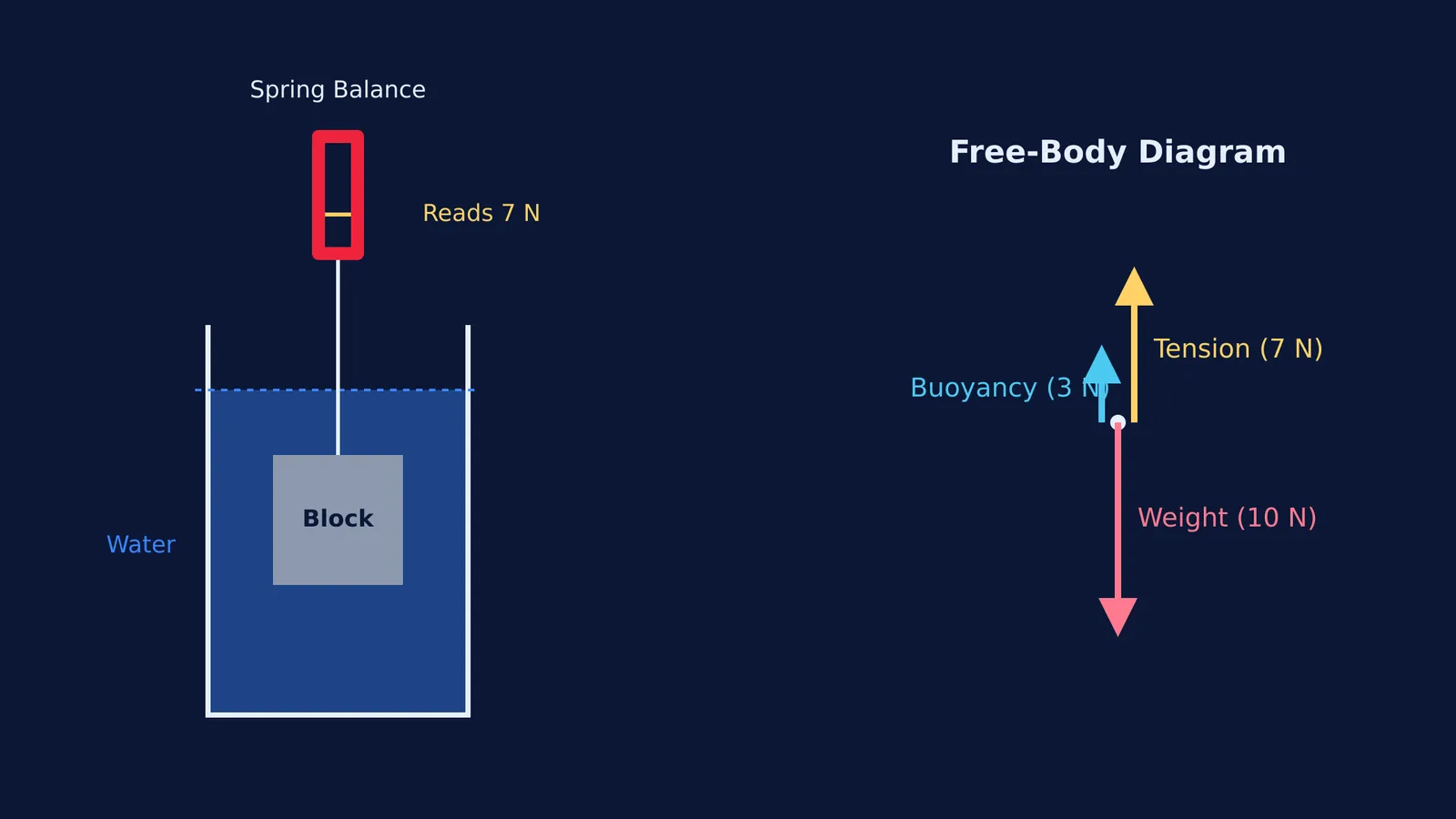
True Weight: You hang the solid stone from a spring balance in the air. The scale settles and reads exactly 10 newtons.
Displacement: You slowly lower the stone completely into a eureka can filled with water. The stone sinks, pushing water out of the spout and into an empty measuring cylinder.
Weight of Water: You take the measuring cylinder and weigh the displaced water. You find that the displaced water weighs exactly 3 newtons.
Apparent Weight: Because the buoyant force acting upward equals the weight of the displaced water (3 newtons), the spring balance reading will decrease. It will now read 7 newtons (10 N - 3 N = 7 N).
If you get stuck on why different materials, like a block of aluminium versus a block of iron, displace different amounts of water for the exact same mass, Fermi's AI tutor can work out what you already know and build a plan for the session. It writes on a virtual board to help you map out the specific relationship between mass, volume, and density.
How to master buoyancy for JEE and NEET?
For competitive engineering and medical exams, you have to do much more than memorize the basic definition of Archimedes' principle. You will frequently be asked to compare spring balance readings when the same solid block is submerged in fluids of different densities, such as placing it in salty water versus tap water.
Because salty water has a higher density, the exact same volume of displaced fluid weighs more. This creates a much larger upward buoyant force, resulting in a lower reading on the spring balance. You will also encounter problems where objects are only partially submerged, requiring you to calculate the precise fraction of the volume under the surface.
Instead of staring at a blank page when tackling these multi-step fluid mechanics problems, the Fermi Problem Library has worked problems with a step-by-step solver that explains the reasoning rather than just printing an answer. This helps you build the strong physical intuition needed to solve complex exam questions with confidence.


