On this page
A steel rail gets longer as it heats up, and the gap between two rails leaves room for that growth. One line of Class 11 physics tells you how big that gap should be.
Why do railway tracks have gaps?
For a rod or a rail, the change in length is ΔL = αLΔT, where α is the coefficient of linear expansion, L is the original length and ΔT is the temperature change (thermal expansion, Wikipedia). For ordinary steel, α is about 11 to 13 × 10⁻⁶ per kelvin, according to the same source.
Training notes for Indian track engineers use α = 0.00001152 per °C for rail steel (IPWE notes on welded railway track). In northern India, the notes say, the maximum rail temperature in summer is about 20 °C above the maximum air temperature. Indian track is split into four rail temperature zones, from 40-50 °C in Zone I up to 71-76 °C in Zone IV.
With no gap, a heated rail cannot get longer, so the push becomes force. Our post on thermal stress in clamped rods works out how big that force gets. On long stretches of continuous rail, thermal expansion is the driving force behind rail buckling, where the track bends out of line (Wikipedia).
How big should the gap in a railway track be?
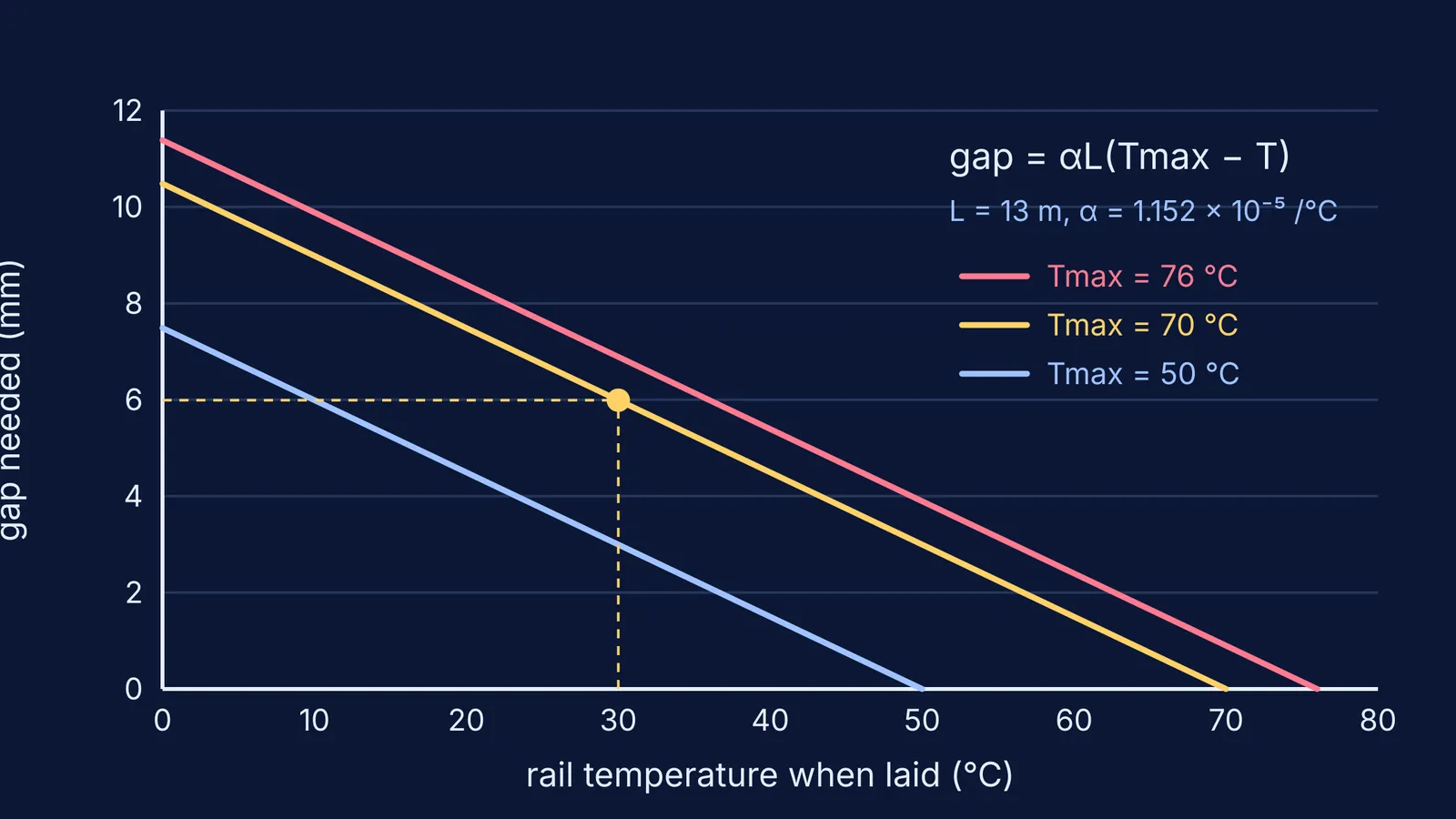
Take one 13 m rail. The IPWE notes build broad gauge short welded rails from three 13 m rails (IPWE notes), so we use L = 13 m.
Growth per degree: αL = 1.152 × 10⁻⁵ × 13,000 mm = 0.150 mm per °C.
Pick ΔT: the highest rail temperature the rail will reach, minus its temperature on the day it is laid. Zone III tops out at 70 °C. If the rail is laid at 30 °C, ΔT = 40 °C.
Multiply: ΔL = 0.150 × 40 = 6.0 mm.
So the gap left on laying day should be about 6 mm. Six millimetres is also the "standard gap" the same notes give for a fish-plated joint at the standard installation temperature.
Now change the laying temperature and keep the 70 °C maximum:
Laid at 10 °C: leave about 9.0 mm.
Laid at 30 °C: about 6.0 mm.
Laid at 50 °C: about 3.0 mm.
Laid at 70 °C: no gap needed, because the rail can get no longer.
Cooling works the other way. Lay the rail at 30 °C with a 6 mm gap, and on a 0 °C winter morning it is 30 °C colder. It shrinks by 0.150 × 30 ≈ 4.5 mm, so the gap opens to about 10.5 mm.
Why are some railway tracks welded without gaps?
The IPWE notes call the rail joint the weakest link in the track and say a joint needs about 25% more maintenance than plain track (IPWE notes). So railways weld rails into long welded rail (LWR), and the central part of an LWR does not move as the temperature changes.
The steel still tries to expand. It is held by the sleepers and the stone ballast (here is why railway tracks have stones), so the expansion becomes force: P = EAαT. The notes work this out as 1.638 tonnes per °C for a 52 kg rail. A 40 °C rise therefore locks about 65 tonnes of force into the fixed central part of such a rail.
Only the ends move. Each end has a breathing length of about 100 m on broad gauge. With temperatures swinging ±35 °C from the mean, the ends move about ±20 mm, half what free rail would do. Switch expansion joints at the ends are designed for ±60 mm, according to the same notes. Compare a free 1 km rail warming by 60 °C: 1,000 m × 1.152 × 10⁻⁵ × 60 ≈ 0.69 m, more than five times the 120 mm total movement those joints allow. Bridges handle the same problem with expansion joints.
How do you calculate the expansion gap for a rail yourself?
Predict first, then calculate. The zone temperatures come from the IPWE notes.
Guess the gap for a 13 m rail laid at 20 °C in Zone IV, where the top is 76 °C.
Work it out: 0.150 × 56 ≈ 8.4 mm.
Now take a 39 m short welded rail, which the notes say expands along its whole length. Predict, then check: the gap triples, because ΔL is proportional to L.
The Fermi Simulation Lab has interactive simulations for ideas that are easier to see than to read. If a thermal expansion numerical keeps going wrong, the Fermi Problem Library has a step-by-step solver that explains the reasoning rather than printing an answer.
Next time your train clicks over a joint, you will know roughly how wide that gap is and why.