

On this page
Summer heat does not just make the asphalt sticky; it physically changes the shape of the bridge itself. You may have noticed the rhythmic *clunk-clunk* as your car drives over the metal teeth spanning the width of an overpass. These gaps, called expansion joints, are not a construction flaw. They are essential for keeping the bridge standing through the changing seasons.
Why do bridges have gaps called expansion joints?
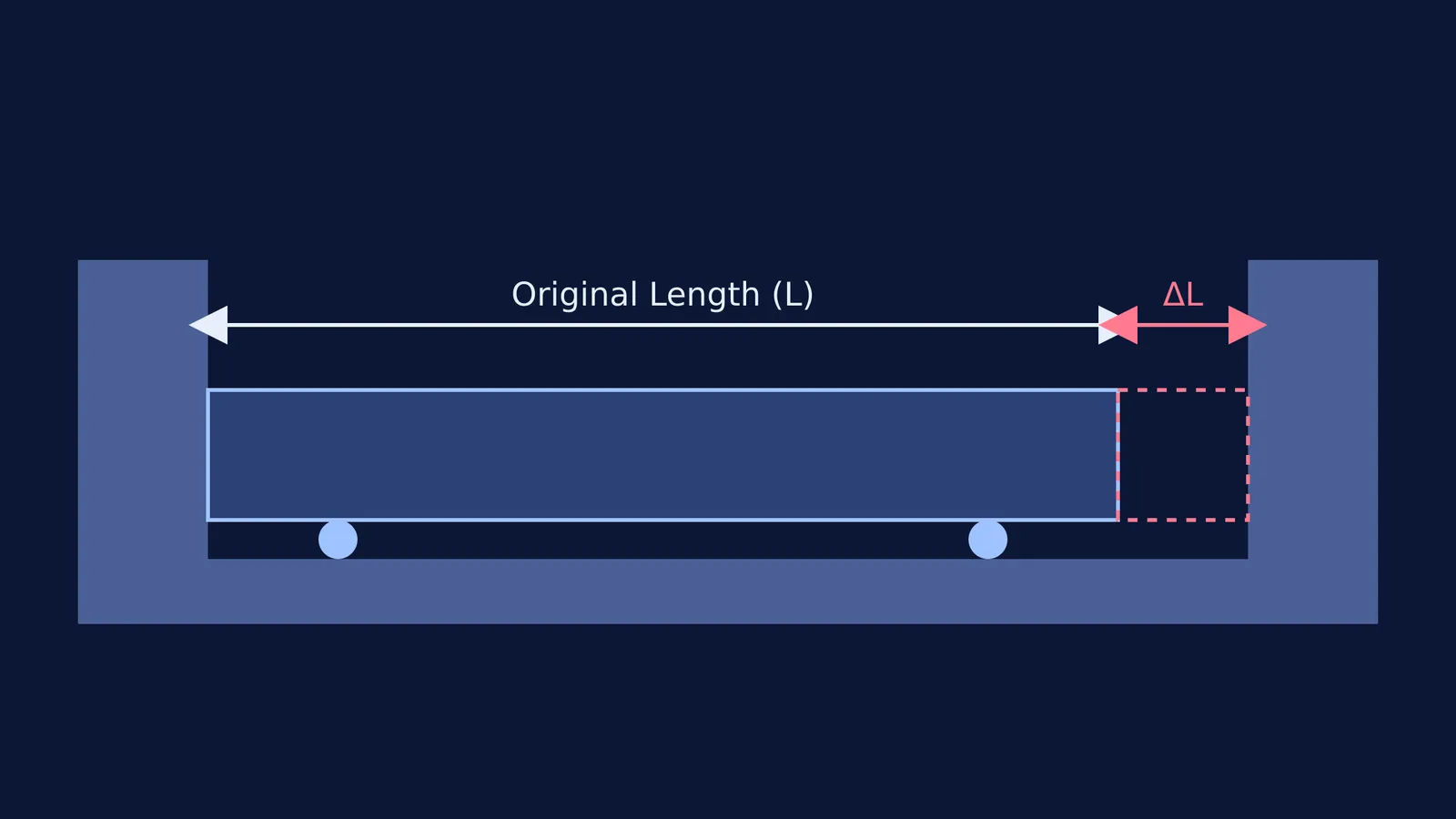
Solid materials expand when their temperature rises. As the thermal energy of the atoms increases, they vibrate more vigorously and push slightly further apart from their neighbours. While the expansion between any two individual atoms is vanishingly small, across a massive structure made of billions of atoms, it adds up into a macroscopic change called linear thermal expansion.
If a bridge is firmly pinned to the ground at both ends without any gaps, this thermal expansion creates immense compressive stress. With nowhere to expand, a long steel or concrete beam will either buckle upwards or shatter the concrete abutments supporting it. Expansion joints act as a crucial safety valve. They provide empty space for the bridge deck to grow into on a hot summer afternoon, and to pull back from on a freezing winter night.
Seeing these abstract microscopic forces in action can be tricky from a textbook. In the Fermi Simulation Lab, you can change the temperature of a solid and watch the atoms vibrate and push the material outwards, helping you build an intuition for thermal expansion.
How much does a bridge expand?
The amount a material expands depends on three factors: its original length (L), the change in temperature (ΔT), and the material's specific coefficient of linear thermal expansion (α). The relationship is captured by the straightforward formula ΔL = α × L × ΔT.
According to the Engineering ToolBox, the coefficient of linear thermal expansion for steel is around 12.0 × 10⁻⁶ / °C. This means a piece of steel will grow by 12 millionths of its length for every single degree Celsius the temperature goes up.
Imagine a 100-metre steel bridge span. If the temperature rises by 40 °C between a cold winter night and a hot summer afternoon, we can calculate the growth:
ΔL = 12.0 × 10⁻⁶ × 100 × 40 ΔL = 0.048 metres
That is 4.8 centimetres of extra length. It might not sound like much, but a solid steel girder trying to force its way into a rigid concrete abutment by nearly 5 centimetres will simply destroy the abutment.
To handle this, engineers use different types of joints. For short spans that only move a few millimetres, a rubber compression seal might be enough. For massive highway bridges, you will see interlocking finger joints — heavy metal teeth that slide deeply between each other while still providing a smooth, continuous surface for your car's tyres.
How to solve linear thermal expansion problems
Questions about thermal expansion are common in school physics exams. Here is a step-by-step framework to solve them without getting tangled in the units:
Identify the givens. Write down the original length (L), the change in temperature (ΔT), and the coefficient (α). Ensure ΔT is the difference between the final and initial temperatures.
Align the units. If your α is given per °C, your ΔT must be in °C. A change of 1 °C is exactly equal to a change of 1 K, so you can use them interchangeably for ΔT. Keep L in metres if you want the final answer in metres.
Calculate the change. Multiply them all together: ΔL = α × L × ΔT.
Find the final length. If the temperature rose (ΔT > 0), the material expanded, and the new length is L + ΔL. If the temperature dropped, the material contracted, and the new length is L - ΔL.
Once you master thermal expansion in solid materials, you can move on to how gases behave under heating, such as the Free expansion of an ideal gas. Or, you can explore other mechanical forces that deform solids, like A rod stretching under its own weight.


