

On this page
Stand on any platform in India and look down. The rails sit on concrete sleepers, and the sleepers sit in a bed of grey, sharp-edged stones called ballast. It does three physics jobs at once.
Why are stones laid between railway tracks?
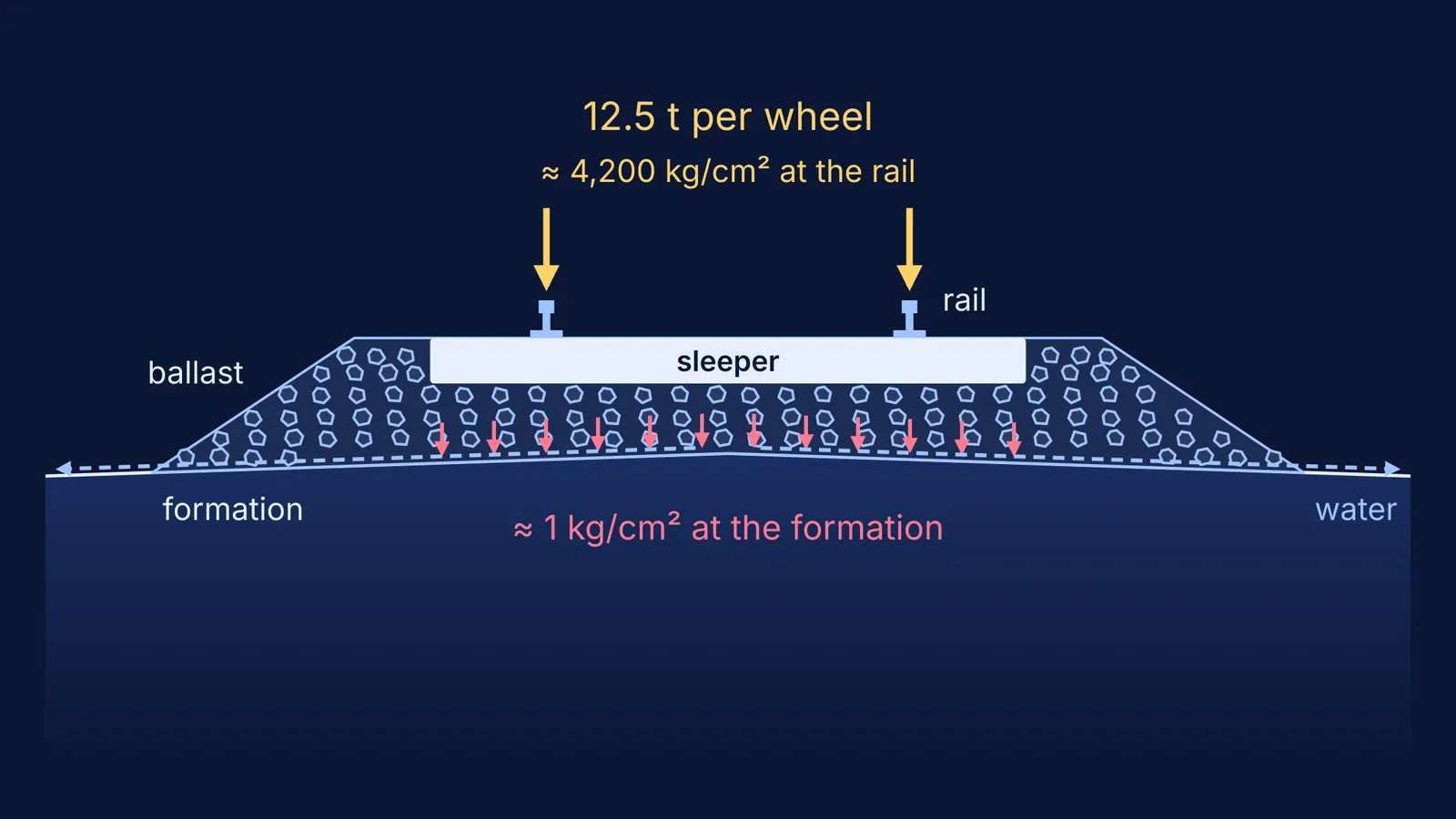
A track is a stack of layers, each wider than the one above: wheel, rail, sleeper, ballast, then the earth bank engineers call the formation. A keynote paper from the University of Wollongong's rail geotechnics centre describes ballast as gravel-sized aggregates of 10–60 mm that ensure the cyclic train loads are "safely transmitted" to the soil below and that "the track is anchored transversely and longitudinally" (Indraratna and colleagues, From Theory to Practice in Rail Geotechnology). In plain words, that is three jobs:
Spread the load so the soil underneath is never pressed harder than it can bear.
Drain the water through the gaps between stones, so the sleepers never sit in mud.
Hold the sleepers so they cannot slide sideways on a curve or lengthways when a train brakes.
How does ballast reduce pressure on the ground?
Pressure is force divided by area: P = F/A. The same force on a small area gives a large pressure, which is why a sharp knife cuts better than a blunt one. A track uses the rule in reverse.
The load. Indian Railways decided in 2009 that its formations would be built for a 25-tonne axle load, according to its design body RDSO (RDSO, Comprehensive Guidelines and Specifications for Railway Formation, 2020). An axle has two wheels, so each wheel carries about 12.5 tonnes, a force of about 125 kN.
At the rail. A track engineering chapter by J.S. Mundrey, revised by F.A. Wingler, works through a 125 kN wheel on a contact area of about 3 cm², where the stress is "in the order of 42 kN/cm²" (Mundrey and Wingler, Ballast, Formation and Drainage). That is about 4,200 kg/cm².
At the soil. The same chapter says this has to be brought down to about 10 N/cm² at the formation, roughly 1 kg/cm².
The ratio. 42,000 ÷ 10 = 4,200. From rail to soil, pressure falls roughly four-thousand-fold.
The area needed. In the chapter's worked figure, the wheel's load is spread over about 10,100 cm², roughly one square metre, by the time it reaches the formation.
The stiff rail shares each wheel's load across several sleepers, each sleeper spreads it along its length, and the ballast spreads it further with depth.
What happens when water gets into the track?
Indraratna and colleagues list what poor drainage does: weaker, less stiff ballast, more settlement, a softened subgrade, and "clay pumping" under repeated loading (From Theory to Practice in Rail Geotechnology). Wet soil shaken by every passing axle turns to slurry and is pushed up into the stones. Clean ballast has open gaps, so rain runs down through it.
Below the ballast, the top of the formation slopes 1 in 30 from the centre to both sides, so water runs off to the edges, as RDSO's typical cross-section shows (RDSO formation guidelines). Between ballast and soil sits a layer of coarse granular material that RDSO calls the blanket; the Wollongong paper notes that such a layer can act as a filter that "minimises the adverse effects of clay pumping".
Why are ballast stones sharp and not round?
Round pebbles roll over each other like marbles, so a heap of them slumps. Crushed stone has flat faces and corners that lock together, and friction between faces lets a heap keep a steep side, the idea behind the angle of repose and the angle of friction. That is why Mundrey and Wingler say ballast "should be cubic and/or angular".
There is a trade-off: ballast that is "angular, well graded and compact" gives more load-bearing strength but drains less, so engineers balance the two (Indraratna and colleagues).
Force fanning out through layers is easier to see than to read about; the Fermi Simulation Lab has interactive simulations for ideas like this.
Try it: how does your footprint compare with a train wheel?
Stand on centimetre graph paper and trace around one shoe.
Count the full squares, and count each part-square as half. That is the area of one foot in cm²; double it for two feet.
Divide your mass in kg by the total area. That is your pressure in kg/cm².
Compare it with about 4,200 kg/cm² at the rail and about 1 kg/cm² at the formation (Mundrey and Wingler). Which is your number closer to?
Divide 10,100 cm² by one shoe print's area: that is how many of your footprints one wheel's load covers at the formation.
If the P = F/A step itself feels shaky, the Fermi Concept Library has a lesson on every physics concept with its place in the map, so you can go back a step.
The rails above the stones do more than carry weight: here is how railway signals know a train has passed.


