On this page
A honeycomb is a sheet of six-sided cells packed wall to wall. The reason comes down to two ideas from school maths: tessellation, covering a surface with no gaps, and the trade-off between perimeter and area. Every wall costs wax, so the shape that holds the most for the least wall wins.
Which shapes can tile a comb without gaps?
A comb needs cells that fit together with no wasted space. If every cell is the same regular polygon, the corners that meet at each point must add up to exactly 360°.
Only three regular polygons tile the plane: the equilateral triangle, the square and the regular hexagon (Wolfram MathWorld, Regular Tessellation). Six triangles meet at a point (6 × 60°), four squares meet (4 × 90°), or three hexagons meet (3 × 120°). A regular pentagon's 108° does not divide 360°, so pentagons leave gaps. We go through the full argument in which regular polygons tessellate the plane.
A circle encloses the most area for a given boundary, but circles packed side by side leave gaps between them. So the real contest is between triangles, squares and hexagons.
Why hexagons and not squares or triangles?
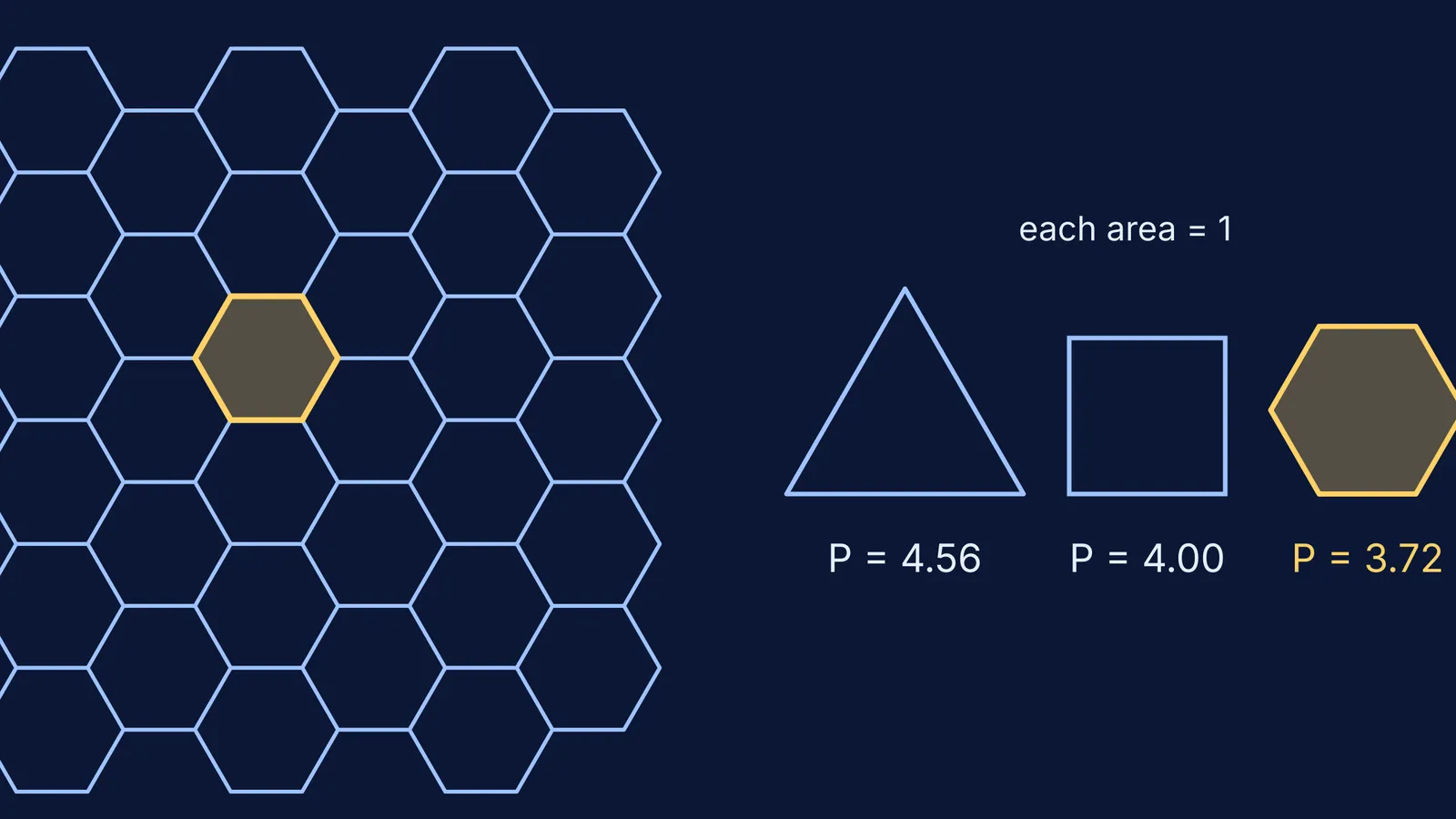
Here is a worked example you can check with a calculator. Give each shape an area of exactly 1 square unit and compare the perimeters, using the area formula for a regular polygon, A = ¼na²cot(π/n) (Wolfram MathWorld, Regular Polygon).
Square: area = a², so the side is 1 and the perimeter is 4.00.
Equilateral triangle: area = (√3/4)a², so the side is about 1.520 and the perimeter about 4.56.
Regular hexagon: area = (3√3/2)a², so the side is about 0.620 and the perimeter about 3.72.
If the hexagon formula looks like magic, it comes from splitting the hexagon into six equilateral triangles, shown step by step in area of a regular hexagon.
In a comb, every inner wall is shared by two cells, so the wall per cell is half the perimeter: about 2.28 for triangles, 2.00 for squares and 1.86 for hexagons. On these figures, worked out from the formulas above, hexagons need about 7% less wall than squares and about 18% less than triangles to hold the same amount. A circle of area 1 would need a perimeter of only 3.54, but circles cannot tile.
The pattern is general: for regular polygons of the same area, the perimeter falls as the number of sides rises, which you can see from the area of a regular polygon with n sides. The hexagon has the most sides of any regular polygon that still tiles, so it sits closest to the circle without leaving gaps.
Is the hexagon really the best possible shape?
Comparing three regular polygons is not a proof: cells could be irregular, curved or mixed. The Greek mathematician Pappus discussed the question, and it became known as the honeycomb conjecture.
The honeycomb conjecture states that any partition of the plane into regions of equal area has a perimeter at least that of the regular hexagonal tiling (Hales, Discrete & Computational Geometry, 2001). Thomas Hales published the first general proof in 2001, and the published version even allows cells made of separate pieces and gaps between cells.
The proof is about flat cells, so it explains the hexagonal cross-section of a comb rather than its three-dimensional back walls.
Do bees build hexagons on purpose?
This is where biologists still disagree. In 2013, B. L. Karihaloo and colleagues reported that cells in a natural comb are circular at first and quickly become rounded hexagons, which they put down to molten wax flowing near the junctions where three cells meet, with the heat supplied by worker bees (Karihaloo, Zhang and Wang, Journal of the Royal Society Interface, 2013).
Daniel Bauer and Kaspar Bienefeld filmed comb building with infrared and thermographic video and saw bees shaping wax directly with their antennae, mandibles and legs. They measured the wax at 33.6 to 37.6 °C during construction, well below 40 °C, the temperature at which wax is assumed to be in the liquid state that self-organised building would need (Bauer and Bienefeld, Naturwissenschaften, 2013).
Francesco Nazzi pointed out that a hexagon can only form if each similar, roughly round cell is already surrounded by six others, and suggested this follows from the way bees go about building (Nazzi, Scientific Reports, 2016).
So the maths explains why hexagons are efficient, while how bees arrive at them is still being worked out.
How can you check this on paper?
Draw a patch of square cells and a patch of hexagonal cells, and count the walls each cell shares.
Explain in two sentences why a circle loses even though it has the shortest boundary.
If the shapes are easier to see than to read, the Fermi Simulation Lab has interactive simulations for ideas like these. If the area formulas are the gap, the Fermi Concept Library has its own lesson for each concept in mathematics.