

On this page
Have you ever noticed that bathroom tiles and honeycombs use the same few shapes? While you can draw a regular polygon with literally any number of sides—from a simple triangle to a million-sided shape that looks almost identical to a circle—only three of them can tile a flat surface perfectly: equilateral triangles, squares and regular hexagons MathWorld.
This perfect tiling is called a regular tessellation. To cover a plane without leaving any gaps or overlaps, the polygons meeting at each corner, or vertex, must fit together exactly. If there is even a tiny fraction of a degree left over, the pattern will eventually warp, curve or overlap as it spreads outwards across the surface.
Why do only three regular polygons tessellate?
If you place identical shapes around a single point, their interior angles must add up to exactly 360° to form a complete circle. Mathematically, this means the interior angle of the shape must be a factor of 360° MathWorld.
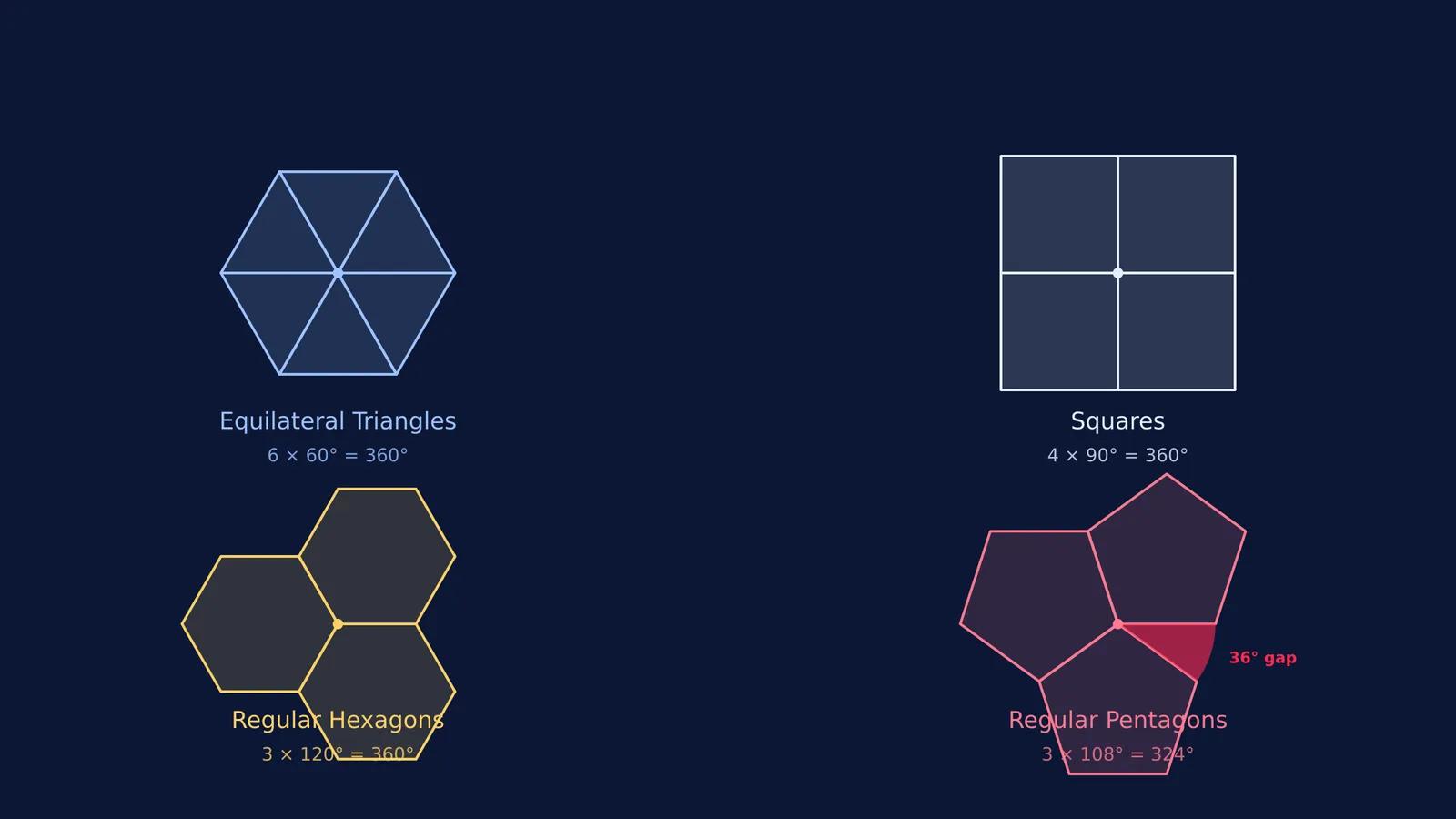
The formula for the interior angle of a regular polygon with *p* sides is *(1 − 2/p) × 180°* MathWorld. When we test the simplest polygons against the 360° rule, only three work:
Equilateral triangle (3 sides): The interior angle is 60° MathWorld. Since 360° ÷ 60° = 6, exactly six triangles meet at every vertex.
Square (4 sides): The interior angle is 90° MathWorld. Since 360° ÷ 90° = 4, exactly four squares meet at each vertex.
Regular hexagon (6 sides): The interior angle is 120° MathWorld. Since 360° ÷ 120° = 3, exactly three hexagons meet perfectly.
Why do regular pentagons fail?
A regular pentagon has five sides. Using the interior angle formula, a pentagon's angle is exactly 108° MathWorld.
If you try to tile a floor with regular pentagons, you run into a problem at the very first corner. Placing three pentagons together covers 324° (3 × 10⁸°). This leaves a narrow gap of 36°, which is too small to fit another pentagon MathWorld. Trying to squeeze a fourth one in would require 432°, causing the tiles to overlap. Because 360 is not divisible by 108, pentagons cannot tessellate.
Even though regular pentagons cannot tile the plane, irregular pentagons can. Over the past century, mathematicians have discovered exactly 15 families of convex irregular pentagons that can tessellate Wikipedia. The search began in 1918 when Karl Reinhardt found the first five families. For decades, mathematicians and amateurs alike—including Marjorie Rice, who found four new families in the 1970s without formal mathematical training—hunted for more. The 15th and final family was only found in 2015 using an exhaustive computer search, and a computer proof in 2017 confirmed that no other convex pentagon families exist. This highlights a crucial distinction in problem-solving: loosening a single constraint, such as requiring all sides and angles to be strictly equal, can suddenly open up entirely new solutions.
What about polygons with more than six sides?
As you add more sides to a regular polygon, its interior angle grows. A regular heptagon (7 sides) has an interior angle of about 128.6°, and a regular octagon (8 sides) has an interior angle of 135°.
Because the interior angle is always growing but never reaches 180°, no shape past the hexagon will ever divide 360° evenly. For instance, putting two octagons together takes up 270°, leaving a 90° gap (which is why octagons are often paired with squares in tile designs). If you try to tile a surface with regular nonagons (9 sides) or decagons (10 sides), the gaps become increasingly awkward. To tessellate by itself, a polygon needs at least three shapes to meet at every vertex. Since three shapes with angles larger than 120° will always exceed 360°, the hexagon is the absolute mathematical limit for regular tessellations.
In nature, bees use the regular hexagon to build honeycombs. The hexagon is mathematically the most efficient way to divide a surface into regions of equal area with the least total perimeter, a principle known as the honeycomb conjecture. For over two millennia, mathematicians suspected this was true, but it was only rigorously proven in 1999 by Thomas Hales Wikipedia. For students, understanding why bees use hexagons rather than squares or triangles is a classic application of both geometry and optimisation.
Tracing the geometry
Sometimes, memorising geometric rules is harder than seeing why they are true. The Fermi Concept Library explains every concept in physics, chemistry, biology, mathematics and computing, each with its own lesson and its place in the map. Tracing the reasoning behind polygon interior angles makes the formulas much easier to recall during an exam.
Once you know the rules of angles and edges, you can spot them in almost every curriculum, from the Introduction to Euclid's geometry in Class 9: axioms and postulates to evaluating the CBSE Class 10 maths theorems you must be able to prove. Even early mathematicians relied on these properties to measure the world, much like Liu Hui and how doubling a polygon's sides closes in on pi.


