On this page
Most students memorise a separate area formula for each regular polygon, and then forget them. You only need one idea: a regular polygon with n sides is n identical triangles that meet at the centre. Once you see that, you can work out the formula for any n in about four lines, and check it in your head.
What is the formula for the area of a regular polygon with n sides?
If r is the circumradius (the distance from the centre to any corner), the area is A = ½nr² sin(360°/n), the same formula Wolfram MathWorld gives in radians as ½nR² sin(2π/n).
The same MathWorld page gives two other versions, depending on what the question tells you:
Circumradius r (centre to a corner): A = ½nr² sin(360°/n)
Inradius or apothem a (centre to the middle of a side): A = na² tan(180°/n)
Side length s: A = ¼ns² cot(180°/n)
All three describe the same area. They just start from different lengths. The Wikipedia article on regular polygons lists the same set, and adds A = ½ × perimeter × apothem.
Why does splitting into n isosceles triangles work?
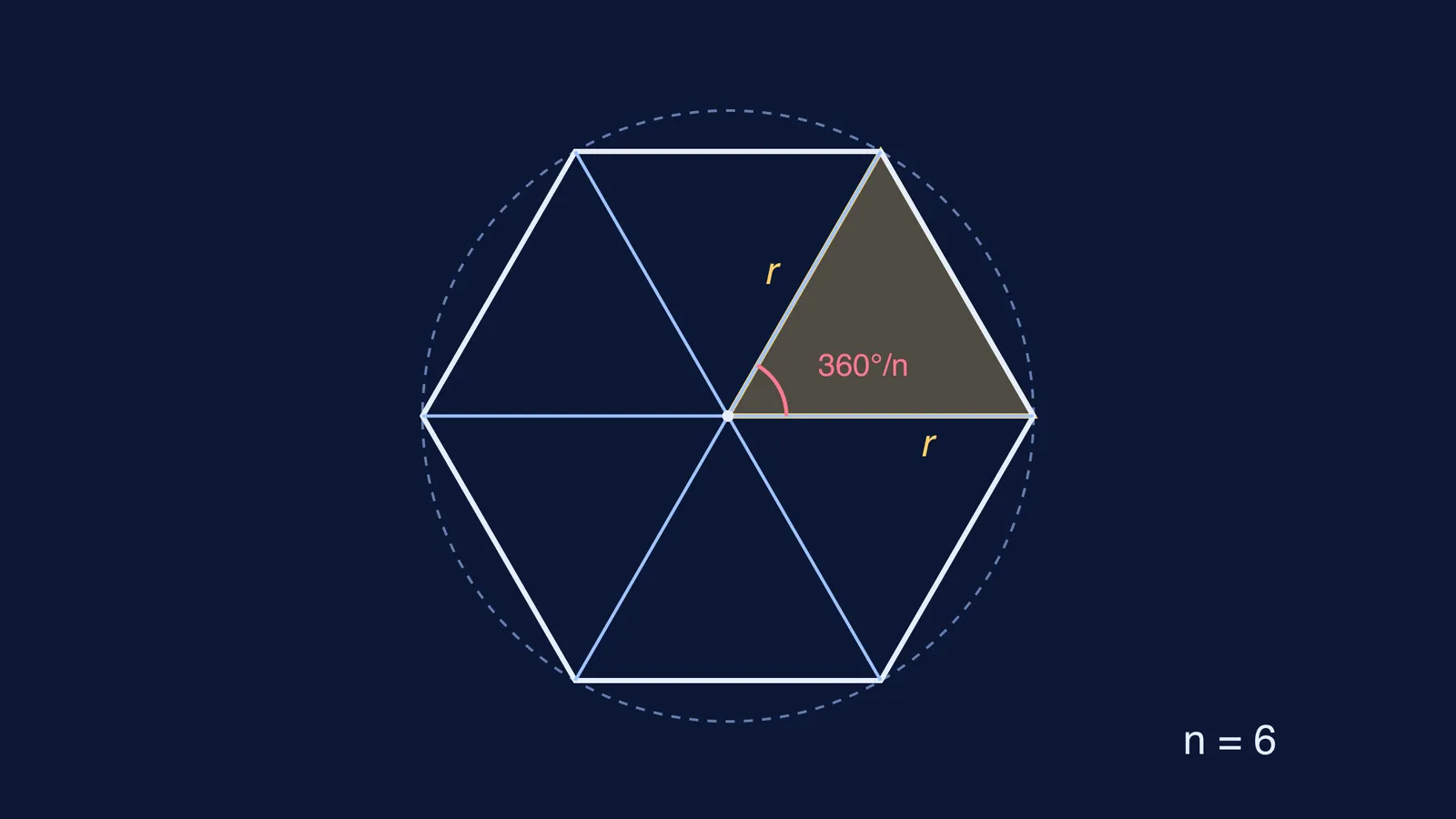
Join the centre to every corner. You now have n triangles, and they are all identical, because a regular polygon has equal sides and equal angles.
Look at one of them:
Two of its sides run from the centre to a corner, so both have length r. That makes it isosceles.
The n angles at the centre fill a full turn, so each is 360°/n.
The area of any triangle is ½ab sin C, where C is the angle between sides a and b (MathWorld, triangle area). Here a = b = r and C = 360°/n, so one triangle has area ½r² sin(360°/n).
There are n of them, so A = ½nr² sin(360°/n).
That is the whole proof. If you forget the formula in an exam, rebuild it from steps 1 to 4.
Does the formula work for a square?
Put n = 4. Each central angle is 360°/4 = 90°, and sin 90° = 1, so:
A = ½ × 4 × r² × 1 = 2r²
Now check it another way. The square's diagonal runs through the centre, so it is 2r long. A square with diagonal 2r has side r√2, and (r√2)² = 2r². The two answers match.
With numbers: if the centre-to-corner distance is 5 cm, the formula gives 2 × 25 = 50 cm². The side is 5√2 ≈ 7.07 cm, and 7.07² ≈ 50 cm². Same answer.
What is the area of a regular hexagon?
Put n = 6. Each central angle is 60°, and sin 60° = √3/2, so:
A = ½ × 6 × r² × (√3/2) = (3√3/2)r² ≈ 2.598r²
This matches the hexagon value in the Wikipedia table of regular polygon areas, which gives 3√3/2 ≈ 2.598 when r = 1.
The hexagon also gives you a free check. Its six central triangles have two sides of length r and a 60° angle between them, so they are equilateral, with every side equal to r. An equilateral triangle of side r has area (√3/4)r², and six of them give (6√3/4)r² = (3√3/2)r². Same result again.
With numbers: if r = 4 cm, the area is (3√3/2) × 16 = 24√3 ≈ 41.6 cm².
What happens as n gets very large?
As you add sides, the polygon hugs its circle more tightly. MathWorld notes that, with a circumradius of 1, the areas stay below π and approach it as n grows. You can see this with the formula:
n = 12: ½ × 12 × sin 30° = 3, so a regular dodecagon has area exactly 3r²
n = 100: 50 × sin 3.6° ≈ 3.1395, close to π ≈ 3.1416
This gives you a quick sense check. Your answer for any regular polygon should be less than πr², the area of the circle through its corners.
A 30-second checklist before you write the answer
Is the length you were given the circumradius, the apothem or the side? Pick the matching formula.
Is the calculator in degrees (or did you use 2π/n in radians)?
Is your answer less than πr²?
For n = 4 or n = 6, does it match 2r² or (3√3/2)r²?
If a step still feels shaky, the Fermi Problem Library has worked problems with a step-by-step solver that explains the reasoning rather than printing an answer. To revise the ideas underneath, such as the sine area rule and central angles, each concept has its own lesson in the Fermi Concept Library.
Next time you meet a pentagon or an octagon, don't look it up. Split it into triangles at the centre and work it out.