On this page
Reshaping India’s Political Map is Chapter 2 of the new NCERT Class 8 book *Exploring Society: India and Beyond*, Part 1 (book code hees1; first edition July 2025, reprinted March 2026, per the book's prelims). It follows how kingdoms rose, fell and redrew borders from the 13th century onward. CBSE publishes no separate 2026-27 curriculum for Classes 6 to 8; these classes follow the NCERT book, and the chapter is assessed by the school.
What is Reshaping India’s Political Map about?
For this book, "medieval" simply means the 11th to the 17th centuries. The chapter opens with invasions from beyond the Hindu Kush, many by Turkic or Afghan groups from Central Asia, and asks how borders changed, how society and the economy coped, and what it meant for people.
The book records plunder, the destruction of temples and centres of learning, enslavement, and the jizya tax that some rulers levied on non-Muslim subjects. It also records that Akbar abolished the jizya and followed sulh-i-kul, tolerance of all faiths, and that ordinary people of different faiths mostly lived together peacefully and depended on each other economically. The book's note on page 20 reminds readers that no one today bears responsibility for acts committed centuries ago.
Which powers rose and fell?
All dates below are from the NCERT chapter:
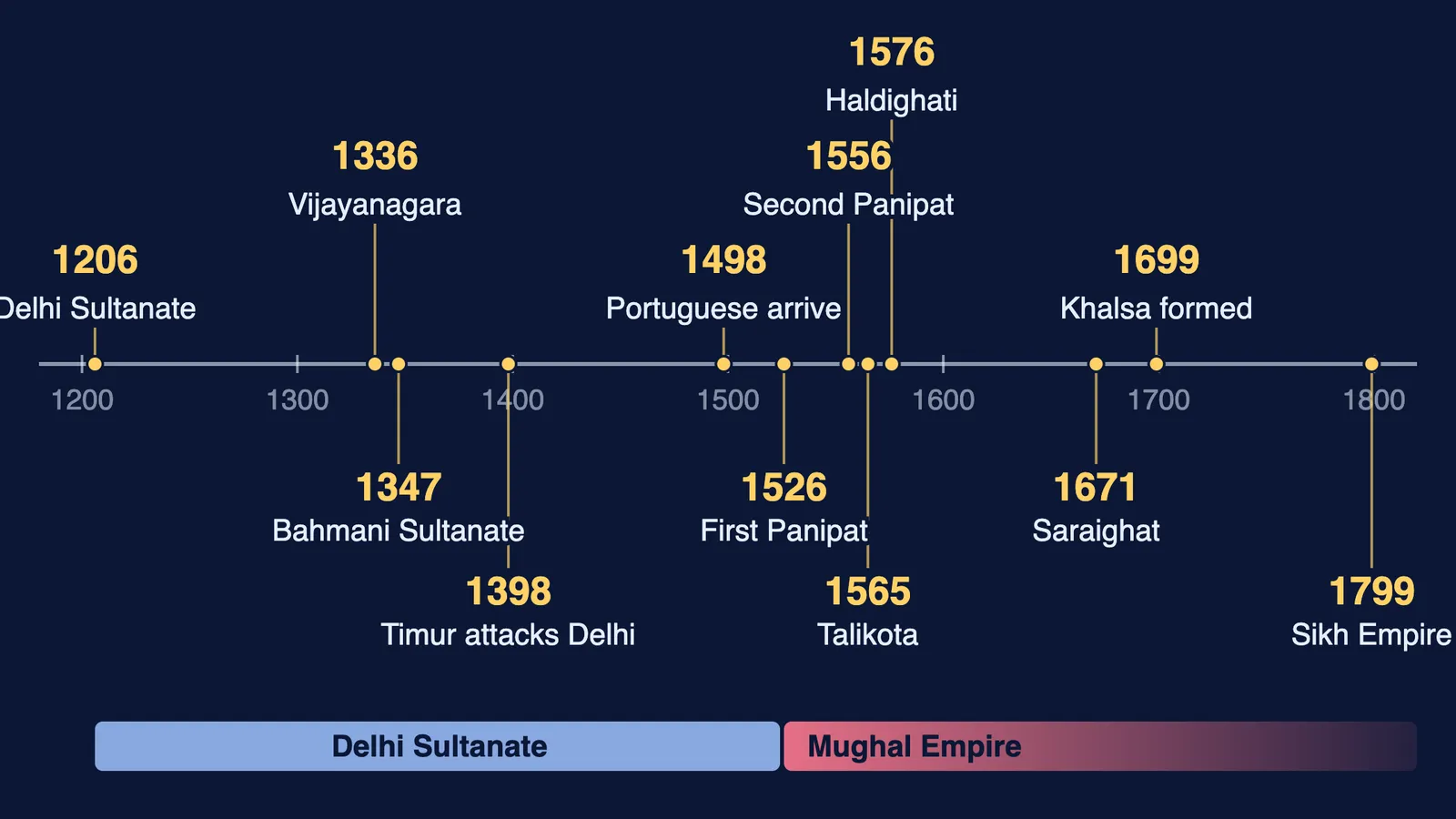
Delhi Sultanate (1206). Five dynasties ruled in turn: Mamluks, Khiljis, Tughlaqs, Sayyids and Lodis. Muhammad bin Tughlaq moved his capital to Daulatabad and back, and his copper token coins led to forgery and confusion. Timur attacked Delhi in 1398.
Vijayanagara (1336). Founded by the brothers Harihara and Bukka Raya, it peaked under Krishnadevaraya, a patron of Sanskrit, Telugu and Kannada writers. A coalition of Deccan Sultanates defeated it at Talikota in 1565.
Bahmani Sultanate (1347). It later split into five Deccan Sultanates: Ahmednagar, Berar, Bidar, Bijapur and Golconda.
Mughals (1526). Babur beat Ibrahim Lodi at the First Battle of Panipat with gunpowder weapons. Akbar won the Second Battle of Panipat in 1556, and the empire reached its largest extent under Aurangzeb, who died in 1707.
Who resisted, and how?
By region, as the chapter tells it:
East: Narasimhadeva I of the Eastern Gangas held off the Sultanate and built the Sūrya temple at Konark.
South: the Hoysalas long stayed independent; the Musunuri Nayakas united over 75 chieftains to drive Tughlaq forces out of Warangal.
Rajasthan: Rana Kumbha built Kumbhalgarh Fort; Maharana Pratap fought on after Haldighati (1576), helped by Bhil archers.
Central India: Rani Durgavati of the Gond kingdom of Garha fought Akbar's general in 1564.
Northeast: at Saraighat (1671), Lachit Borphukan's 10,000 Ahom soldiers defeated a Mughal force of 30,000.
Punjab: Guru Gobind Singh formed the Khalsa in 1699; Maharaja Ranjit Singh later built the Sikh Empire (1799).
How were the empires run, and how did people live?
In the chapter, the Sultanate's iqta system assigned lands to nobles who collected taxes and, after expenses, sent them to the Sultan's treasury, largely to pay for the army; these posts were not hereditary. Akbar reorganised the government around four key ministers, with such ministers in each of the twelve provinces (subahs): the Diwan for finance, the Mir Bakhshi for the military, the Khan-i-Saman for public works, trade, industry, agriculture and the royal household, and the Sadr for justice, religion and education. Under his mansabdari system, each officer's rank fixed how many troops and animals he kept ready.
Land revenue was usually one-fifth of the produce, though some sultans raised it to one-half. Traders used the hundi, a written payment order, to move money across borders without carrying coins. Temples ran markets, lent to merchants and built tanks and rest houses.
Worked example: how do you compare two systems?
Question (our suggestion: 4 marks): Compare the Ahom paik system with Akbar's mansabdari system.
Model answer:
Shared aim: both let a ruler field a large force without keeping a permanent army.
Who served: under paik, every able-bodied man owed the state labour or military service; under mansabdari, ranked officers kept a set number of soldiers and animals.
What they got: paik service was rewarded with land rights; mansabdars were usually paid through land assignments called jagirs.
Extra use: paik labour also built public works, while mansabdari came with regular inspections.
How should you revise, and what comes next?
Practice questions (mark labels are our suggestion):
Why did Muhammad bin Tughlaq's token currency fail? (2 marks)
Name two resisters in this chapter who used terrain against a larger army, and say how each did. (3 marks)
Put in order: Talikota, Timur's attack on Delhi, Saraighat, First Panipat. (1 mark)
How did the hundi protect traders during political instability? (3 marks)
Chapter 3, The Rise of the Marathas, continues the story. For the same centuries, see our Class 9 guide to Resistance and Resilience (1000–1700 CE) and the older syllabus's Class 7 Mughal empire summary. If an AI chat's date disagrees with the book, check it against NCERT.
Revising several chapters? Fermi's AI tutor works out what you already know and builds a plan for the session.