On this page
Resistance and Resilience (1000–1700 CE) is Chapter 3 of the new NCERT Class 9 Social Science book *Understanding Society: India and Beyond* Part 2, introduced for 2026-27. It is the only History chapter in Part 2 and starts on page 45, after two geography chapters, including Oceans and Life, Class 9 (NCERT contents page).
What is Resistance and Resilience (1000–1700 CE) about?
The chapter uses two linked ideas to read seven centuries of Indian history:
Resistance: actively opposing a force or threat to protect power, territory or cultural identity. It can mean war, but also alliances, diplomacy and negotiation.
Resilience: the capacity of communities to endure hardship, adapt and still keep their traditions.
The chapter treats resilience as what lets resistance last, and it describes the period as one of "both conflict and cooperation", not only invasions and battles.
Which kingdoms and people does the chapter cover?
Names and dates below follow the chapter.
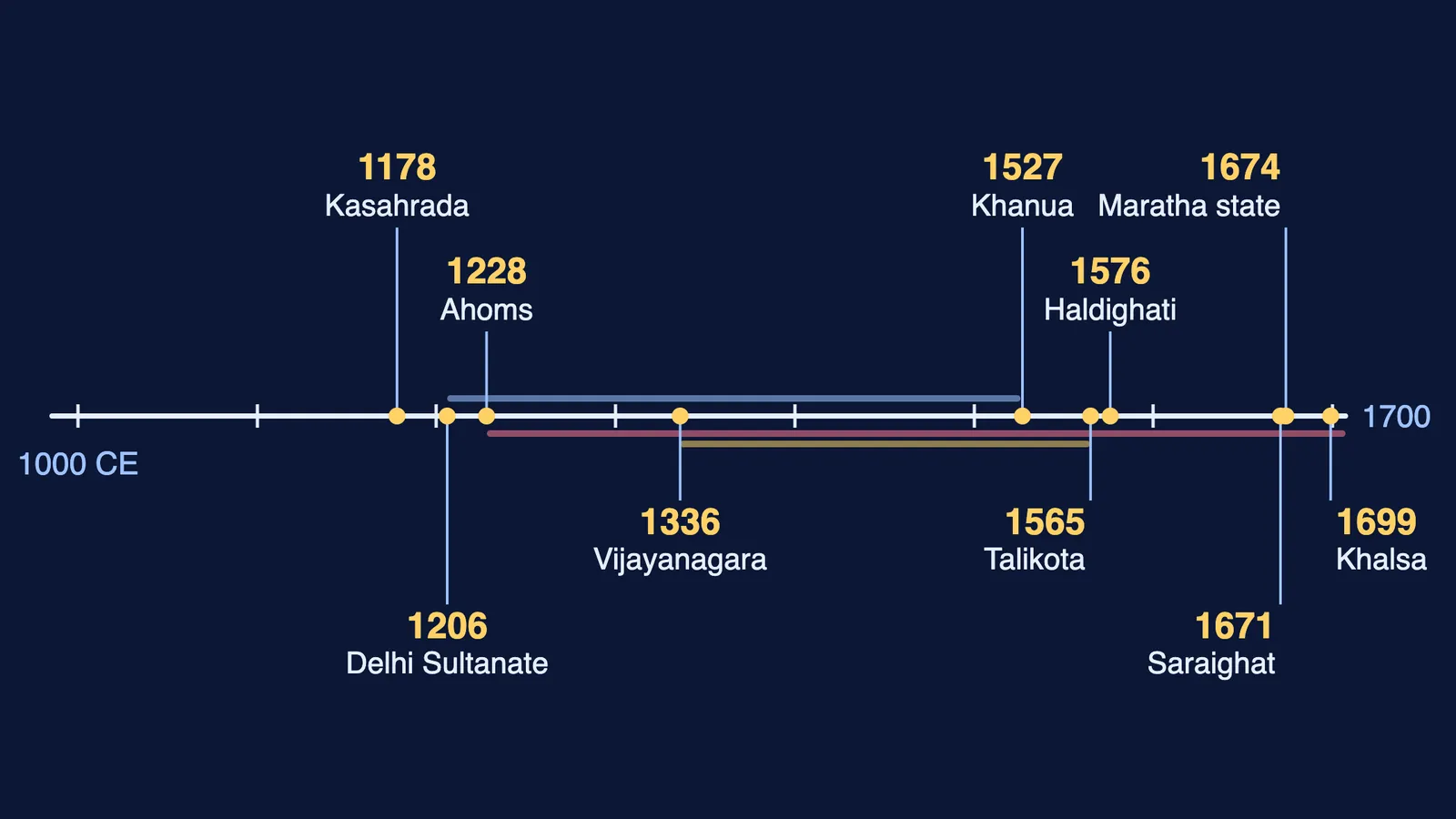
11th–12th centuries: Mahmūd of Ghaznī's first invasion in 1001 was against Jayapāla of the Hindu Shāhi dynasty. In 1178, Queen Nāikī Devī of the Chaulukya kingdom defeated Muhammad Ghūrī at Kasahrada, near Mount Abu.
Delhi Sultanate (from 1206): the Sultanate was resisted by the Yādavas of Devagiri, Rajput dynasties, the Kākatīyas of Warangal and the Hoysālas.
Rajputs and Mughals: Rāṇā Sāngā led a Rajput confederacy against Bābur at Khanua in 1527. Some kingdoms, such as Mewar, resisted the Mughals, while others, such as the Kachhwāhas of Amber, negotiated cooperation and received mansabs. Mahārāṇā Pratāp fought at Haldighati in 1576, used guerrilla tactics in the Aravallis with Bhil support; the Battle of Dewair in 1582 helped him regain control of Mewar.
Ahoms: independent for almost six centuries (1228–1826). Lachit Borphukan defeated a Mughal fleet at Saraighat in 1671.
Vijayanagara: founded by Harihara and Bukkā in 1336; defeated at Talikota in 1565 by an alliance of the Deccan sultanates, after which Nāyaka kingdoms took over many territories.
Marathas: an independent state in 1674, linked to Chhatrapati Śhivājī and the idea of swarājya, with forts such as Raigad and Sinhagad.
Sikhs and Jats: Guru Hargobind set up the Akāl Takht, and Guru Gobind Singh founded the Khalsa in 1699. The Jats rebelled against the Mughal Empire under Gokul Jat in 1669.
How did Bhakti, temples and trade help communities endure?
The chapter argues that resilience went beyond the battlefield.
Bhakti: devotion sung in local languages, community singing and nām kīrtan made worship less dependent on buildings. Tulsidas wrote the Rāmcharitmānas in Awadhi. Devotees came from many backgrounds, including Raskhān and Rahīm.
Other traditions: the chapter also describes Akbar's later policy of Sulh-i-kul, a policy of tolerance, and how Sufi orders used Indian languages such as Hindavi and Bengali.
Temples: they were economic and cultural centres. Many were restored, and from the 16th century some were built in a plain house-like style that historians call the havelī temple.
Economy: irrigation, merchant networks, the hunḍī (a bill of exchange, compared to a cheque) and Indian Ocean trade kept the economy active.
How do you revise a chapter with this many names?
Build a resistance-and-resilience grid. Write each group as a row (Rajputs, Ahoms, Vijayanagara, Marathas, Sikhs, Jats) and fill three things:
One date and one event from the chapter.
How they resisted: battle, alliance, guerrilla tactics, diplomacy or defiance.
What helped them endure: terrain, forts, a navy, alliances, institutions or faith.
Worked example, the Ahoms: 1671, Saraighat. They resisted with a navy of fast bāchārī boats and guerrilla tactics. They endured through knowledge of Assam's rivers and forests, the Paik system and alliances.
Then redraw the timeline at the top of this post from memory. Our guide to checking history dates against NCERT shows how to catch a wrong year, and a cause-and-effect chart for a history chapter suits the Sultanate and Mughal sections.
What mistakes do students make in this chapter?
Treating resistance as only war. The chapter includes alliances, diplomacy, negotiation and cultural forms.
Mixing up Haldighati (1576) and Dewair (1582).
Getting the dynasty wrong: Nāikī Devī was a Chaulukya queen; Rūdramā Devī was a Kākatīya queen.
Calling the period a story of invasion alone. The chapter stresses cooperation, adaptation and exchange too.
Confusing Nirguṇa and Saguṇa bhakti. Nirguṇa is devotion to a formless divine; Saguṇa is devotion to a divine with attributes.
How should you prepare for CBSE 2026-27?
The CBSE 2026-27 Class IX curriculum gives this theme 9 teaching hours and lists resistance and alliances, art, architecture, languages and literature, Bhakti, forts, and the economy (CBSE Class IX Social Science curriculum 2026-27). It says the course structure will be provided shortly, so there are no chapter-wise marks yet; check the CBSE site before exams.
Fermi is an AI-powered STEM learning platform, so it does not teach this chapter. If Class 9 maths or science is where you are stuck, Fermi's AI tutor can work out what you already know and build a plan for the session, so you sit down to a clear next step.