On this page
Chapter 4 of Ganita Prakash Part II, NCERT's Grade 8 maths book (book code 0889, NCERT file code hegp2, First Edition December 2025, per the prelims), covers two themes: fractals, shapes that repeat themselves at ever smaller sizes, and ways of showing a solid on flat paper.
The CBSE 2026-27 curriculum page lists only Classes IX to XII; Classes 6 to 8 follow the NCERT book, and this chapter is assessed by the school.
What is in Exploring Some Geometric Themes?
The chapter runs in this order:
Fractals: the fern; the Sierpinski Carpet and Triangle (after the Polish mathematician Sierpinski); the Koch Snowflake, described by Von Koch in 1904; fractal-like art in the Kandariya Mahadev Temple, Khajuraho (completed around 1025 C.E.).
Solids: profiles; faces, edges and vertices (a cube has 6, 12 and 8); prisms and pyramids.
Nets: a cube has 11, a regular tetrahedron 2, an octahedron 11 and a dodecahedron 43,380.
Shortest paths on a cuboid, then projections, shadows and isometric drawing.
How do you count squares and holes in a fractal?
The book tracks Rₙ, the squares remaining at step n, and Hₙ, the holes. Every remaining square makes one new hole at the next step, so Hₙ₊₁ = Hₙ + Rₙ.
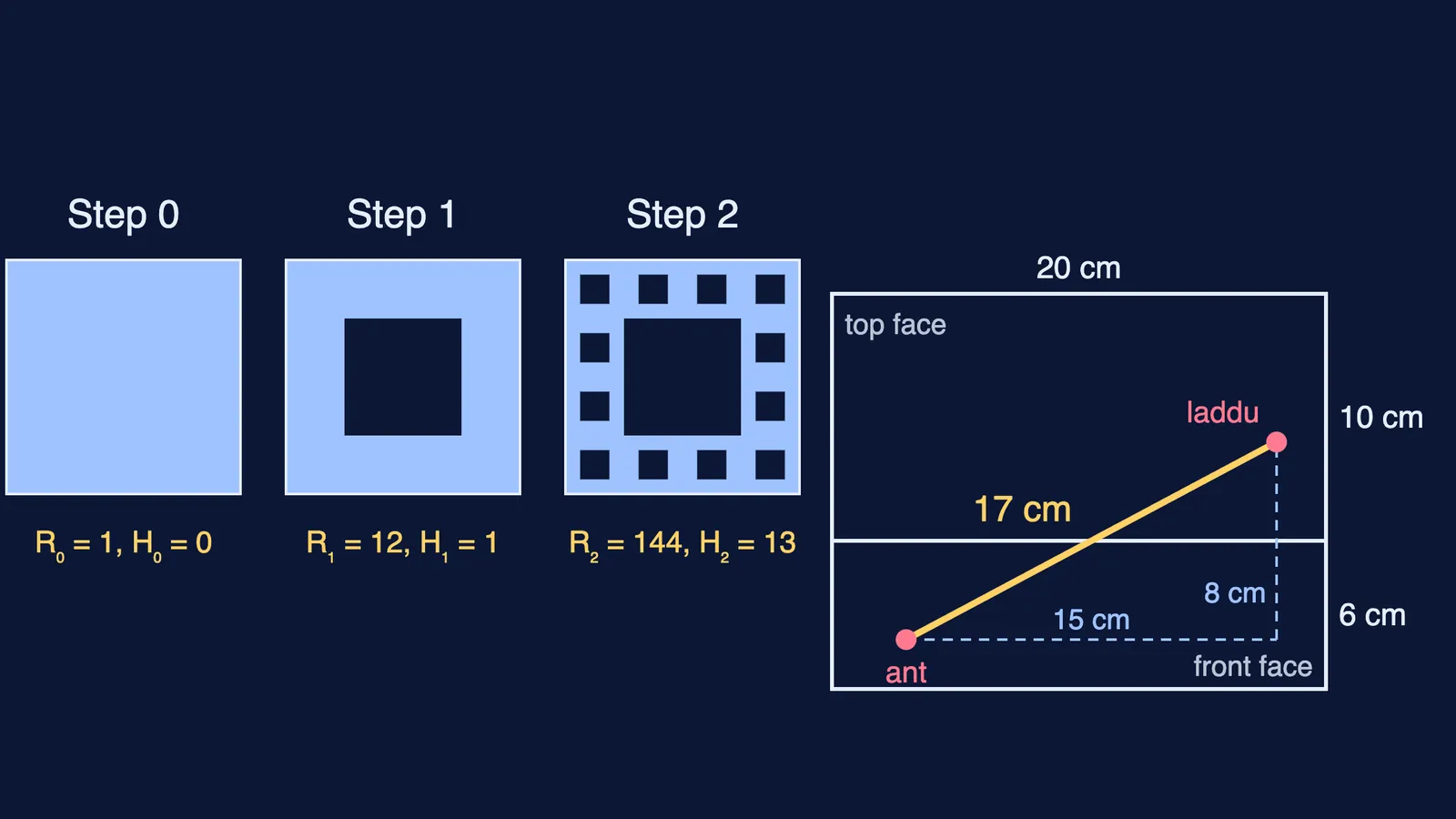
Worked example (our own fractal). Split a square into 16 (4 by 4), remove the central 4, and repeat on the 12 left.
Each square leaves 12, so Rₙ₊₁ = 12Rₙ and Rₙ = 12ⁿ: R₁ = 12, R₂ = 144, R₃ = 1,728.
Holes: H₁ = 0 + 1 = 1, H₂ = 1 + 12 = 13, H₃ = 13 + 144 = 157.
Area: each step keeps 12/16 = 3/4, so from 1 square unit, step 3 leaves (3/4)³ = 27/64 ≈ 0.42 square units.
Check: step-3 squares have side 1/64, and 1,728 × (1/64)² = 27/64.
How do nets find the shortest path on a cuboid?
A net is a solid unfolded flat. A path on the surface keeps its length on the net, so the shortest route is a straight line on a suitable net, measured with the Baudhayana Theorem.
Worked example. A box is 20 cm long, 10 cm deep and 6 cm high. An ant on the front face is 3 cm from the left edge, 2 cm above the bottom. A laddu on the top face is 18 cm from the left edge, 4 cm behind the front edge.
Unfold the top face up from the front face's top edge.
Across: 18 − 3 = 15 cm. Up: (6 − 2) + 4 = 8 cm.
d² = 15² + 8² = 225 + 64 = 289, so d = 17 cm, crossing the front-top edge 10.5 cm from the left.
Other unfoldings (via the right or left side face) give about 21.8 cm and 23.1 cm, so 17 cm is shortest.
What are front, top and side views?
A projection drops each point of a solid perpendicularly onto a plane. The front view falls on the vertical plane, the top view on the horizontal plane and the side view on the side plane. One view fits many objects, so all three are used.
Parallel lines project to parallel lines, which sunlit shadows let you test. A cube balanced on one corner projects to a regular hexagon with equal edges: the isometric projection (Greek for "equal measure"), the basis of isometric grid paper.
How does Chapter 4 connect to the rest of Ganita Prakash?
Shortest paths use the Baudhayana-Pythagoras theorem (Chapter 2).
The Koch Snowflake was first met in Grade 6 Ganita Prakash.
In Class 9, fractal counts return as geometric progressions (sequences, AP and GP guide), and unrolled nets explain area formulas (surface area and volume guide).
Practice questions
Marks are our suggestion.
(1 mark) A prism's two congruent faces are octagons. How many faces, edges and vertices does it have?
(2 marks) Split a square into 25 equal squares (5 by 5) and remove the central 3 by 3 block. Repeat on each remaining square. Find R₂, H₂ and the area left at step 2.
(3 marks) A box is 16 cm × 8 cm × 5 cm (length, depth, height). An ant on the front face is 2 cm from the left edge, 3 cm above the bottom; a laddu on the top face is 14 cm from the left edge, 3 cm behind the front edge. Find the shortest path.
(2 marks) A cylinder (radius 3.5 cm, height 9 cm) stands on its base. Give its front and top views and the rectangle in its net (π = 22/7).
Answers: (1) 10 faces, 24 edges, 16 vertices. (2) R₂ = 256, H₂ = 17, area 256/625. (3) 12 cm across, 5 cm up: 13 cm (the side-face unfoldings give about 16.8 cm and 17.5 cm). (4) Front: a rectangle 7 cm wide and 9 cm tall; top: a circle of radius 3.5 cm; net rectangle 9 cm by 22 cm.
Stuck on nets? Fermi's AI tutor works out what you already know and builds a plan for the session.