On this page
This guide is for Chapter 14 of the new 2026-27 NCERT Class 9 maths book, Ganita Manjari Part II, first published in August 2026. If your school still uses the older NCERT textbook, its chapter numbers and exercises will not match.
What is in Math of Space, Chapter 14 of Ganita Manjari?
The Part II contents page lists six chapters, 9 to 14, with Math of Space as the last one, starting on page 123. The chapter itself covers cuboids and cubes, right circular cylinders, cones, pyramids, spheres and hemispheres, then ends with "guesstimate" problems where you model a real situation and make a sensible estimate.
Three things stand out:
Pyramids. Any pyramid's volume is one third of base area times height, the same rule as a cone.
Why formulas work. A cylinder is a stack of thin khakhras; a cone's surface unrolls into a sector; a salt activity shows a cone holds a third of a matching cylinder.
Estimation. Golgappa and tennis-ball questions reward clear assumptions over one exact answer.
Which surface area and volume formulas do you need?
Take r as radius, h as height and l as slant height. These are the formulas as the chapter gives them:
Cuboid: surface area 2(lw + wh + hl), volume lwh. Cube of side a: 6a² and a³.
Cylinder: curved surface 2πrh; closed at both ends 2πr(h + r); open at one end πr(2h + r); volume πr²h.
Cone: l² = h² + r²; curved surface πrl; total πr(l + r); volume (1/3)πr²h.
Sphere: surface 4πr²; volume (4/3)πr³.
Hemisphere: curved surface 2πr²; total 3πr²; volume (2/3)πr³.
How do you solve surface area and volume questions step by step?
Our own dimensions, π = 22/7 unless stated. Write the formula, substitute with units, and check the answer is in cm² for area or cm³ for volume.
Cuboid lunch box, 8 cm × 5 cm × 4 cm. Volume = 8 × 5 × 4 = 160 cm³. Surface area = 2(40 + 20 + 32) = 2 × 92 = 184 cm².
Closed steel dabba, r = 7 cm, h = 10 cm. Curved surface = 2 × 22/7 × 7 × 10 = 440 cm². Total = 2 × 22/7 × 7 × (10 + 7) = 748 cm². Volume = 22/7 × 49 × 10 = 1540 cm³, which is 1.54 litres since 1000 cm³ = 1 litre.
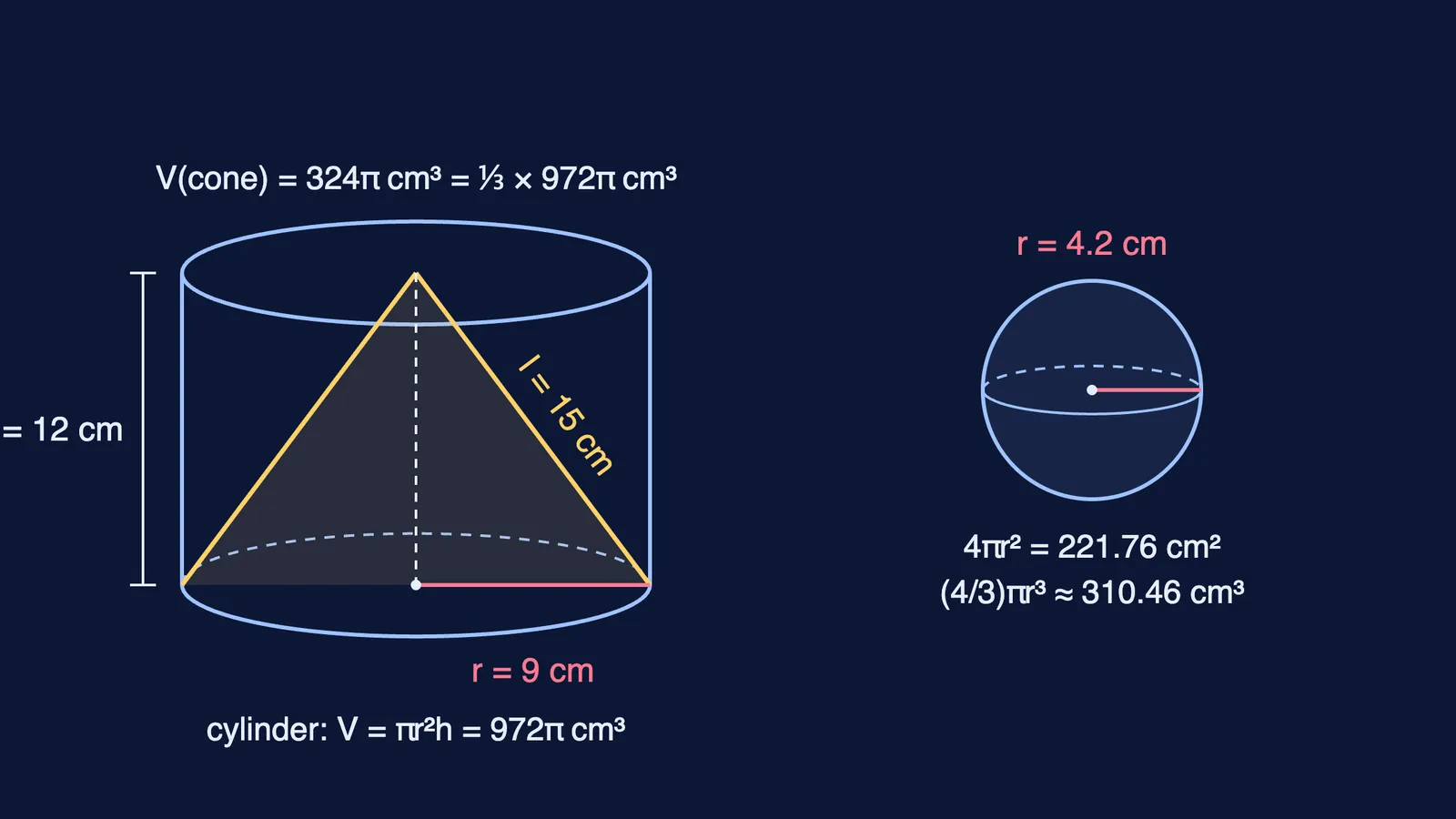
Cone, r = 9 cm, h = 12 cm (π = 3.14). Slant height l = √(144 + 81) = 15 cm. Curved surface = 3.14 × 9 × 15 = 423.9 cm². Volume = (1/3) × 3.14 × 81 × 12 = 1017.36 cm³. A cylinder with the same base and height holds 972π ≈ 3052.08 cm³, three times as much.
Ball, r = 4.2 cm. Surface = 4 × 22/7 × 17.64 = 221.76 cm². Volume = (4/3) × 22/7 × 74.088 ≈ 310.46 cm³. Cut it in half for a bowl: volume ≈ 155.23 cm³, total surface = 3 × 22/7 × 17.64 = 166.32 cm².
More practice: the surface area of an open box and an ice cream cone topped with a hemisphere.
If your method keeps going wrong rather than your arithmetic, the Fermi Problem Library has worked problems with a step-by-step solver that explains the reasoning rather than printing an answer.
What are the common mistakes in Class 9 surface area and volume?
Using h where the formula needs l. Cone surface uses slant height; cone volume uses vertical height. In example 3, swapping them changes both answers.
Curved versus total surface. Count the flat ends: a pipe has none, a glass one, a closed tin two.
Radius versus diameter. Halve the diameter before you square or cube anything.
Units. A ball of radius 3 cm has surface 4π × 9 = 36π cm² and volume (4/3)π × 27 = 36π cm³. Same number, different quantity; the unit tells you which one you found.
Litres. Convert cm³ to litres by dividing by 1000, not 100.
How many marks is surface area and volume in CBSE Class 9 2026-27?
The CBSE Class IX maths curriculum for 2026-27 gives the Mensuration unit 14 of the 80 theory marks. That 14 is shared between two chapters, Area and Perimeter and Surface Area and Volume, so there is no separate figure for this chapter. Our guide to Measuring Space, the Class 9 area and perimeter chapter covers the other half. The internal assessment (20 marks) includes 5 marks for lab practicals; hands-on work like the chapter's paper nets and salt activity is good preparation.
If one solid still will not make sense, the Fermi Concept Library has a lesson for every concept in mathematics.