

On this page
This is one of the most familiar "combination of solids" questions in Class 10 maths: a cylinder full of ice cream is shared out into cones, each with a hemisphere of ice cream on top. It looks like three shapes at once, but there are only two steps. Find the volume of one cone plus its hemisphere, then divide the cylinder's volume by it.
What is the volume of an ice cream cone with a hemispherical top?
The ice cream is one solid made of two parts that share a circle: the cone below and the hemisphere sitting on its rim. Because they touch along a flat circle and do not overlap, the total volume is simply the sum of the two parts.
The volume of a right circular cone is V = (1/3)πr²h, one third of the base area times the height (Wikipedia: Cone).
The volume of a sphere is V = (4/3)πr³ (Wikipedia: Sphere), so a hemisphere, which is half a sphere, has volume (2/3)πr³.
The hemisphere sits exactly on the cone's open circle, so both parts use the same radius r. That gives one formula for the whole scoop:
Volume of one ice cream cone = (1/3)πr²h + (2/3)πr³ = (1/3)πr²(h + 2r)
Here h is the height of the cone alone, not the height of the cone plus the scoop.
How many cones can be filled from a cylindrical container?
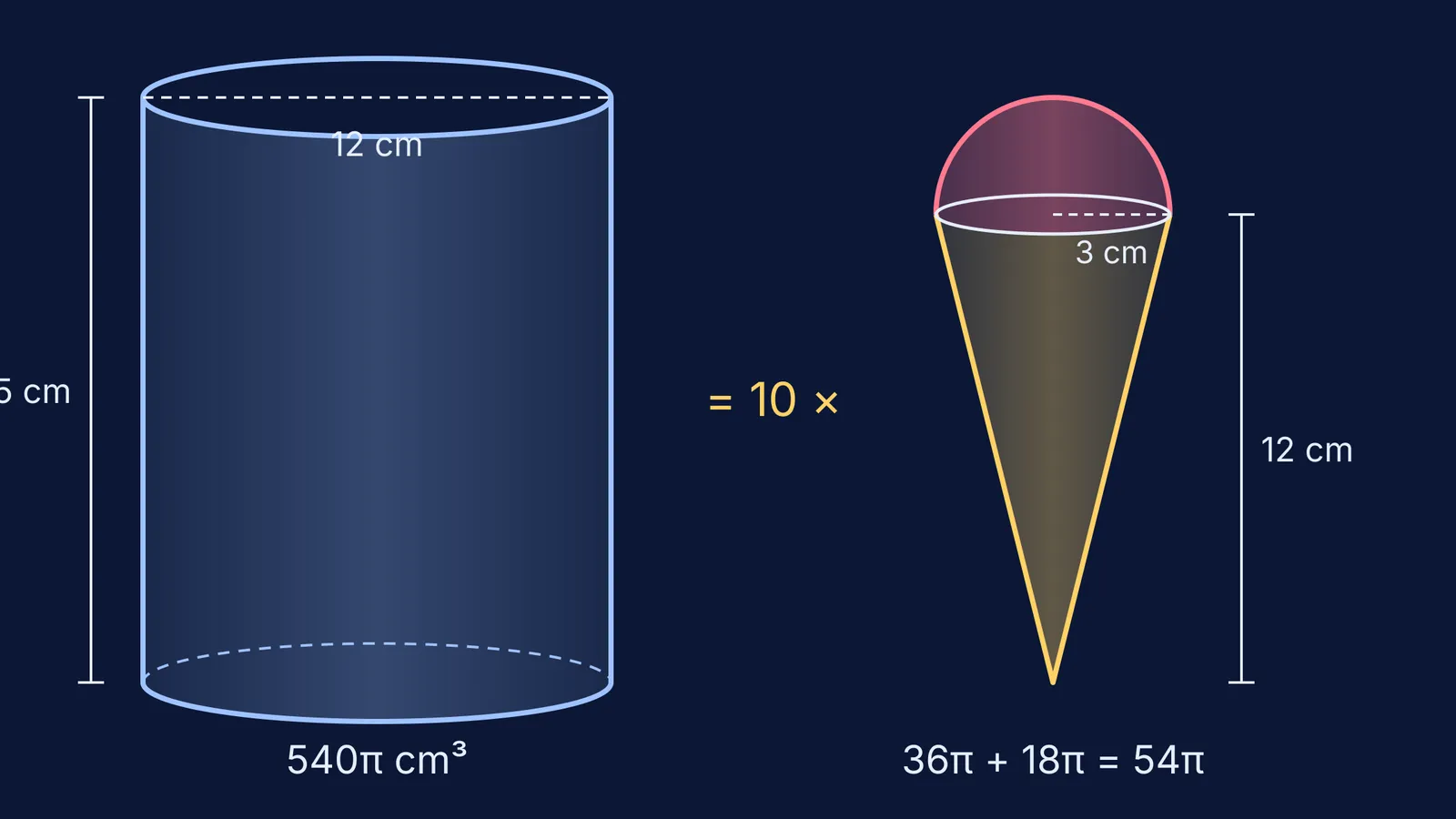
The NCERT Class 10 question reads: a container shaped like a right circular cylinder, 12 cm in diameter and 15 cm tall, is full of ice cream, which is to be filled into cones 12 cm tall and 6 cm in diameter, each with a hemispherical top; find how many cones can be filled (the question as listed on Careers360).
Halve the diameters first. Cylinder: R = 6 cm, H = 15 cm. Cone and hemisphere: r = 3 cm, h = 12 cm.
Cylinder volume: πR²H = π × 36 × 15 = 540π cm³.
Cone part: (1/3)π × 9 × 12 = 36π cm³.
Hemisphere part: (2/3)π × 27 = 18π cm³.
One filled cone: 36π + 18π = 54π cm³.
Number of cones: 540π ÷ 54π = 10.
So the container fills 10 cones. If you want the actual volumes, take π = 22/7: one cone holds about 169.7 cm³ and the cylinder about 1697.1 cm³.
Why do students get 12 or 15 instead of 10?
Wrong answers to this NCERT question usually come from a handful of slips:
Diameter used as radius. Using r = 6 for the cone makes every term four or eight times too big. Halve both diameters in step 1, before you write any formula.
Whole sphere instead of a hemisphere. Using (4/3)πr³ gives 36π + 36π = 72π per cone and a wrong count of 7.5.
Hemisphere forgotten. Using only the cone gives 540π ÷ 36π = 15 cones.
Wrong height. The 12 cm is the cone's height. The scoop adds another 3 cm on top, but that is already counted in the hemisphere term.
Arithmetic in the hemisphere. (2/3) × 27 is 18, not 9 or 27. A slip that makes one filled cone 45π instead of 54π gives the wrong answer 12.
A quick sense check: the cone part beats the scoop whenever h is more than 2r, as here (36π against 18π).
If you want to see why a hemisphere is a fixed fraction of a cylinder, our post on why a sphere fills two-thirds of its cylinder shows the result Archimedes proved.
What if the answer is not a whole number?
Exam setters often choose numbers that divide neatly, but real containers do not. If the division gives 9.6, the answer is 9 cones: you cannot sell a cone that is six-tenths full. Always round down for "how many can be filled" and round up for "how many are needed".
The same idea, that volume is conserved when the solid changes shape, runs through every Class 10 problem where a solid is melted and recast; our guide to melting and recasting problems uses the same check-as-you-go method. If the question asks for paint or wrapping instead of ice cream, you need surface area, and the joined faces behave differently: see the surface area of a toy made of a cone and hemisphere.
If a step still feels shaky, the Fermi Problem Library has worked problems with a step-by-step solver that explains the reasoning rather than printing an answer. If the gap is in the formulas themselves, the Fermi Concept Library gives each mathematics concept its own lesson.
Next, cover the practice answer, work it out yourself, then invent one with your own radii.


