

On this page
When you join two geometric solids together, their total volume is additive, but their total surface area is not. Melting two metal spheres preserves every cubic centimetre of material. But gluing a solid cone onto a solid hemisphere to make a toy seals two circular faces inside the seam.
Understanding which faces survive and which vanish is a central hurdle in Class 10 mensuration. Adding the individual total surface areas of the separate parts produces an inflated, incorrect answer.
Why do faces vanish when solids are joined?
In a spatial measurement study in the International Journal of Science and Mathematics Education, researchers Gülçin Tan Şişman and Meral Aksu investigated 445 students across 16 geometric tasks. They found that learners routinely apply additive shortcuts to boundary problems, confusing interior space with exterior area. When evaluating joined solids, students frequently add individual total surface areas because additive arithmetic feels intuitive.
By mathematical definition, surface area measures only the exterior boundary separating an object from the outside. Any face sealed inside a joint contributes zero to that boundary. If you cannot touch a face from the outside, it is not part of the surface area.
This trips students up because volume behaves additively: combining solids of 25 cm³ and 50 cm³ yields 75 cm³. But surface area behaves subtractively when shapes meet. Gluing two identical unit cubes face-to-face leaves 10 exposed square faces, not 12, because two faces vanish inside the seam.
Mastering the difference between curved surface area and total surface area requires matching formulas to the exposed boundaries of the final solid, not its isolated parts.
How do you find the surface area of a toy made of a cone and hemisphere?
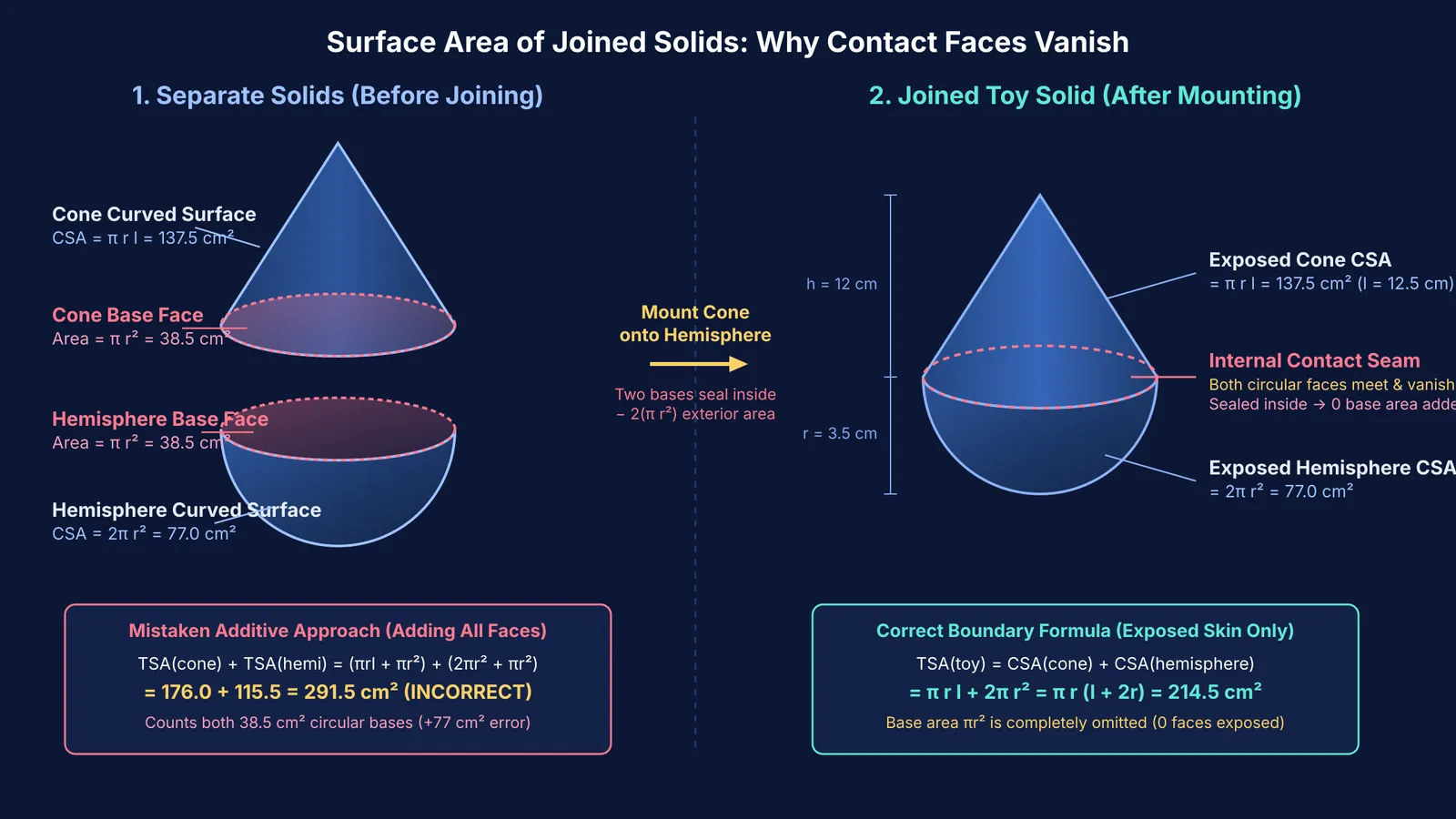
In the NCERT Class 10 Mathematics textbook, Exercise 12.1 presents the classic toy problem: a cone is mounted on a hemisphere of the same radius, where radius r is 3.5 cm and total toy height is 15.5 cm.
To find the surface area without falling into the additive trap:
Find the vertical and slant height of the cone. The hemisphere's radius of 3.5 cm equals its vertical depth. The cone's vertical height is h = 15.5 cm − 3.5 cm = 12 cm. Calculating curved area requires slant height l, not vertical height h. Using l = √(r² + h²), you get l = √((3.5)² + 12²) = √156.25 = 12.5 cm. Our guide on cone slant height versus vertical height covers this distinction.
Identify exposed surfaces. When the cone sits on the hemisphere, both circular bases vanish inside. The exterior consists of the conical wall and hemispherical dome: Total Surface Area = CSA of Cone + CSA of Hemisphere = π r l + 2π r² = π r (l + 2r).
Calculate the value. Substituting r = 3.5 cm (or 7/2 cm) and l = 12.5 cm with π = 22/7 gives (22/7) × (7/2) × (12.5 + 7) = 11 × 19.5 = 214.5 cm².
Adding the separate total surface areas of the cone (π r l + π r² = 176 cm²) and hemisphere (3π r² = 115.5 cm²) yields 291.5 cm²—an error of 77 cm², exactly twice the area of the 38.5 cm² contact face.
How does the same rule apply to a medicine capsule?
The CBSE Class 10 Mathematics syllabus pairs the toy problem with a medicine capsule: a cylinder capped with two hemispheres. A standard problem gives total length 14 mm and diameter 5 mm.
The diameter of 5 mm gives shared radius r = 2.5 mm. Because each end dome has depth r = 2.5 mm, cylinder length is h = 14 mm − (2.5 mm + 2.5 mm) = 9 mm.
Four circular faces vanish into two internal joints. The only surfaces exposed to air are the cylindrical sleeve and two hemispherical domes: Total Surface Area = 2π r h + 4π r² = 2π r (h + 2r). Substituting r = 2.5 mm, h = 9 mm, and π = 22/7 yields 2 × (22/7) × (5/2) × (9 + 5) = 220 mm².
The two hemispherical ends form 4π r², the surface area of a complete sphere. While melting and recasting problems conserve total volume, joining solid boundaries eliminates flat surfaces entirely.
What is the step-by-step checklist for joined solid exam questions?
Whenever you solve a problem on joined solids, use this four-point check:
Explode the solid mentally. Picture the shapes pulled apart slightly so every face is visible.
Cross out contacting faces. Each contact seam removes two faces from the exterior.
Isolate component dimensions. Never plug overall height into a component formula; subtract the attached radius first.
Factor common terms. Writing π r (l + 2r) instead of calculating terms separately prevents rounding errors.
The Fermi Problem Library provides worked geometry problems with a step-by-step solver that explains the reasoning rather than printing an answer. When setting up three-dimensional boundary calculations, Fermi's AI tutor works out what you know and notices where you get stuck, drawing the figure and checking understanding as you go.


