

On this page
If you are solving a mensuration problem involving a cone, the first thing to check is which height you have been given.
Swapping the two heights of a cone is a common cause of lost marks in Class 10 board exams. Students often grab the first number labelled "height" and plug it into their formula, leading to a wrong answer before the real calculation has even begun.
Here is how to tell them apart, which formula needs which height, and how to catch the tricks examiners set.
What is the difference between slant height and vertical height?
According to Mathwords, a right circular cone has two distinct heights:
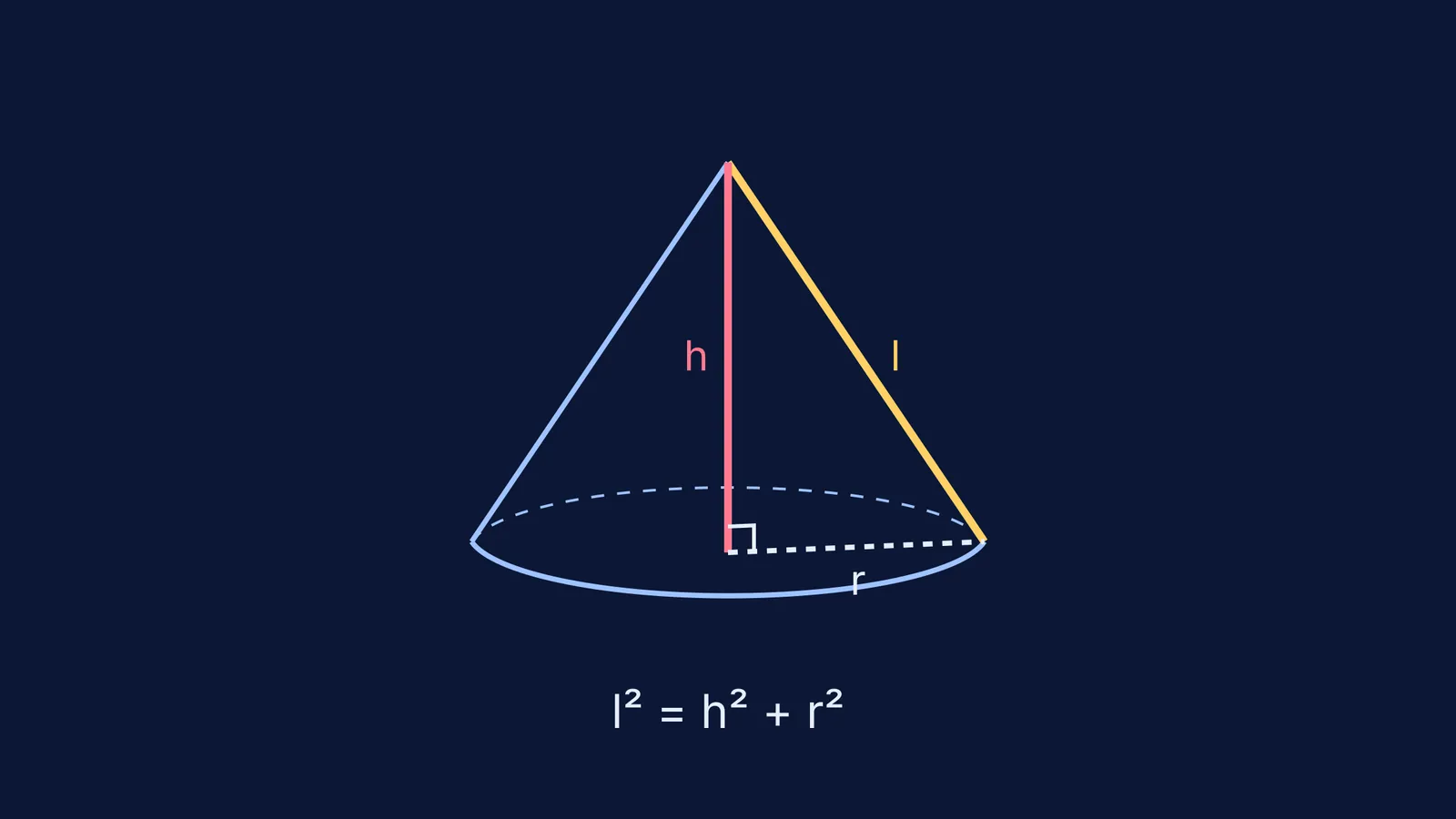
Vertical height (h): Also called the altitude, this is the perpendicular distance straight down from the apex (the top point) to the centre of the circular base.
Slant height (l): This is the distance from the apex down the sloping outside edge to any point on the rim of the base.
Because the vertical height drops straight down to the base and the radius goes straight across, they meet at a 90-degree angle. This means the vertical height, the radius (r) and the slant height form a right-angled triangle inside the cone.
The slant height is the hypotenuse of this triangle, which gives us the key rule: the slant height is always longer than the vertical height.
Which cone formula uses slant height?
The height you need depends on whether you are calculating the space inside the cone or the material needed to make its outside surface.
1. Volume uses vertical height (h)
The volume measures the 3D space the cone takes up. The formula is V = ⅓πr²h. If you accidentally use the slant height here, your answer will be too large, because l is always greater than h.
2. Surface area uses slant height (l)
The curved surface area (CSA) measures the material wrapping around the sloped side. The formula is CSA = πrl. To find the total surface area (TSA), you add the flat circular base to get TSA = πrl + πr². If you use the vertical height in these formulas, your answer will be too small.
How do you find a missing height?
Exam questions rarely give you all three dimensions. They usually give you two and ask a question that requires the third. If a problem gives you the radius and the vertical height, but asks for the curved surface area, you must stop and calculate the slant height first.
Because they form a right-angled triangle, you can always find the missing side using Pythagoras' theorem: l² = h² + r².
For example, if a tent has a radius of 5 m and a vertical height of 12 m, what is the area of canvas needed?
Find the slant height: l = √(5² + 12²) = √(25 + 144) = √169 = 13 m.
Calculate the area: CSA = π × 5 × 13 = 65π m².
If you are struggling to picture the hidden right-angled triangles inside 3D shapes, the Fermi Concept Library explains every concept in mathematics step by step.
What happens when you fold a sector into a cone?
A common tricky question asks what happens when you take a flat slice of a circle (a sector) and roll it up so its straight edges touch, forming a cone.
Students often assume the radius of the original flat circle becomes the radius of the cone's base. It does not. The radius of the flat sector becomes the slant height (l) of the new cone. The curved arc of the sector becomes the circumference of the cone's base (2πr). If you are given a folding problem, always set the sector's radius equal to l, not r or h.
How to avoid height mistakes in exams
Exams often use combinations of solids, such as a cone placed on top of a cylinder or a hemisphere, to test your attention to detail.
Draw it first: Sketch the shape and clearly label the vertical height down the middle and the slant height on the edge. Drawing stops you from using the wrong number by mistake.
Watch the total height: If a toy is a cone on a hemisphere and its "total height" is 15 cm, the cone's vertical height is 15 cm minus the radius of the hemisphere. Do not use 15 cm as the cone's h or l.
Check the units: A classic trap is giving the radius in cm and the height in m. Convert them to the same unit before doing any squares or square roots.
If you are revising geometry, read our guide on Class 10 CBSE maths: board answer mistakes and how to show working to see how examiners award step marks. You can also review how to set up Quadratic word problems in Class 10: speed, age and area.


