

On this page
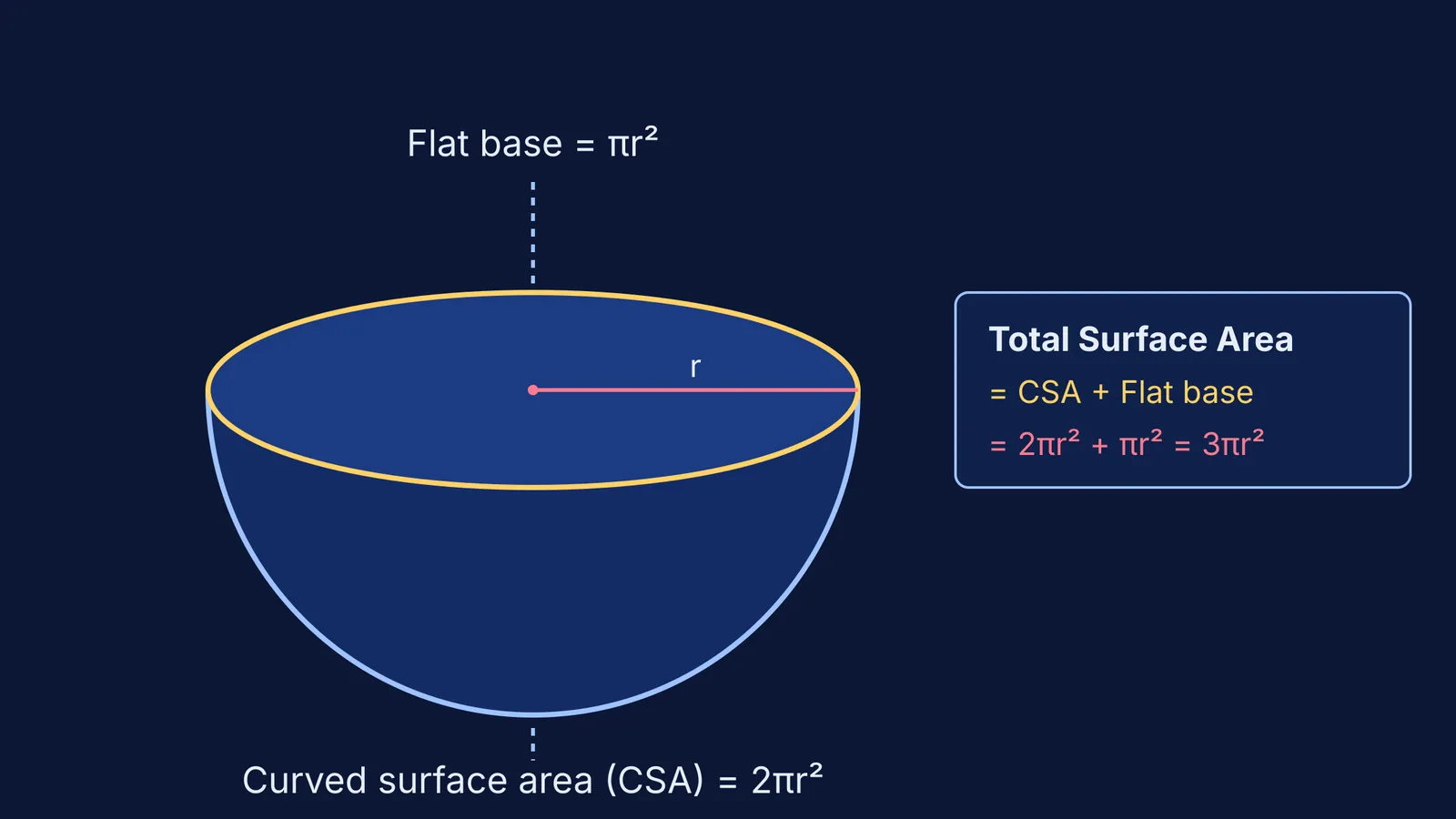
A hemisphere is exactly half of a full sphere, like a melon cut perfectly down the middle. When you slice it, you expose a flat circular face that was previously hidden inside.
The curved surface area (CSA) is the area of the rounded, bowl-like part only. For a full, perfect sphere, the surface area is 4πr², so exactly half of that is 2πr². You use this formula if you are painting the outside of a dome, working with an open bowl, or dealing with any hollow hemispherical shell.
The total surface area (TSA) is the area of that rounded part plus the area of the flat circular base you created by slicing it. The area of that flat circle is exactly πr². Adding them together gives the total surface area: 2πr² + πr² = 3πr². You use this formula when dealing with a solid object, like a solid wooden paperweight or a half-cut orange where the flat face is exposed.
According to the NCERT Mathematics Class 10 syllabus on Surface Areas and Volumes, understanding this distinction is the essential first step to solving problems with combined solids. If you are currently revising, our guide to Surface area and volume in Class 9: cones, spheres and hemispheres covers the fundamental properties of these individual shapes in more detail.
What about a cylinder and a cone?
The same logic applies to other three-dimensional shapes that feature flat bases.
For a cylinder (like a tin can or a pipe):
CSA: Imagine cutting the label off a soup can and unrolling it. It forms a flat rectangle. The width of this rectangle is the circumference of the circular base (2πr), and its length is the height of the can (h). Multiplying them gives the curved surface area: 2πrh.
TSA: A fully closed cylinder has two flat circular bases (a top lid and a bottom floor). Adding the area of those two circles (2πr²) to the CSA gives the TSA formula: 2πr(r + h).
For a cone (like a party hat or a traffic cone):
CSA: The slanted, curved surface unrolls into a shape called a circular sector. Its area is determined by the radius of the base (r) and the slant height along the side (l), giving the formula πrl.
TSA: If the cone is a solid block of wood, you must account for the flat circular bottom as well. Adding that base circle (πr²) to the curve gives the TSA formula: πr(l + r).
Once you are comfortable distinguishing between the open curve and the closed total for each shape, you will frequently use them together. Our walkthrough on Combined solids in Class 10: surface area and volume, worked demonstrates how to calculate the final area when a cone is placed precisely on top of a hemisphere.
Why do composite solids use curved surface area?
When you join two shapes together—like placing a cone on top of a cylinder to build a toy rocket—the total surface area of the new combined solid is *not* the TSA of the cone plus the TSA of the cylinder.
This is a common mistake students make in board exams. When the two flat bases touch, they are glued together and hidden entirely inside the object. Because surface area only measures the exposed outside faces that you can physically touch or paint, those hidden internal circles no longer count toward the total.
Instead, you have to add the curved surface area (CSA) of the cone to the curved surface area (CSA) of the cylinder, and then add the single flat circle remaining at the very bottom of the rocket. This creates a new formula tailored specifically to that object: πrl + 2πrh + πr².
How do you know which formula the question wants?
Exam questions rarely tell you directly whether to use CSA or TSA. Instead, they provide physical clues about the object in the word problem. You have to picture the object in real life to decide which surfaces are actually exposed.
Use Curved Surface Area (CSA) when the shape is hollow, open, or joined to another solid:
"A canvas tent in the shape of a cone" (it relies on the ground, so it has no canvas floor).
"An open cylindrical water bucket."
"Painting the inside of a hemispherical bowl."
Use Total Surface Area (TSA) when the shape is completely solid and stands alone:
"A solid wooden cylinder."
"A solid hemispherical paperweight."
"A closed cylindrical water tank."
Often, the hardest part of an exam question is figuring out which surfaces to include before you even write down a formula. If you keep calculating the total area when a question only wanted the curved part, the Fermi Problem Library has worked problems with a step-by-step solver that explains the reasoning rather than printing an answer. It helps you build the intuition to read a geometry word problem correctly the first time.


