On this page
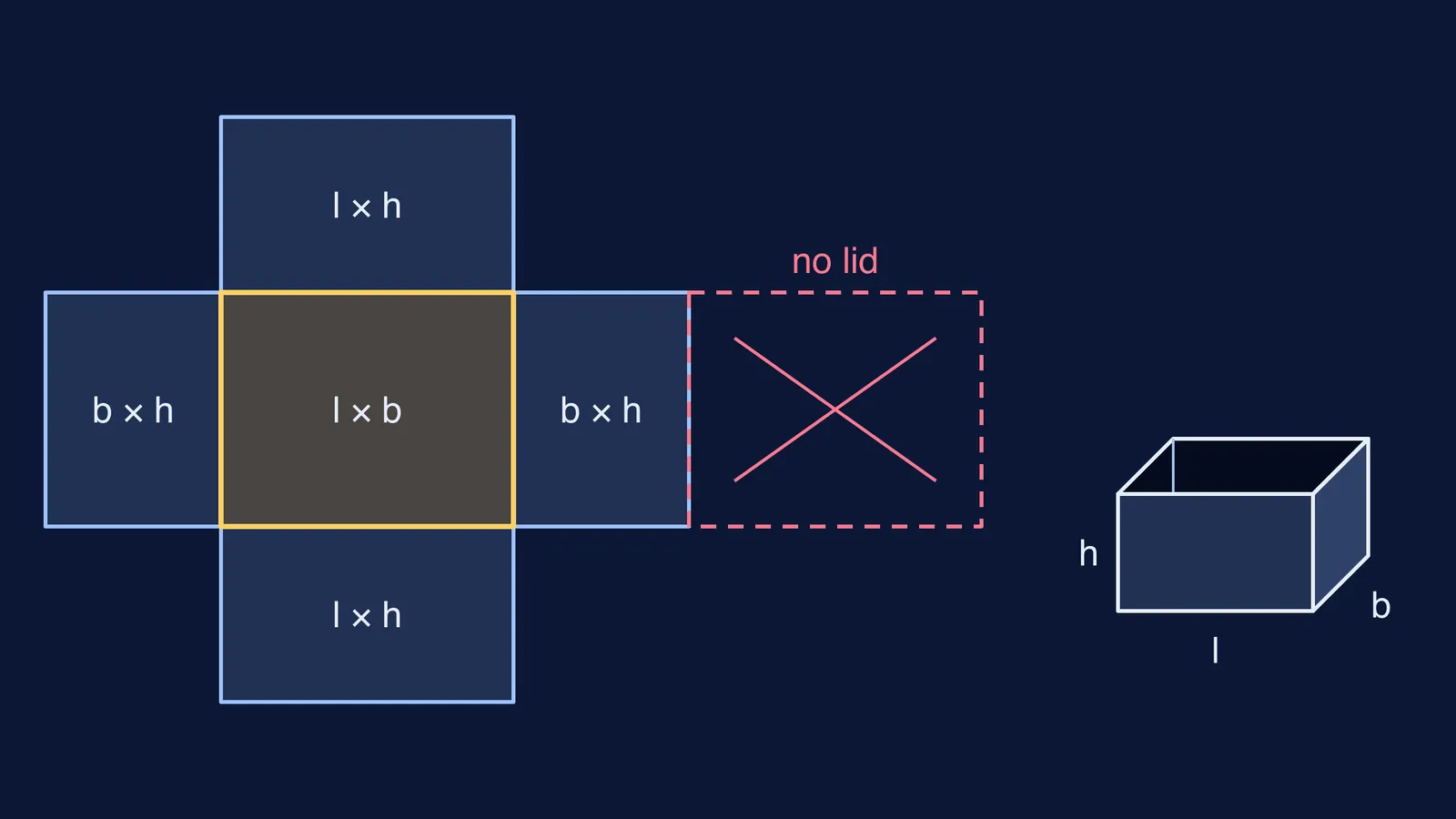
Box and room questions turn on one thing: which faces you count. A closed box has six faces, a box without a lid has five, and the walls of a room have four.
What is the surface area of an open box without a lid?
NCERT's Class 8 Mensuration chapter gives the total surface area of a cuboid as 2(lb + bh + hl), where l, b and h are its length, breadth and height (NCERT Class 8 Mathematics, Chapter 9).
An open box has no lid, so you take away one face of area l × b:
Surface area of an open box = 2(lb + bh + hl) − lb
This simplifies to lb + 2h(l + b): one base, plus a band of four walls around it.
Worked example: a 50 cm × 40 cm × 30 cm box without a lid
With l = 50, b = 40 and h = 30: lb = 2000 cm², bh = 1200 cm², hl = 1500 cm².
Closed box: 2(2000 + 1200 + 1500) = 9400 cm².
Remove the lid: 9400 − 2000 = 7400 cm².
Check with the short form: 2000 + 2 × 30 × (50 + 40) = 7400 cm².
Now a cost step. Suppose the sheet costs ₹200 per m² (a practice rate, not a market price). Since 1 m² = 100 cm × 100 cm = 10,000 cm², the box needs 7400 ÷ 10,000 = 0.74 m² of sheet, so it costs 0.74 × 200 = ₹148. Convert units before you multiply.
What is the lateral surface area of a room?
NCERT defines the lateral surface area as the side walls, excluding top and bottom, and says the four walls of a cuboidal room are its lateral surface area, 2h(l + b) (NCERT Class 8 Mathematics, Chapter 9). An easy way to remember it is perimeter of the floor × height.
The same chapter's Example 5 shows the cost step: a room 12 m × 8 m × 4 m has walls of 2(12 + 8) × 4 = 160 m², so whitewashing at ₹5 per m² costs ₹800, and adding the 96 m² ceiling brings the total to ₹1280 (NCERT Class 8 Mathematics, Chapter 9).
How do you find the cost of painting a room per square metre?
NCERT works these as perimeter of the floor × height, then area × rate (NCERT Class 8 Mathematics, Chapter 9). In steps:
Write l, b and h in one unit (metres for rooms).
Read the question for which surfaces get paint: walls only, walls and ceiling, or something else.
Walls = 2h(l + b). Add lb if the ceiling is included.
Subtract doors and windows only if the question gives their sizes.
Multiply by the rate per m² to get the cost.
For paint cans, divide the area by what one can covers, and round up.
Here is a room that uses every step: 5 m × 4 m × 3 m, walls and ceiling painted, one 2 m × 1 m door, one 1.5 m × 1 m window, at a practice rate of ₹25 per m².
Walls: 2 × 3 × (5 + 4) = 54 m²
Ceiling: 5 × 4 = 20 m²
Door and window: 2 + 1.5 = 3.5 m²
Area to paint: 54 + 20 − 3.5 = 70.5 m²
Cost: 70.5 × 25 = ₹1762.50
For more traps, see our guide to the cost of painting the four walls of a room.
Which formula do you need for each face count?
Closed box, six faces: 2(lb + bh + hl)
Box without a lid, five faces: lb + 2h(l + b)
Four walls of a room: 2h(l + b)
Walls and ceiling: 2h(l + b) + lb
A cube of side a without a lid: 5a²
The missing face is not always the top. NCERT's Exercise 9.2 asks for the outside of a 1 m × 2 m × 1.5 m cabinet painted on every face except the bottom (NCERT Class 8 Mathematics, Chapter 9). That is an open box upside down: the full surface is 2(2 + 1.5 + 3) = 13 m², minus the 2 m² bottom, giving 11 m².
Practise until the face count is automatic
An open tank 2 m × 1.5 m × 1 m: how much sheet metal? (Answer: 3 + 2 × 1 × 3.5 = 10 m²)
A hall 15 m × 10 m × 7 m, walls and ceiling, where one can of paint covers 100 m² (Exercise 9.2 in NCERT Class 8 Mathematics, Chapter 9): how many cans? (Answer: 350 + 150 = 500 m², so 5 cans)
If a question still trips you up, the Fermi Problem Library has worked problems with a step-by-step solver that explains the reasoning rather than printing an answer, so you can see which face went missing. To revisit area and units, the Fermi Concept Library gives each mathematics concept its own lesson.
Next, try converting cuboid volume between cubic metres and litres.