

On this page
When a mathematics problem asks for the capacity of a cuboid water tank, it usually provides the length, width and height in metres or centimetres, but asks for the final answer in litres. This is where many students make a mistake: they calculate the volume correctly but divide by the wrong power of ten during the final conversion.
Understanding the exact mathematical relationship between lengths and litres is much safer than trying to memorise conversion tables.
Why does 1 cubic metre equal 1000 litres?
The answer lies in how the litre is officially defined. In 1964, the 12th General Conference on Weights and Measures (CGPM) passed Resolution 6, which declared that the word "litre" is simply a special name for the cubic decimetre (BIPM).
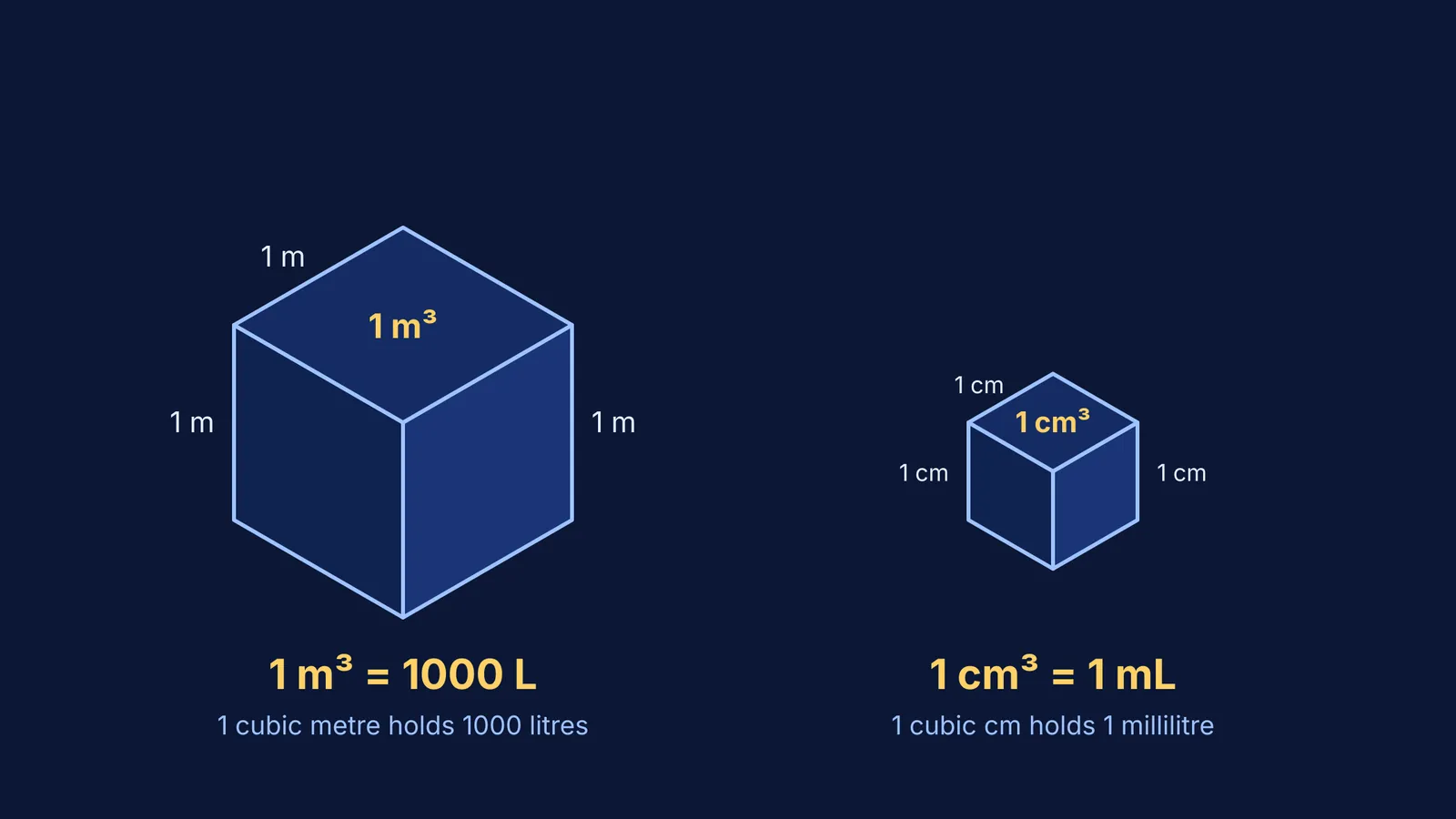
A decimetre is one-tenth of a metre (10 cm). A cubic decimetre is a block that measures 10 cm × 10 cm × 10 cm. Since 1 metre is 10 decimetres, a full cubic metre measures 10 dm × 10 dm × 10 dm. Multiplying these together gives 1,000 cubic decimetres.
Because 1 cubic decimetre is exactly 1 litre, 1 cubic metre must therefore hold exactly 1,000 litres.
If you struggle to recall whether to multiply or divide by 1,000, you can look up related ideas in the Fermi Concept Library, which covers every concept in mathematics with its own step-by-step lesson.
How do you convert the volume of a cuboid to litres?
Tank capacity questions often mix units to test your attention to detail. For example, a water tank might have a length of 2 m, a width of 50 cm, and a depth of 1.5 m.
The safest way to handle these problems is to convert all dimensions into a single unit *before* you multiply them to find the volume. If you multiply first and then try to convert cubic centimetres to cubic metres, you have to divide by 1,000,000 (since 100 × 100 × 100 = 1,000,000). Students often forget this and mistakenly divide by just 100, ruining their answer. Why 1 square metre is 10,000 cm²: mastering area conversions covers a similar pitfall in 2D geometry.
Instead, use this framework for volume of a cuboid litres and cubic metres conversion:
Read the final unit required. If the answer must be in litres, decide whether you will work in metres (where 1 m³ = 1000 L) or centimetres (where 1000 cm³ = 1 L).
Convert all three side lengths (length, width, height) into that chosen unit.
Multiply the three lengths to get the volume.
Apply the conversion to litres as your final step.
Should you convert units before or after multiplying?
Always convert lengths before multiplying. Let us apply this rule to the tank with dimensions 2 m × 50 cm × 1.5 m.
Method 1: Working in metres (Recommended for large tanks) First, convert the 50 cm width into metres: 50 cm = 0.5 m. Now multiply the lengths: 2 m × 0.5 m × 1.5 m = 1.5 m³. Since 1 m³ = 1,000 L, multiply by 1,000. The capacity is 1,500 L.
Method 2: Working in centimetres Convert the two metre measurements into centimetres: 2 m = 200 cm, and 1.5 m = 150 cm. Multiply the lengths: 200 cm × 50 cm × 150 cm = 1,500,000 cm³. Since 1,000 cm³ = 1 L, divide the result by 1,000. The capacity is 1,500 L.
Both methods give the same result, but working in metres often keeps the numbers smaller and easier to manage without a calculator.
If you find yourself repeatedly tangled in mixed units or making calculation errors in mensuration, the Fermi Problem Library has worked problems with a step-by-step solver that explains the reasoning rather than just printing an answer. This helps you spot exactly where your method strayed. You can also explore Converting Cubic Centimetres to Litres for Tank Problems or read about finding the Volume of a Hollow Cylinder Pipe: Formula and Flow Rate to practice applying these rules to other shapes.


