

On this page
When you look at a pipe, it has two different volumes. The material volume is the amount of metal or plastic that makes up the pipe itself. The internal capacity is the empty space inside, which determines how much water or gas can flow through it.
Whether you are calculating the mass of a steel pipe for a physics problem or the flow rate of water, mixing up the inner and outer dimensions is a frequent source of lost marks.
What is the volume of a hollow cylinder pipe?
The volume of any uniform cylinder is its cross-sectional area multiplied by its height (h).
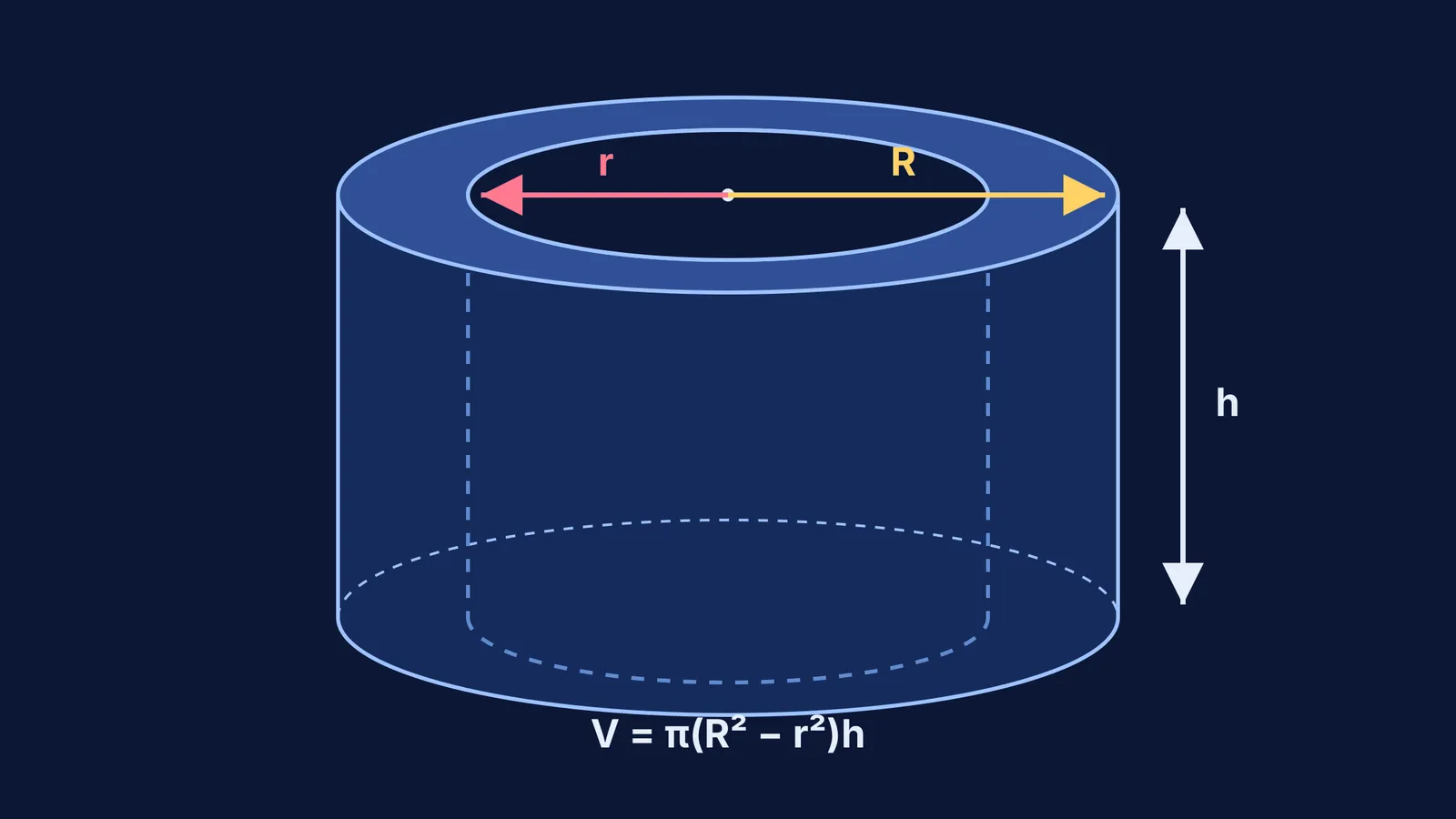
For a hollow cylinder, the cross-section is a ring (an annulus). You calculate its area by taking the area of the outer circle and subtracting the area of the inner hole. Therefore, the volume of the material is V = π(R² − r²)h, where R is the outer radius and r is the inner radius (CueMath).
If you only need the internal capacity — the volume of fluid the pipe can hold at rest — you treat the empty space as a solid cylinder. That formula is simply V = πr²h.
The thickness versus radius trap
A common error happens when a problem gives you the outer diameter (D) and the wall thickness (t), rather than the radii.
Many students hastily subtract the thickness once to find the inner diameter (d = D − t). However, because the wall exists on both sides of the pipe's centre, the thickness must be subtracted twice: d = D − 2t.
If you are working with radii, it is more straightforward. The outer radius is the inner radius plus one wall thickness: R = r + t.
If you keep getting the wrong answer in geometry problems, drawing a quick cross-section helps. The Fermi Problem Library notices where a student is stuck on this exact thickness error, and the AI tutor will stop to draw the cross-section on the board so you can see why the thickness is subtracted twice.
How do you find the mass of a hollow cylinder pipe?
Once you have calculated the material volume of the pipe, the next step in many physics problems is to determine its mass. Mass is the amount of matter in an object, and it depends on both the volume of the object and the density of the material it is made from.
The formula for mass is m = ρ × V, where ρ (the Greek letter rho) represents the density of the material (such as steel, copper, or PVC), and V is the material volume we calculated earlier using the outer and inner radii.
For instance, if an exam question states that the density of the metal is 8 grams per cubic centimetre, you simply multiply this density by the 1800π cm³ volume to get the total mass of the pipe in grams.
This calculation is crucial in engineering and construction, where knowing the weight of pipes is necessary to ensure the structural integrity of a building or a supporting frame. It also explains why manufacturers often specify the dimensions of their pipes so precisely. When studying for exams, always double-check whether the question asks for the volume or the actual mass, as stopping at the volume is a common way to lose the final mark.
Flow rate: how much fluid passes through?
When a fluid moves through the pipe, we measure its volumetric flow rate (Q), which is the volume of fluid passing a point per second.
In fluid dynamics, the flow rate is the cross-sectional area of the inner space multiplied by the fluid's average velocity: Q = A × v (The Engineering Mindset). Because the fluid only flows through the empty space, the area A is πr².
This principle is also why flow rate remains constant in a closed system, even if the pipe changes shape. If the pipe narrows, the cross-sectional area decreases, so the fluid velocity must increase to maintain the same volume per second. For more on how changing shapes affect physical properties, see our guide on the resistance of a tapered conductor.
A worked example: metal volume and water flow
Let's apply these formulas to a typical exam problem. Suppose a steel pipe is 2 metres (200 cm) long. It has an outer diameter of 10 cm and a wall thickness of 1 cm. Water flows through it at 50 cm/s.
Find the radii:
The outer radius R is half the outer diameter, so R = 5 cm. The inner radius r is the outer radius minus the thickness, so r = 5 − 1 = 4 cm.
Calculate the volume of the steel:
Using V = π(R² − r²)h: V = π(5² − 4²) × 200 V = π(25 − 16) × 200 V = π(9) × 200 = 1800π cm³.
Calculate the flow rate:
Using Q = πr² × v: Q = π(4²) × 50 Q = 16π × 50 = 800π cm³/s.
If the formulas feel abstract, stepping back to visualise the 3D structure is always the best next step. You can use the Concept Library to explore how 2D cross-sections build into 3D volumes, making it easier to recall the right formula under pressure. Also related to cylindrical geometry, you can read our derivation of the capacitance of spherical and cylindrical capacitors.


