

On this page
Painting or white-washing a room is a classic mensuration problem in school mathematics. While the basic calculation appears straightforward, exam questions frequently introduce real-world constraints such as doors, windows, and ceilings. Overlooking these details turns an easy geometry problem into lost marks.
The key to solving any room painting problem is identifying exactly which surfaces of the three-dimensional room receive paint.
What is the formula for the area of four walls of a room?
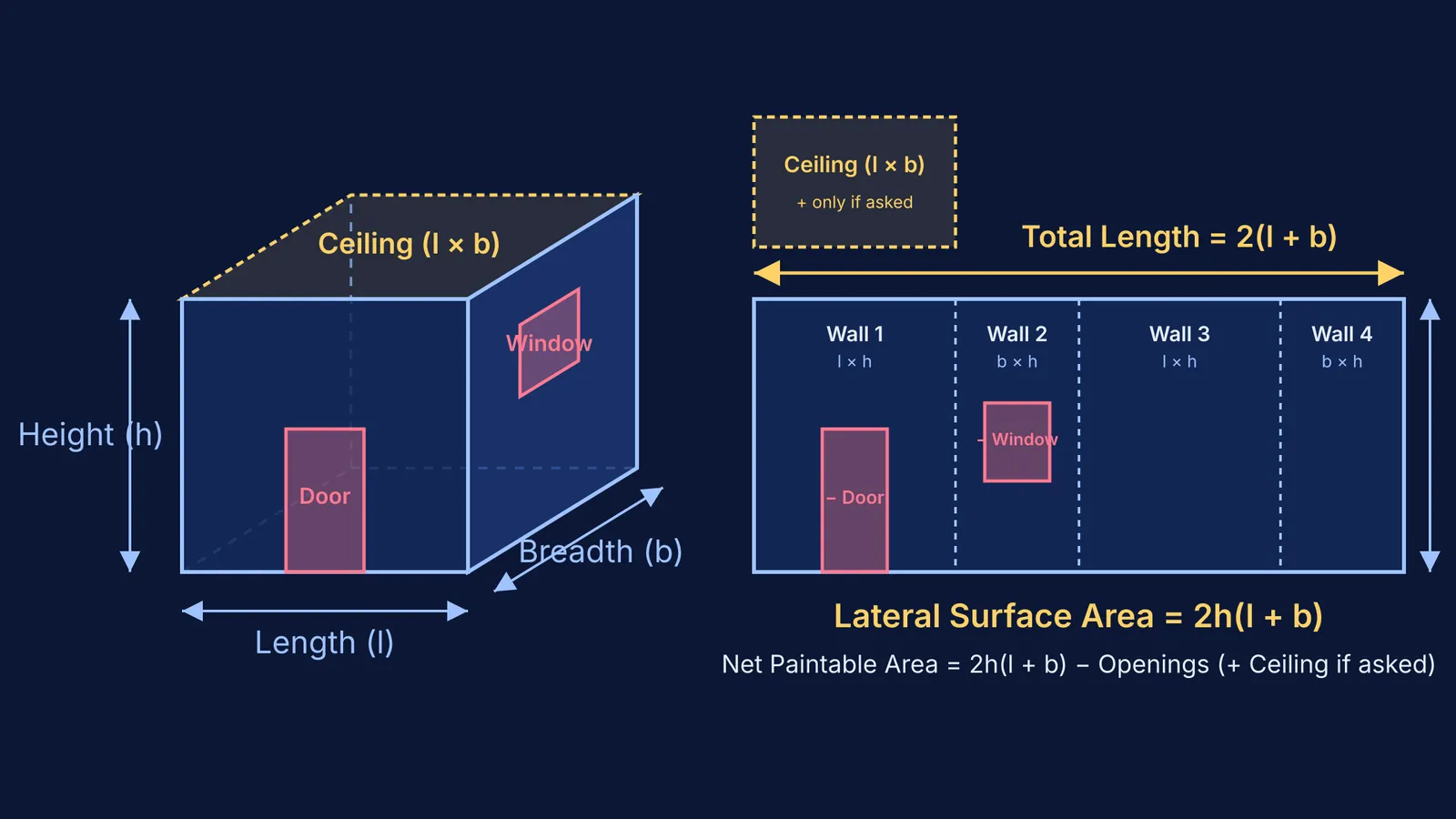
A standard room has the shape of a cuboid with length l, breadth b, and height h. The area of the four vertical walls is the lateral surface area of the cuboid.
Because the room has two walls along its length and two along its breadth, their combined area equals:
Area of four walls = 2lh + 2bh = 2h(l + b).
Visualizing the walls unfolded flat creates a single rectangle whose length equals the perimeter of the floor, 2(l + b), and whose height is h. Therefore, the lateral area is the perimeter of the base multiplied by the height.
The NCERT curriculum uses this principle in secondary mensuration to connect two-dimensional perimeters to three-dimensional surface areas. To see how foundational boundary concepts build into spatial calculations, review our guides on perimeter and area in Class 6 and mensuration in Class 8.
How do you subtract doors and windows from the wall area?
Doors and window openings do not receive wall paint, so their areas must be subtracted before calculating cost:
Net paintable area = 2h(l + b) − (Area of doors + Area of windows).
To find the area of an opening, multiply its width by its height. If a question includes multiple identical windows, multiply the area of one window by the total count.
The CBSE curriculum stresses that all dimensions must share identical units. If a room is measured in metres while a door is given as 100 cm by 200 cm, failing to convert the door to 1 m by 2 m leads directly to calculation errors.
When should you add the ceiling to the painting cost?
Some exam questions ask for the cost of painting or white-washing the walls and the ceiling together. The ceiling is a horizontal rectangle of area l × b:
Total area with ceiling = 2h(l + b) + (l × b) − (Area of doors + Area of windows).
Do not confuse this five-surface calculation with the total surface area formula, 2(lb + bh + hl), which accounts for all six faces of a cuboid. Because floors are not painted in these problems, using total surface area mistakenly adds an extra l × b. To understand how multiple surface calculations combine in three-dimensional geometry, read our walkthrough on combined solid surface areas in Class 10.
Why do students make mistakes on room painting problems?
These errors reflect documented patterns in spatial reasoning. In an empirical study of 445 sixth-grade students published in the *International Journal of Science and Mathematics Education*, Gülçin Tan Şişman and Meral Aksu (2016) found that students frequently confuse surface area with perimeter, apply volume formulas to area tasks, and struggle to coordinate two-dimensional nets with three-dimensional boundaries. Without visualizing which faces enclose space, learners often combine numbers mechanically.
The Fermi Problem Library has worked problems with a step-by-step solver that explains the reasoning rather than printing an answer. When a student gets stuck on a geometry problem, the AI tutor notices where they struggle and decides whether to explain the steps, ask guiding questions, or show the unfolded net so they see the boundary directly. Students can also explore the Fermi Concept Library, which maps every concept in mathematics with its own lesson and its place in the curriculum map.
How do you calculate the total cost in a worked example?
The standard question format in the NCERT curriculum provides room dimensions, openings, and a rate per square metre.
Consider a room with length 6 m, breadth 4 m, and height 3 m. The room has one door measuring 2 m by 1 m and two windows each measuring 1.5 m by 1 m. Find the cost of painting the four walls at ₹25 per m², and the extra cost if the ceiling is also painted.
Gross wall area: Compute the lateral surface area using 2h(l + b) = 2 × 3 × (6 + 4) = 6 × 10 = 60 m².
Area of openings: The door is 2 m × 1 m = 2 m². The two windows are 2 × (1.5 m × 1 m) = 3 m². Total openings equal 2 m² + 3 m² = 5 m².
Net paintable area: Subtract the openings from the gross wall area: 60 m² − 5 m² = 55 m².
Cost of painting walls: Multiply net area by the rate: 55 m² × ₹25 per m² = ₹1,375.
Ceiling addition: The ceiling area is l × b = 6 m × 4 m = 24 m². Painting the ceiling costs 24 m² × ₹25 per m² = ₹600, making the combined cost ₹1,975.
Following this order guarantees you account for every surface without adding the floor or missing cutouts.


