On this page
Chapter 8 of Ganita Manjari Part I, the new NCERT Class 9 maths textbook first published in April 2026 for the 2026-27 session, is called Predicting What Comes Next: Exploring Sequences and Progressions. Here it is in plain words, with fresh worked examples, common slips and a practice plan.
What is in Chapter 8 of the new Class 9 maths book?
The chapter defines a sequence as an ordered list of numbers, where each number is a term. Terms are written t1, t2, t3, …, so the subscript is the position.
Explicit rule: uses the position n directly, such as tn = 2n − 1 for odd numbers.
Recursive rule: builds each term from earlier ones, such as t1 = 1, tn = tn−1 + 3. The chapter's star example is the Virahānka–Fibonacci sequence 1, 2, 3, 5, 8, …, which Virahānka wrote down in the 7th century CE.
AP: the difference between consecutive terms is constant, and tn = a + (n − 1)d.
Sum of the first n natural numbers: n(n + 1)/2, which the chapter traces to Āryabhaṭa's Āryabhaṭīya.
GP: the ratio between consecutive terms is constant, and tn = arⁿ⁻¹.
Fractals: Sierpiński triangle counts and areas form GPs.
How many marks does sequences and progressions carry in CBSE 2026-27?
In the CBSE Class 9 Maths curriculum for 2026-27, Sequences and Progressions sits in Unit II, Algebra, together with Introduction to Polynomials, Exploring Algebraic Identities and Linear Equations in Two Variables. That whole unit carries 20 of the 80 marks in the theory paper. There is no separate figure for this chapter. Listed outcomes include finding the nth term of an AP and a GP, drawing both as graphs, analysing fractals with GPs and solving the Tower of Hanoi puzzle.
How do you find the nth term of an AP?
Say you put ₹20 in a jar in week 1 and add ₹15 every week after that. The totals are 20, 35, 50, 65, …
Check the differences: 35 − 20 = 15, 50 − 35 = 15. Constant, so it is an AP with a = 20 and d = 15.
Write the rule: tn = 20 + (n − 1) × 15 = 15n + 5.
Week 12: t12 = 15 × 12 + 5 = 185, so ₹185.
When does the jar hold ₹305? Solve 15n + 5 = 305, so n = 20. Week 20.
Exactly ₹400? 15n + 5 = 400 gives n = 26.33…, not whole, so never.
Recursive form: t1 = 20, tn = tn−1 + 15 for n ≥ 2.
To add a run of consecutive natural numbers, use the chapter's formula for the sum of the first n natural numbers twice: 31 + 32 + … + 60 = S60 − S30 = 1830 − 465 = 1365.
How is a GP different from an AP?
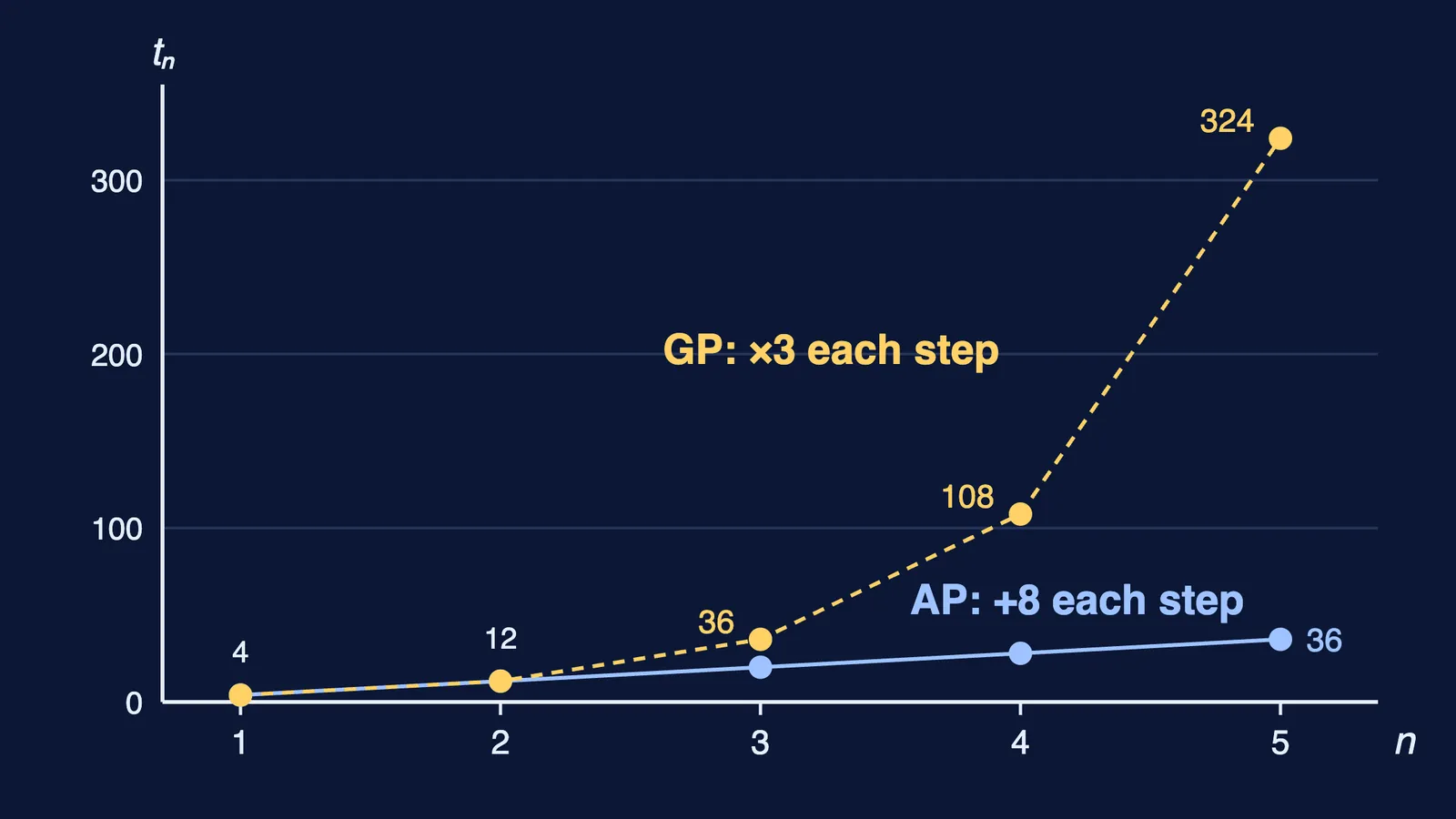
The two sequences in the graph above both start 4, 12. If the rule is "add 8", you get the AP 4, 12, 20, 28, 36. If the rule is "multiply by 3", you get the GP 4, 12, 36, 108, 324. Two terms cannot predict the third; you need the rule.
For the GP, tn = 4 × 3ⁿ⁻¹, so t6 = 4 × 243 = 972. Which term is 2916? Divide by 4 to get 729, which is 3⁶, so n − 1 = 6 and it is the 7th term.
The chapter also shows the picture: AP points sit on a straight line, while GP points curve away from one.
Which mistakes cost marks in this chapter?
Writing a + nd instead of a + (n − 1)d. Put n = 1: you must get a.
Accepting a fractional or negative n. Positions are natural numbers.
Dropping the minus sign of d in a falling AP such as 50, 43, 36 (d = −7).
Dividing the earlier term by the later one, which flips r.
Treating arⁿ⁻¹ as (ar)ⁿ⁻¹. Only r is raised to the power.
Missing that the Sierpiński table starts at stage 0, so the count is 3ⁿ, not 3ⁿ⁻¹.
If your method keeps going wrong, the Fermi Problem Library has worked problems with a step-by-step solver that explains the reasoning rather than printing an answer.
A one-week practice plan
Day 1: Write an explicit and a recursive rule for each opening pattern in the chapter.
Day 2: Invent five APs, one falling, and find each 15th term.
Day 3: Test whether chosen numbers are terms of your APs.
Day 4: Add runs such as 41 to 80 with n(n + 1)/2.
Day 5: Build three GPs, one with r = 1/2, and plot five terms each.
Day 6: Draw Sierpiński stages 0 to 3 and count triangles.
Day 7: Try the starred problems without notes.
Next, read why AP terms form a straight line, how to find the nth term and common ratio of a GP and arithmetic progressions in Class 10, where AP sums come in.