

On this page
Most GP questions come in two kinds: you get two terms and must rebuild the progression, or you get the progression and must say which term equals some number. Both use one formula, plus care with one sign trap.
What is the nth term formula of a GP?
A geometric progression is a sequence of non-zero numbers where each term after the first comes from multiplying the previous one by a fixed number called the common ratio (Wikipedia: Geometric progression).
The nth term of a geometric sequence is a r^(n−1), where a is the first term and r is the common ratio (OpenStax College Algebra 2e, section 9.3).
The power is n − 1 because the first term has not been multiplied by r yet; the 5th term is a r^4. Not sure a sequence is geometric? Our guide on telling an AP from a GP walks through the test.
How do you find the common ratio from two terms?
Write both terms with the formula and divide. The a cancels, and what is left is r raised to the gap between the two positions. OpenStax uses this method in a worked example: from a first term of 3 and a 4th term of 24, it gets 24 = 3r^3, so r^3 = 8 and r = 2 (OpenStax, section 9.3).
Worked example 1. The 3rd term of a GP is 24 and the 6th term is 192. Find the 10th term.
Write the terms: a r^2 = 24 and a r^5 = 192.
Divide the second by the first: r^3 = 192 ÷ 24 = 8, so r = 2.
Put r back in: a × 4 = 24, so a = 6.
The 10th term is 6 × 2^9 = 6 × 512 = 3072.
Check: the GP starts 6, 12, 24, 48, 96, 192, so the 3rd and 6th terms match.
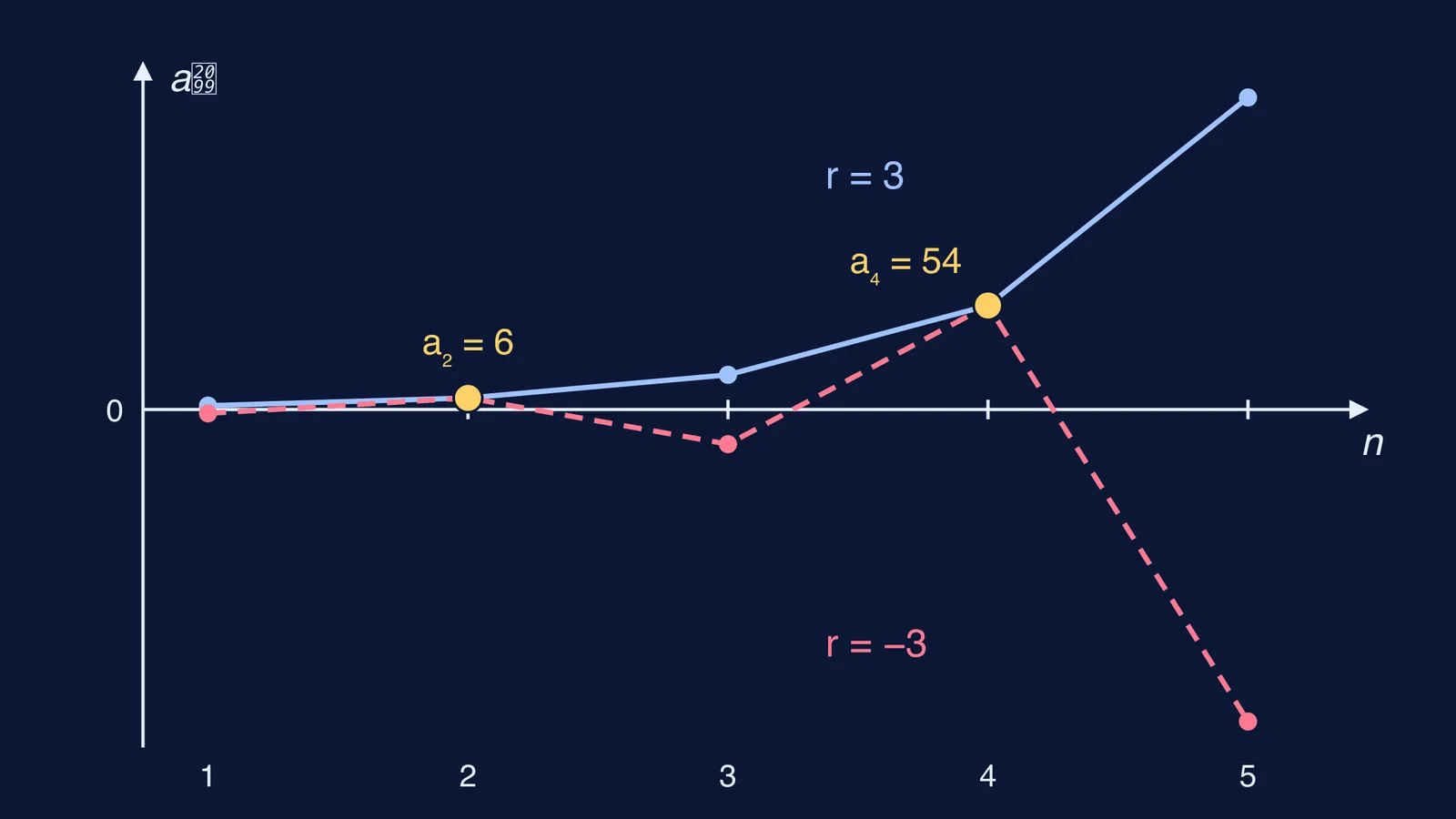
Worked example 2. The 2nd term of a GP is 6 and the 4th term is 54. Find the 5th term.
Divide: r^2 = 54 ÷ 6 = 9, so r = 3 or r = −3.
If r = 3, then a = 6 ÷ 3 = 2, and the GP is 2, 6, 18, 54, 162.
If r = −3, then a = 6 ÷ (−3) = −2, and the GP is −2, 6, −18, 54, −162.
Both fit the given terms, so the 5th term is 162 or −162.
If the question says the terms are positive, take the first. Otherwise give both. For more practice, see our walkthrough on finding a GP from two given terms.
How do you find which term of a GP is a given number?
Set the nth term equal to the number and solve for n:
Find a and r from the first two terms.
Divide the target number by a. The result must equal r^(n−1).
Write that result as a power of r, by factorising it into primes if needed.
Accept the answer only if n − 1 is a whole number, 0 or more. If r is negative, check that the sign matches too.
If no whole-number power works, the number is not a term of the GP.
Worked example 3. Which term of 2, 8, 32, ... is 131072?
Here a = 2 and r = 4. Then 4^(n−1) = 131072 ÷ 2 = 65536. Since 4^8 = 65536, n − 1 = 8 and n = 9. It is the 9th term.
Now try 1000 in the same GP. You need 4^(n−1) = 500. But 4^4 = 256 and 4^5 = 1024, and 500 sits between them, so 1000 is not a term.
Worked example 4. Is −384 a term of 3, −6, 12, ...? Is 384?
Here a = 3 and r = −2. For −384 you need (−2)^(n−1) = −128. Since (−2)^7 = −128, n = 8. For 384 you need (−2)^(n−1) = 128, but 128 is 2^7 and an odd power of −2 is negative, so 384 is not a term.
Which mistakes cost the most marks?
Using r^n instead of r^(n−1), which puts every answer one term off.
Dropping the negative root when the gap between positions is even.
Dividing the earlier term by the later one, which gives a power of 1/r instead of a power of r.
Calling a number a term without checking that n is a whole number.
If the setup keeps going wrong, work through a few problems in the Fermi Problem Library, where a step-by-step solver explains the reasoning rather than printing an answer. If the idea of a common ratio itself feels shaky, the Fermi Concept Library gives each mathematics concept its own lesson and its place in the map.
Once the nth term feels routine, the next step is adding terms up: our guide to the sum of n terms of a GP covers the cases, including r = 1.


