

On this page
When you add the terms of a geometric progression (GP), the formula you use depends on the common ratio, r. According to Wikipedia's summary of geometric progressions, while the math works out either way, picking the right version of the formula prevents algebra mistakes with negative signs.
A geometric progression is a sequence where each term is found by multiplying the previous one by a fixed number. If the first term is a, the sequence runs a, ar, ar², ar³, and so on.
How to find the sum of n terms of a GP when r is less than 1?
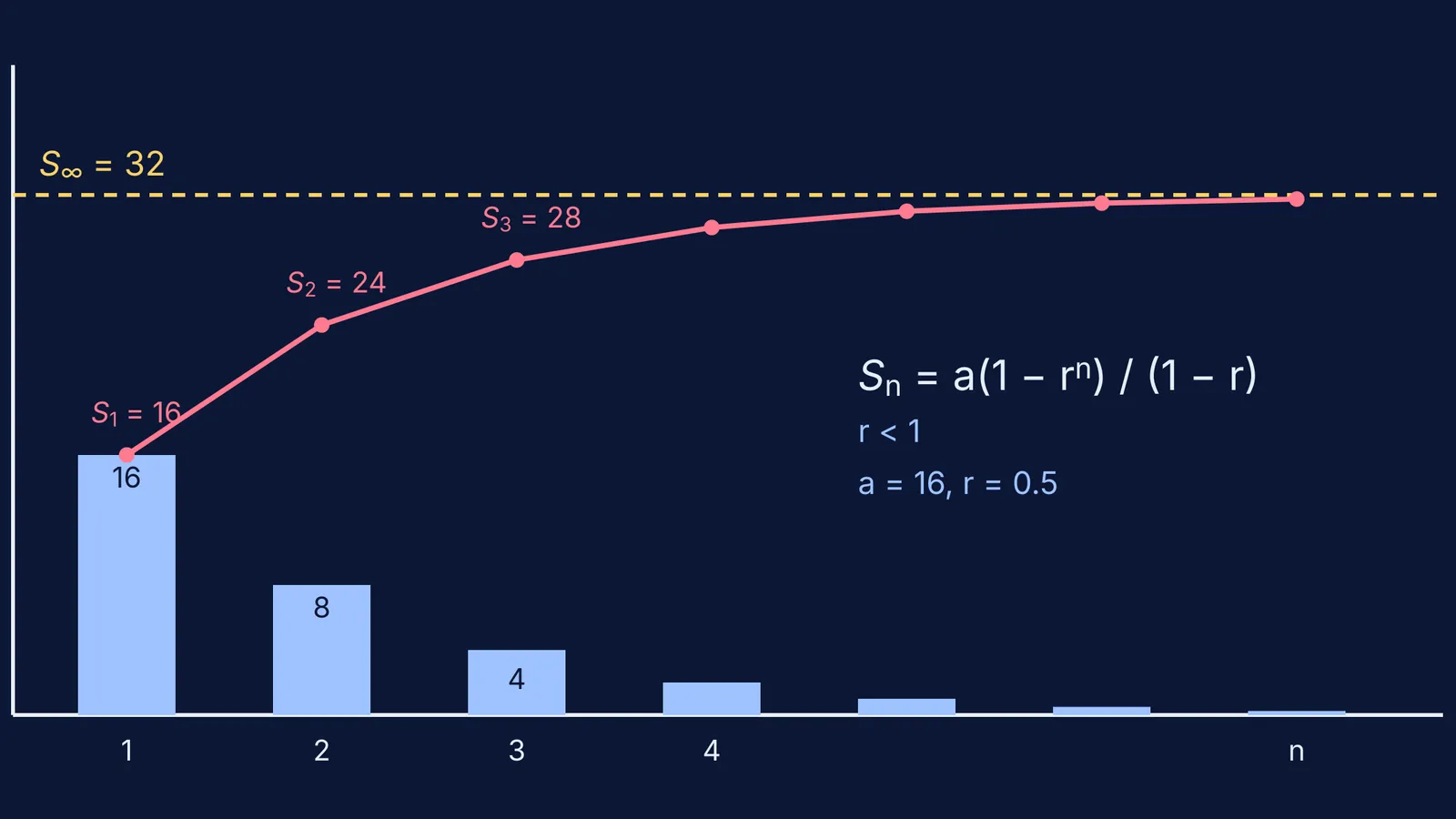
When the common ratio r is less than 1 (and not equal to 1), the standard formula to find the sum of the first n terms is:
Sₙ = a(1 − rⁿ) / (1 − r)
For example, take the series 16, 8, 4, 2, 1... Here, the first term a = 16 and the common ratio r = 0.5, which is less than 1. To find the sum of the first 6 terms:
Substitute the values into the formula: S₆ = 16(1 − 0.5⁶) / (1 − 0.5)
Calculate the powers: 0.5⁶ = 1/64, so 1 − 0.5⁶ = 63/64
Simplify the denominator: 1 − 0.5 = 0.5
Divide and multiply: S₆ = 16 × (63/64) / 0.5 = (63/4) / 0.5 = 31.5
Why do we use different formulas for r > 1 and r < 1?
You will often see two formulas for the sum of a GP:
Sₙ = a(1 − rⁿ) / (1 − r)
Sₙ = a(rⁿ − 1) / (r − 1)
Mathematically, these two are identical. If you multiply the numerator and the denominator of the first formula by -1, you get the second formula.
The reason for choosing one over the other is strictly practical: avoiding negative numbers. If r = 0.5, calculating r − 1 gives -0.5, which forces you to handle negative signs on the top and bottom. Using 1 − r instead keeps the denominator positive, which reduces the chance of making a careless error during a test. If you find yourself repeatedly dropping negative signs, the Fermi Problem Library has worked problems with a step-by-step solver that explains the reasoning rather than printing an answer.
You can read more about building these sequences in our guide to inserting arithmetic and geometric means between two numbers.
What is the sum of a GP when r = 1?
If the common ratio is exactly 1, the formulas above break down because the denominator becomes 1 − 1 = 0, which is undefined.
However, if r = 1, every term in the sequence is simply multiplied by 1. The progression becomes a, a, a, a...
Because you are just adding the number a exactly n times, the sum is simply: Sₙ = n × a
This case rarely appears as a standalone question, but it often trips students up in multiple-choice questions or when recovering aₙ from a formula for Sₙ.
How to find the number of terms from the sum of a GP?
Sometimes you are given the sum Sₙ, the first term a, and the ratio r, and you need to find the number of terms n.
Suppose a GP has a = 3, r = 3, and the sum is 120. Since r > 1, use the formula Sₙ = a(rⁿ − 1) / (r − 1):
Plug in the knowns: 120 = 3(3ⁿ − 1) / (3 − 1)
Simplify the fraction: 120 = 3(3ⁿ − 1) / 2
Multiply both sides by 2 and divide by 3: 240 / 3 = 80 = 3ⁿ − 1
Add 1 to isolate the exponential term: 81 = 3ⁿ
Express 81 as a power of 3: Since 3⁴ = 81, we know n = 4.
For more complex numbers, you might need to use logarithms to solve for n. If you are unsure how to set up the logarithm, Fermi's AI tutor can work out what you already know and build a plan for the session, walking you through the exponent rules step by step. Geometric series also model real-world phenomena; you can see similar exponential math in our post on arithmetic vs geometric growth in plants.


