

On this page
How do you find a GP when two terms are given?
A geometric progression (GP) is defined by a first term a and a constant multiplier r, called the common ratio, where each term satisfies aₖ = aₖ₋₁ × r. In the NCERT Class 11 Mathematics textbook, the general term formula is:
aₙ = a × r^(n−1)
Because this formula has two unknowns—the initial value a and the common ratio r—any two known terms form a system of simultaneous equations.
Suppose you are given an m-th term aₘ and an n-th term aₙ, with n > m. Instead of subtracting terms as in an arithmetic progression, the standard technique is division:
aₙ ÷ aₘ = (a × r^(n−1)) ÷ (a × r^(m−1)) = r^(n−m)
Dividing the higher-index term by the lower-index term cancels the first term a completely, leaving r^(n−m) = aₙ ÷ aₘ. In the CBSE Senior Secondary Mathematics curriculum (Code 041), this ratio method is fundamental before tackling sequence problems like inserting arithmetic and geometric means. Once you extract r, you substitute it back into aₘ = a × r^(m−1) to find the first term a.
How do you solve the classic 3rd and 6th term problem?
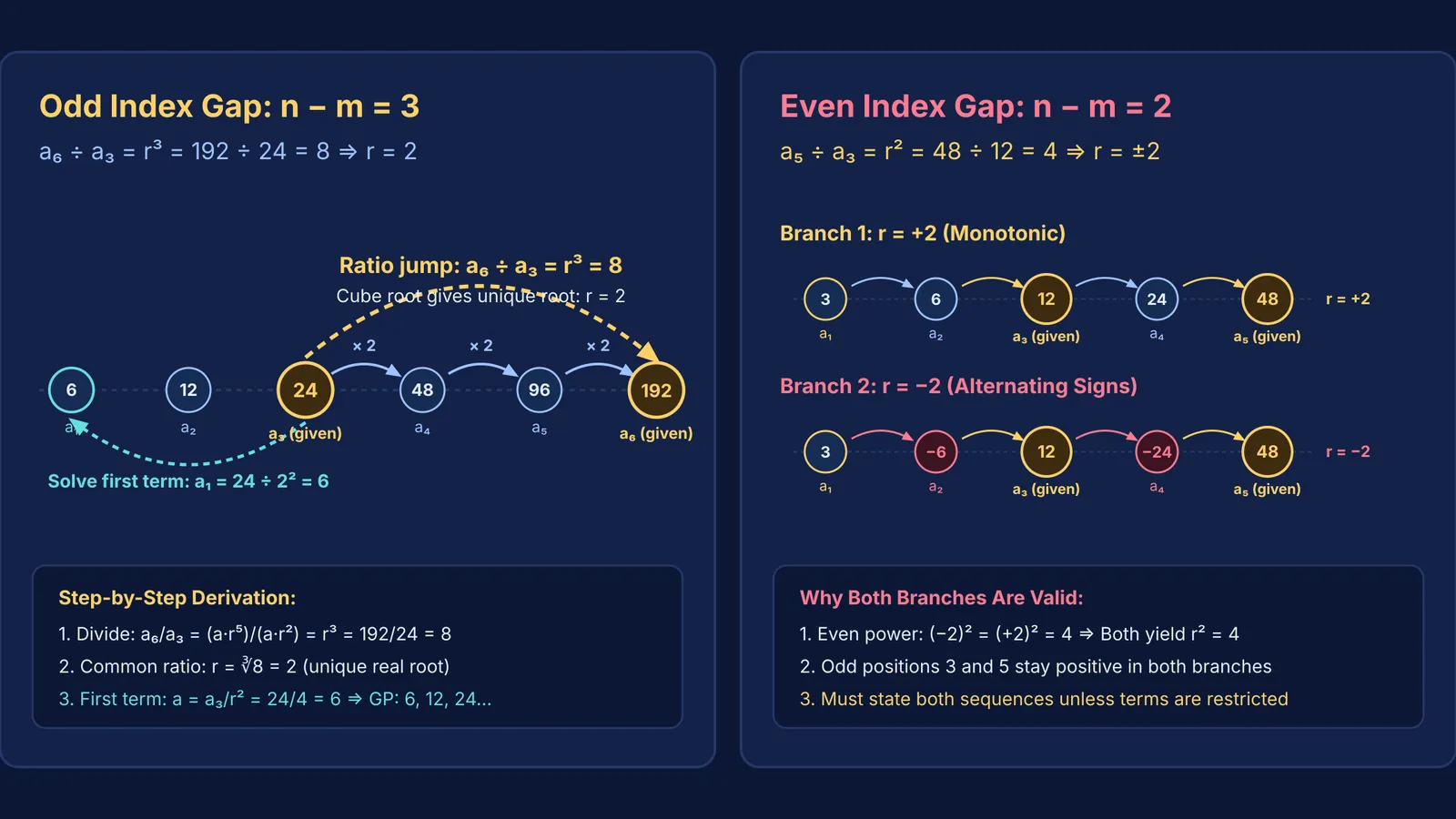
In Example 6 of the NCERT Class 11 Mathematics textbook, the 3rd term of a GP is 24 and the 6th term is 192. Applying the general term formula gives:
a₃ = a × r² = 24
a₆ = a × r⁵ = 192
To isolate r, divide the two equations:
a₆ ÷ a₃ = (a × r⁵) ÷ (a × r²) = 192 ÷ 24
This simplifies to r³ = 8. Because the exponent 3 is odd, taking the cube root gives a unique real solution: r = 2.
Substitute r = 2 into the 3rd term equation to solve for the first term a:
a × (2)² = 24 a × 4 = 24 a = 6
With a = 6 and r = 2, the progression is 6, 12, 24, 48, 96, 192, and so on. For any subsequent term, such as the 10th term, evaluate a₁₀ = a × r⁹ = 6 × 2⁹ = 6 × 512 = 3072.
For students working through multi-step algebra and series derivations, the Fermi Problem Library provides worked problems with a step-by-step solver that explains the reasoning rather than printing an answer.
Why do even index gaps require both plus and minus?
Under the NCERT Class 11 Mathematics syllabus, a common trap occurs when the index difference is an even integer. Suppose a problem gives the 3rd term as 12 and the 5th term as 48:
a₃ = a × r² = 12
a₅ = a × r⁴ = 48
Dividing the two equations yields:
r^(5−3) = r² = 48 ÷ 12 = 4
Because the exponent 2 is an even integer, r² = 4 has two real solutions: r = +2 and r = −2. Writing only r = 2 misses a valid geometric progression.
Both roots satisfy the initial values:
If r = +2, then a × (+2)² = 12 gives a = 3. The progression is 3, 6, 12, 24, 48, ...
If r = −2, then a × (−2)² = 12 gives a = 3. The progression is 3, −6, 12, −24, 48, ...
When r = −2, even-indexed terms are negative while odd-indexed terms remain positive. Because positions 3 and 5 are odd, both evaluate to +12 and +48. Unless a question explicitly restricts the sequence to positive real numbers, both branches are required. This parity rule also applies when choosing symmetric terms in an AP or GP.
What exam traps cost marks in geometric progressions?
In tests following the CBSE Senior Secondary Mathematics curriculum, sequence questions frequently test edge cases. Keeping these rules in mind protects marks:
The subtraction mistake: Subtracting a₆ − a₃ gives a(r⁵ − r²), which does not isolate r. Always divide terms in a GP.
The index-exponent mismatch: Writing the nth term as a × rⁿ instead of a × r^(n−1). The 3rd term uses r², not r³.
Imaginary ratios: If an even index gap yields a negative quotient, such as r² = −4, no real geometric progression exists.
Convergence assumptions: An infinite sum S = a ÷ (1 − r) requires |r| < 1. In progressions where |r| ≥ 1, terms grow and the series diverges, a boundary rule key to converting recurring decimals into infinite geometric series.
When you want to see how geometric progressions form the backbone of exponential functions, logarithmic scales, and discrete mathematics, the Fermi Concept Library maps every concept in physics, chemistry, biology, mathematics and computing, each with its own lesson and its place in the map.


