On this page
Proportional Reasoning-2 is Chapter 3 of Ganita Prakash Part II, NCERT's new Class 8 maths textbook (code hegp2, first edition December 2025). It continues Proportional Reasoning-1 from Part I and adds pie charts and inverse proportion. CBSE publishes no separate 2026-27 curriculum for Classes 6 to 8; they follow the NCERT book, and the chapter is assessed by the school. All examples below use our own numbers.
What is in Proportional Reasoning-2 in Class 8?
The Chapter 3 PDF runs from page 55 to page 69 in six sections:
Recap of proportionality.
Ratios in maps (the Representative Fraction, RF).
Ratios with more than two terms.
Dividing a whole in a ratio.
A Slice of the Pie: pie charts.
Inverse proportions.
Ratios of two terms come from Proportional Reasoning-1, Chapter 7 of Part I. The recap test: a : b and c : d are proportional when a × d = b × c.
How do map scales and three-term ratios work?
The book defines the RF as the ratio of a distance on the map to the matching distance on the ground. It stresses that this is geographical (straight-line) distance, not road distance (NCERT, Chapter 3).
Our example. A map has RF 1 : 25,00,000. Two towns are 7.4 cm apart on it. Ground distance = 7.4 × 25,00,000 = 1,85,00,000 cm. That is 185 km. Revise scale with our Class 6 guide to maps, scale and symbols.
A ratio can have three or more terms if every quantity changes by the same factor: a : b : c :: p : q : r means a/p = b/q = c/r.
Our example. A potting mix uses soil : compost : sand :: 7 : 3 : 1. You have 10.5 kg of compost. Compost is 3 parts, so 1 part = 10.5 ÷ 3 = 3.5 kg. Soil = 7 × 3.5 = 24.5 kg, sand = 1 × 3.5 = 3.5 kg, and the whole mix weighs 24.5 + 10.5 + 3.5 = 38.5 kg.
How do you divide a quantity in a ratio and draw a pie chart?
Splitting x as a : b : c gives a first share of x × a/(a + b + c), and so on.
Our example. Split ₹2,700 in the ratio 2 : 3 : 4. The terms add to 9, so one part is ₹300 and the shares are ₹600, ₹900 and ₹1,200.
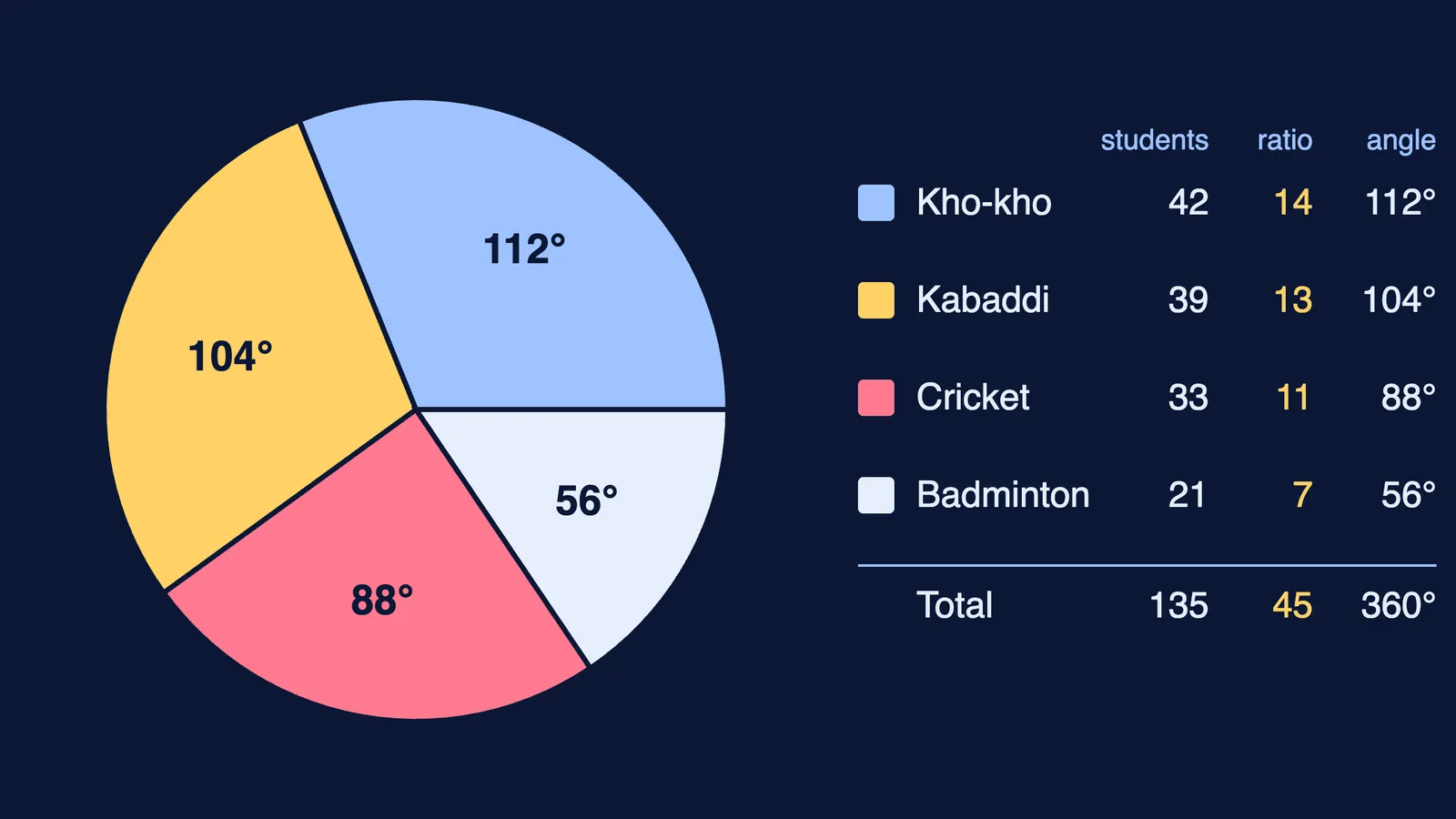
A pie chart divides 360° the same way, since each slice's angle is proportional to its count. Reduce the ratio first by dividing every term by the HCF.
Worked example (the diagram above). 135 students chose a favourite game: kho-kho 42, kabaddi 39, cricket 33, badminton 21.
HCF of the counts is 3, so the ratio is 14 : 13 : 11 : 7.
The terms add to 45, and 360° ÷ 45 = 8°.
Angles: 14 × 8 = 112°, 13 × 8 = 104°, 11 × 8 = 88°, 7 × 8 = 56°.
Check: 112 + 104 + 88 + 56 = 360°.
Draw a radius, measure 112° anticlockwise from it, then each next angle from the last line.
What is inverse proportion in Class 8 maths?
Two quantities are inversely proportional when one changes by a factor n and the other changes by 1/n, so they move in opposite directions. In symbols, xy = k for a constant k, which gives x₁y₁ = x₂y₂ (NCERT, Chapter 3).
Note: the chapter summary on page 69 writes the constant product as x₁y₁ = x₂y₂ = … = n, reusing the letter n from the factor in the line above. It is the same constant that Section 3.6 calls k.
Our example. A school trip's bus costs a fixed ₹7,020, shared equally. With 26 students, each pays ₹270. If 39 students go, each pays 7,020 ÷ 39 = ₹180.
The book also covers combined work. Our example: Meena packs a batch of parcels in 33 minutes, Ravi in 66. Together they pack 1/33 + 1/66 = 3/66 = 1/22 of the batch each minute, so they finish in 22 minutes.
To tell the two kinds apart, see our direct and inverse proportion guide for Class 8.
Practice questions
Marks are our suggestion.
(1 mark) Are 14 : 21 and 22 : 33 proportional? *Yes: both cross products are 462.*
(2 marks) On a map with RF 1 : 65,00,000, two cities are 4.4 cm apart. Find the ground distance. *286 km.*
(2 marks) Divide 196 in the ratio 2 : 5 : 7. *28, 70 and 98.*
(3 marks) A triangle's angles are in the ratio 11 : 13 : 21. Find them. *44°, 52° and 84°.*
(3 marks) 21 harvesters clear a field in 26 days. How long will 14 harvesters take? *39 days, assuming all work at the same rate.*
(2 marks) x takes 7, 13, 26 and y takes 26, 14, 7. Inverse proportion? *Yes: each product is 182.*
Not sure where to start with ratios? Fermi's AI tutor works out what you already know and builds a plan for the session.