On this page
Quadrilaterals is Chapter 4 of Ganita Prakash, Part I, NCERT's new Class 8 maths textbook (code hegp1, First Edition July 2025, reprinted January 2026), according to the book's imprint page. This guide follows the chapter PDF in its own order, with our own numbers throughout.
CBSE publishes no separate 2026-27 curriculum for Classes 6 to 8; these classes follow the NCERT book, and this chapter is assessed by the school.
What does Chapter 4 Quadrilaterals cover in Class 8 Ganita Prakash?
The chapter begins with the Latin roots of the name (quadri, four; latus, sides), then runs in this order: 4.1 rectangles and squares, 4.2 angles in a quadrilateral, 4.3 parallelograms, 4.4 rhombuses, 4.5 playing with quadrilaterals (geoboards and cardboard triangles) and 4.6 kites and trapeziums.
Properties are deduced with congruent triangles (SAS, SSS, AAS, ASA) or parallel-line angles, then checked by measuring.
How do two equal sticks make a rectangle?
Section 4.1 asks how a carpenter should join two wooden strips so their ends mark a rectangle. The book deduces: make them equal, join them at their midpoints, at any angle (NCERT chapter).
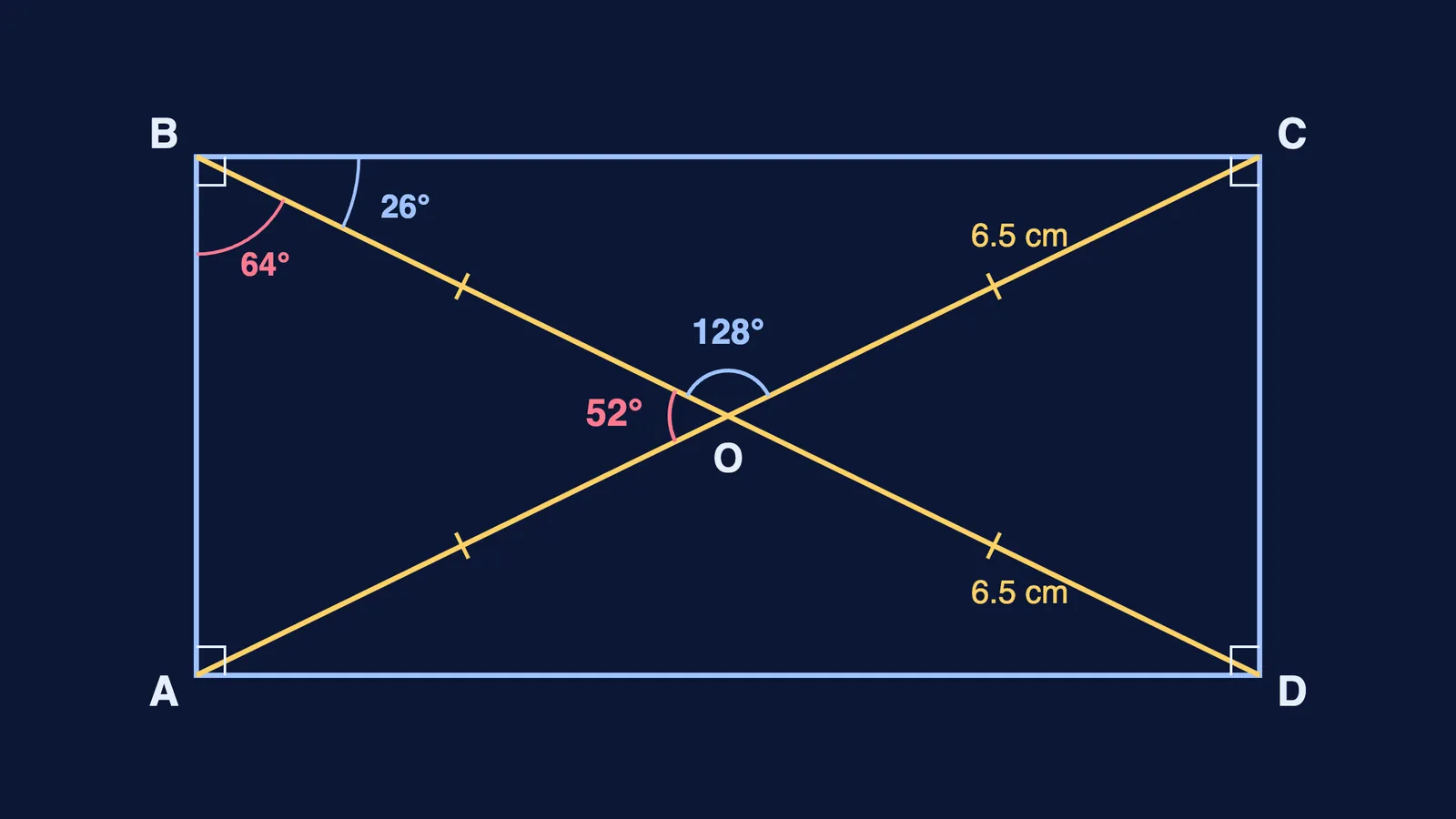
Our example (diagram above): two 13 cm sticks joined at their midpoints O, so OA = OB = OC = OD = 6.5 cm, and ∠AOB = 52°.
Triangle AOB is isosceles (OA = OB), so each base angle is (180° − 52°) ÷ 2 = 64°.
∠BOC forms a linear pair with ∠AOB, so ∠BOC = 180° − 52° = 128°.
Triangle BOC is also isosceles, so each base angle is (180° − 128°) ÷ 2 = 26°.
The corner at B is 64° + 26° = 90°. The same holds at A, C and D, so ABCD is a rectangle.
For any angle x, the corner is (90° − x/2) + x/2 = 90°. If the sticks also cross at 90°, the rectangle is a square.
Why do the angles of a quadrilateral add up to 360°?
Section 4.2 draws a diagonal, splitting the quadrilateral into two triangles, so the angles total 180° + 180° = 360° (NCERT chapter). That is why no quadrilateral can have exactly three right angles.
Example: three angles of a quadrilateral are 88°, 97° and 119°, so the fourth is 360° − 304° = 56°.
What are the properties of a parallelogram, rhombus, kite and trapezium?
From the NCERT chapter:
Rectangle: all angles 90°; opposite sides equal and parallel; diagonals equal and bisect each other.
Square: a rectangle with all sides equal; diagonals bisect each other at 90° and bisect its angles.
Parallelogram: opposite sides parallel and equal; adjacent angles add to 180°; opposite angles equal; diagonals bisect each other.
Rhombus: all sides equal; a parallelogram whose diagonals bisect each other at 90° and bisect its angles.
Kite: AB = BC and CD = DA; diagonal BD bisects the angles at B and D, and cuts AC in half at 90°.
Trapezium: one or more pairs of opposite sides parallel; co-interior angles between the parallel sides sum to 180°; in an isosceles trapezium, the angles opposite the equal sides are equal.
So every square counts as a rectangle and as a rhombus, and both of those are parallelograms; the book draws this as Venn diagrams. Our quadrilateral properties guide adds a naming test.
Angles from the properties:
A parallelogram has one angle of 57°: the angles are 57°, 123°, 57° and 123°.
A rhombus has one angle of 46°: the angles are 46°, 134°, 46° and 134°; the diagonal from a 46° corner makes 23° with each side.
An isosceles trapezium has a base angle of 58°: the angles are 58°, 58°, 122° and 122°.
Practice questions (marks are our suggestion)
(2 marks) The diagonals of rectangle WXYZ meet at O, and ∠WOX = 76°. Find ∠OWX and ∠OWZ.
(1 mark) Three angles of a quadrilateral are 93°, 101° and 118°. Find the fourth.
(2 marks) True or false, with a reason: a parallelogram with one right angle is a rectangle.
(2 marks) One angle of a rhombus is 74°. Find its other angles and the angle the diagonal from that corner makes with a side.
(3 marks) In kite ABCD, AB = BC, CD = DA, ∠B = 86° and ∠D = 62°. Show that ∠A = ∠C and find them.
(2 marks) Trapezium PQRS has PQ ∥ SR, ∠P = 67° and ∠Q = 81°. Find ∠S and ∠R.
Answers: 1) 52°, 38°. 2) 48°. 3) True: adjacent angles add to 180°, so all four are 90°. 4) 106°, 74°, 106°; 37°. 5) Triangles ABD and CBD are congruent by SSS, so ∠A = ∠C = (360° − 148°) ÷ 2 = 106°. 6) ∠S = 113°, ∠R = 99°.
How does this chapter connect to the rest of the book?
In Part I it follows A Story of Numbers, Chapter 3, and precedes Number Play (book preface).
Class 9 turns these properties into tests for a parallelogram; see our Class 9 Ganita Manjari quadrilaterals guide.
Not sure which deduction to practise first? Fermi's AI tutor works out what you already know and builds a plan for the session.