On this page
From Ideas to Startups is Chapter 6 of the new NCERT Class 9 Social Science book *Understanding Society: India and Beyond* Part II, the book introduced for 2026-27. It is the second Economics chapter, after Managing Your Personal Finances (NCERT contents page). This guide is for study, not business or investment advice.
What is entrepreneurship in Class 9 Social Science?
The chapter treats entrepreneurship as the process by which a person or a group turns a possible business idea into a working venture. It opens with a school-fair lemonade stall, since even that needs planning and learning by doing.
An entrepreneur, in the chapter's picture, does five jobs:
spots a problem and keeps at it until there is a solution
takes a risk by putting in money and time
combines the factors of production
makes the key decisions about running the business
helps society
A margin note in the chapter defines a startup as a young, early-stage company that offers a new product or service.
Which entrepreneurs does the chapter use as examples?
The case studies show that ideas need hard work and organisation (NCERT chapter):
Lijjat Papad: in 1959, seven homemakers from a Mumbai chawl started making papads with ₹80. They registered as a cooperative in 1962, where every member is an equal owner. By 2023 it had over 45,000 women members and an annual turnover of ₹1,600 crore.
Mohan Singh Oberoi: a hotel desk clerk in Shimla who in 1934 mortgaged his wife's jewellery to buy a small hotel. He received the Padma Bhushan in 2001.
The Nattukottai Chettiars of Tamil Nadu: traders and bankers known for trust-based lending and careful accounts.
The chapter also says India is the third-largest startup ecosystem in the world, with around 120 unicorns (startups valued at over 1 billion dollars) in 2025. It names Startup India as one government scheme. The official portal says Startup India was launched on 16 January 2016 and is run by a team reporting to the Department for Promotion of Industry and Internal Trade, DPIIT (Startup India).
What are the functional areas of a business?
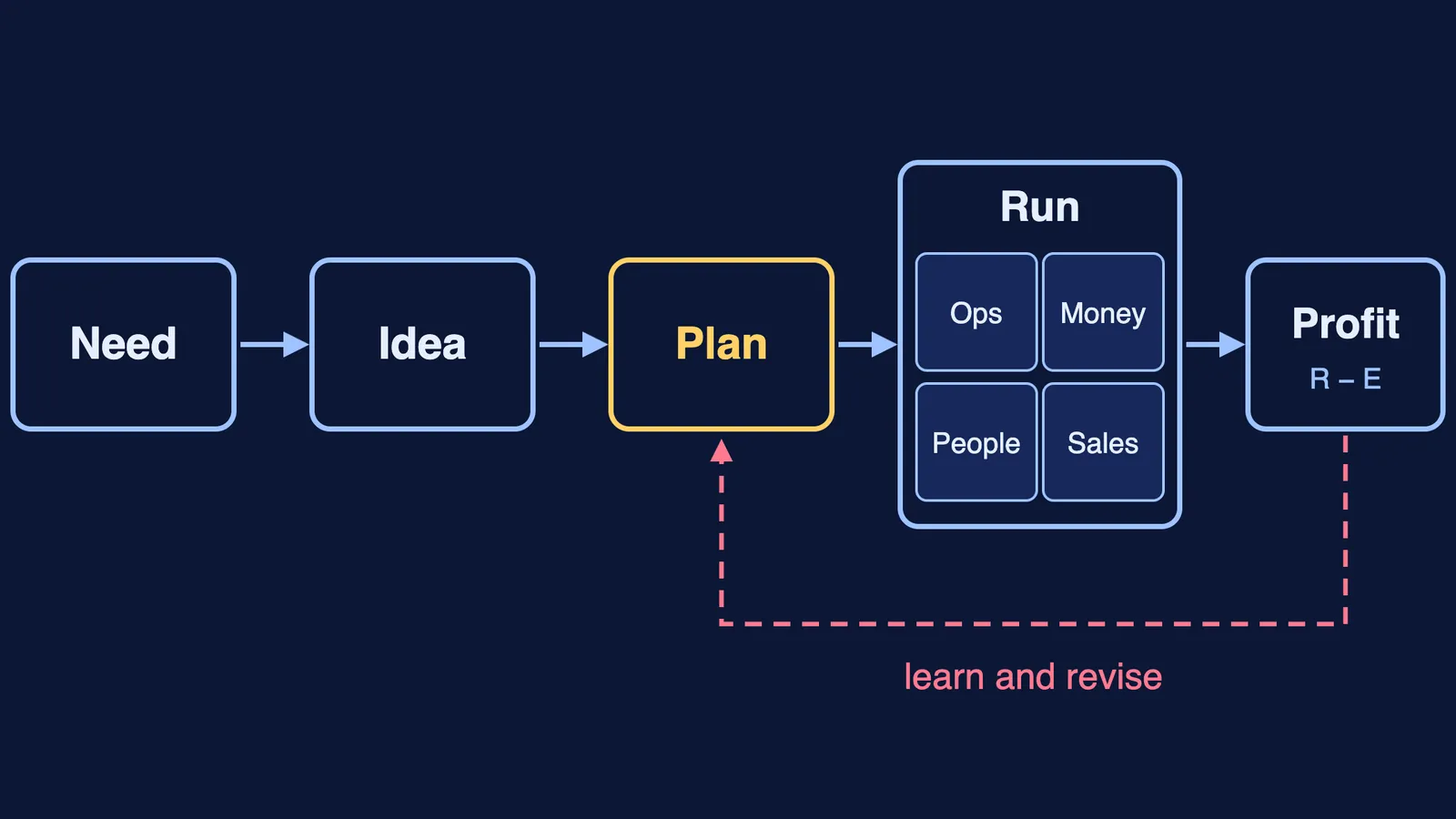
A business plan is a written roadmap of goals and the steps to reach them. Its bakery example asks about needs, customers, costs, location, staff, pricing, promotion and risks.
Those questions group into four functional areas:
Management and operations: daily running, production, quality.
Finance and accounting: planning money, recording what comes in and goes out.
Human resources: hiring, training and looking after staff.
Marketing and sales: making people aware and getting them to buy.
The key formula is Profit = Total revenue − Total expenses. A fixed cost (rent) stays the same whatever you sell; a variable cost (ingredients, packaging) rises and falls with how much you make.
Worked example: your school lemonade stall
Our own numbers. You make 100 glasses to sell at ₹10 each.
Fixed cost: stall table hire, ₹150.
Variable costs: lemons ₹200, sugar ₹80, cups ₹100. Total ₹380.
Total expenses: ₹150 + ₹380 = ₹530.
If you sell 90 glasses, revenue is ₹900 and profit is ₹900 − ₹530 = ₹370. If it rains and you sell only 40, revenue is ₹400 and you make a loss of ₹130.
If the arithmetic in profit and loss questions trips you up, the Fermi Problem Library has worked problems with a step-by-step solver that explains the reasoning rather than printing an answer.
What mistakes do students make in this chapter?
Calling every business a startup. A startup is young and offers something new.
Mixing up revenue and profit. Revenue is all the money earned from sales; profit is what is left after expenses.
Listing functional areas without linking them. Strong answers show how weak finance or poor marketing can sink a good idea.
Treating failure only as a loss. The chapter presents an honest failure as a source of lessons for the next attempt.
How should you prepare for CBSE 2026-27?
CBSE gives the theme From Ideas to Startups 8 teaching hours in the Class IX Social Science curriculum 2026-27. Its outline also lists creative destruction, Make in India, Digital India and MSMEs, which the chapter text does not cover, so ask your teacher how deep to go. CBSE says the course structure will come later, so no chapter marks are published yet; check the CBSE curriculum page before exams.
Practice with your own idea:
Name one problem you see at school every week and who faces it.
Write a two-line business idea that solves it.
List one fixed and two variable costs, and find the profit at two sales levels.
To see where start-up money comes from in more detail, read our guide to owner's and borrowed funds in Class 11 business studies. Later, you might weigh how to choose between a startup and a big company for a first job.