On this page
Managing Your Personal Finances is Chapter 5 of the new NCERT Class 9 Social Science book *Understanding Society: India and Beyond* Part II, introduced for 2026-27. It opens the Economics section of Part II (NCERT contents page). This guide explains ideas only; it is not financial advice.
What is the Managing Your Personal Finances chapter about?
The chapter defines personal finance as planning and managing your own money to meet needs and wants. It builds on five pillars:
Income: salary, business profit, rent, interest or dividends.
Budgeting: planning in advance how income is split.
Saving: keeping money aside for later or emergencies.
Investing: putting savings into assets that earn a return.
Protection: insurance and careful borrowing.
It then covers EMIs, the link between risk and return, and personal income tax.
How do you make a simple budget?
The chapter's method has four steps: list your expenses, set a savings goal with an amount and a date, track what you actually spend, and review the plan when things change.
A worked example with our own numbers. Meera gets ₹800 a month. She wants a ₹960 geometry and art kit in six months, so she must save ₹960 ÷ 6 = ₹160 a month. She saves that first, on the day the money arrives:
Savings: ₹160
Needs (bus fare ₹300, stationery ₹140): ₹440
Wants (snacks, a comic): ₹200
Total: ₹160 + ₹440 + ₹200 = ₹800. If bus fares rise, step four applies: she trims wants, not needs (see our guide to needs, wants and the problem of choice).
What is the difference between simple and compound interest?
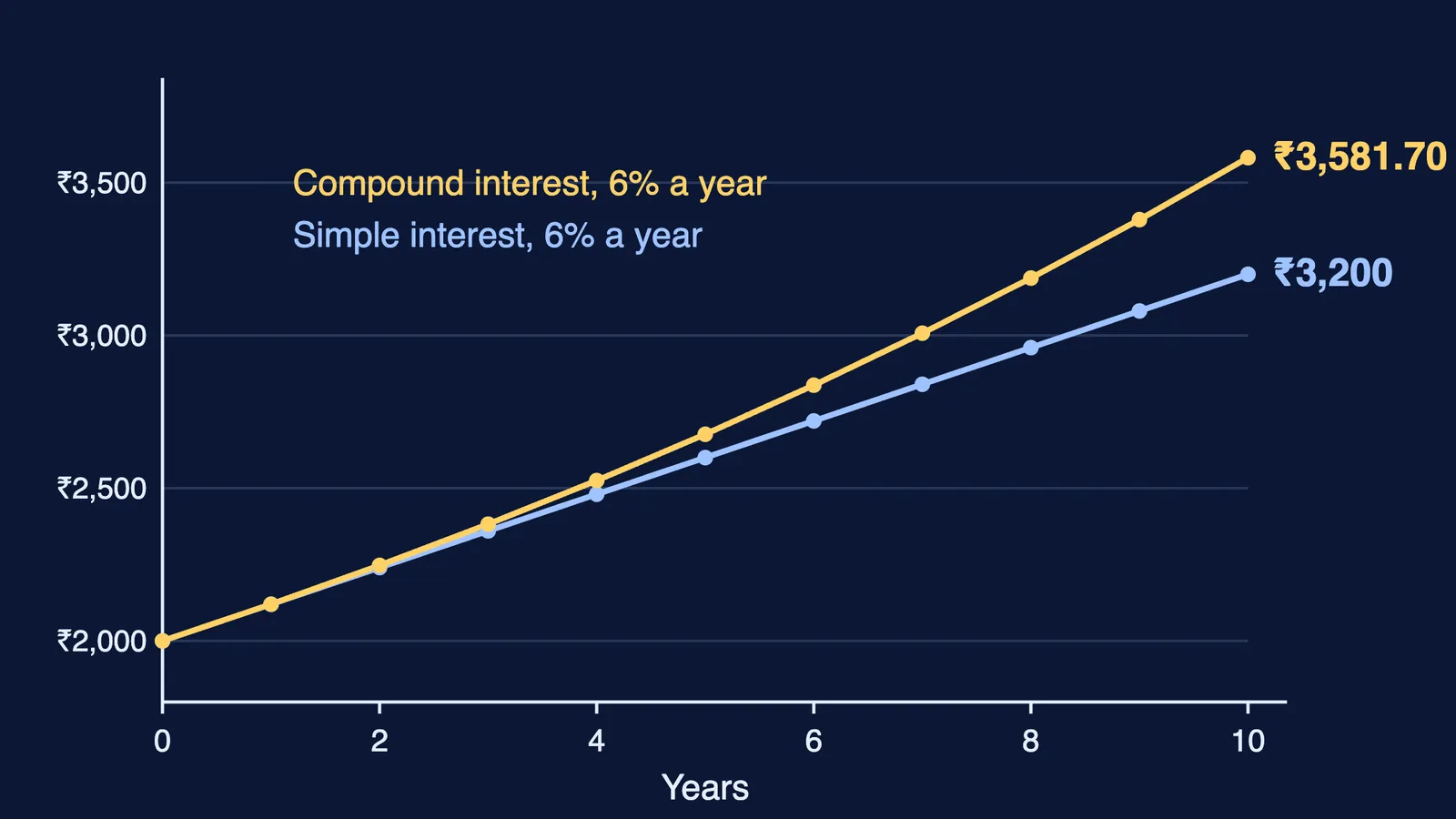
The chapter explains compounding; CBSE adds simple interest. Simple interest is paid on the original sum (the principal) only, so it adds the same amount each year. Compound interest is paid on the principal plus interest already earned, so each year's interest is bigger than the last.
Take ₹2,000 at 6% a year for three years (our numbers):
Simple: 2,000 × 6/100 × 3 = ₹360 interest, so you end with ₹2,360.
Compound: year 1: ₹2,120; year 2: ₹2,247.20; year 3: ₹2,382.03. That is A = P(1 + r)ⁿ = 2,000 × 1.06³.
The gap is only ₹22.03 after three years, but after ten years it is ₹3,581.70 against ₹3,200, as the diagram above shows. Time does most of the work. For a related question, see how many years money takes to double at simple interest.
Inflation is the general rise in prices over time, which means the same rupee buys less. India's official inflation target is 4% (consumer prices), with a band of 2% to 6%, set by the Central Government in consultation with the RBI (Reserve Bank of India). If a ₹250 book rises 4% in a year, it costs ₹260, and ₹250 in a drawer no longer buys it.
If formulas like A = P(1 + r)ⁿ trip you up, the Fermi Problem Library has worked problems with a step-by-step solver that explains the reasoning rather than printing an answer.
How do savings, investments, insurance and tax fit together?
The chapter compares fixed deposits, bonds, shares and mutual funds using four factors: risk (the chance of losing money), return (what you earn), time horizon (how long the money can stay put) and liquidity (how quickly it turns back into cash). Its main idea is a trade-off: lower risk usually comes with lower return, and higher possible returns come with higher risk. The chapter says choices should match a person's goals, risk tolerance and when they need the money.
Insurance shares risk: many people pay premiums into a pool that pays those who suffer a covered loss. Borrowing helps for productive purposes, like an education loan; borrowing for unnecessary goods can become a debt burden.
Income tax in India is progressive: income is split into slabs, and higher slabs are taxed at higher rates. Taxes pay for public services, which links to our explainer on where each rupee of the Union Budget comes from and goes.
What mistakes do students make in this chapter?
Treating saving and investing as the same. Saving sets money aside; investing puts it to work for a return.
Using the compound formula for simple interest. Check which one the question asks for.
Writing r as 6 instead of 0.06 in A = P(1 + r)ⁿ.
Applying the top slab rate to the whole income. Each slab rate applies only to the part of income inside that slab.
How should you prepare for CBSE 2026-27?
CBSE lists this theme as Smart Ways to Manage Your Finances, with 6 hours of teaching, covering inflation, simple vs compound interest, budgeting, savings and investment options, risk and insurance, and personal income tax (CBSE Class IX Social Science curriculum 2026-27). It says the course structure will be provided shortly, so there are no chapter-wise marks yet; check the CBSE curriculum page before exams.
Try this: ₹5,000 at 10% a year for 2 years. Find the simple interest, the compound amount, and the difference. (Answer: ₹1,000 simple interest; compound amount ₹6,050; difference ₹50.)