

On this page
Trigonometry is the language we use to describe waves, orbits, and alternating current. But its most common function, the sine, owes its name to a linguistic accident. It began as a practical Indian geometry term that was translated phonetically into Arabic, misread centuries later, and finally turned into a Latin word for a fold in a garment.
What did Aryabhata mean by ardhajya?
In 499 CE, the Indian mathematician and astronomer Aryabhata completed the *Aryabhatiya*. To solve problems in astronomy, he needed a way to relate the angles of a circle to straight-line lengths.
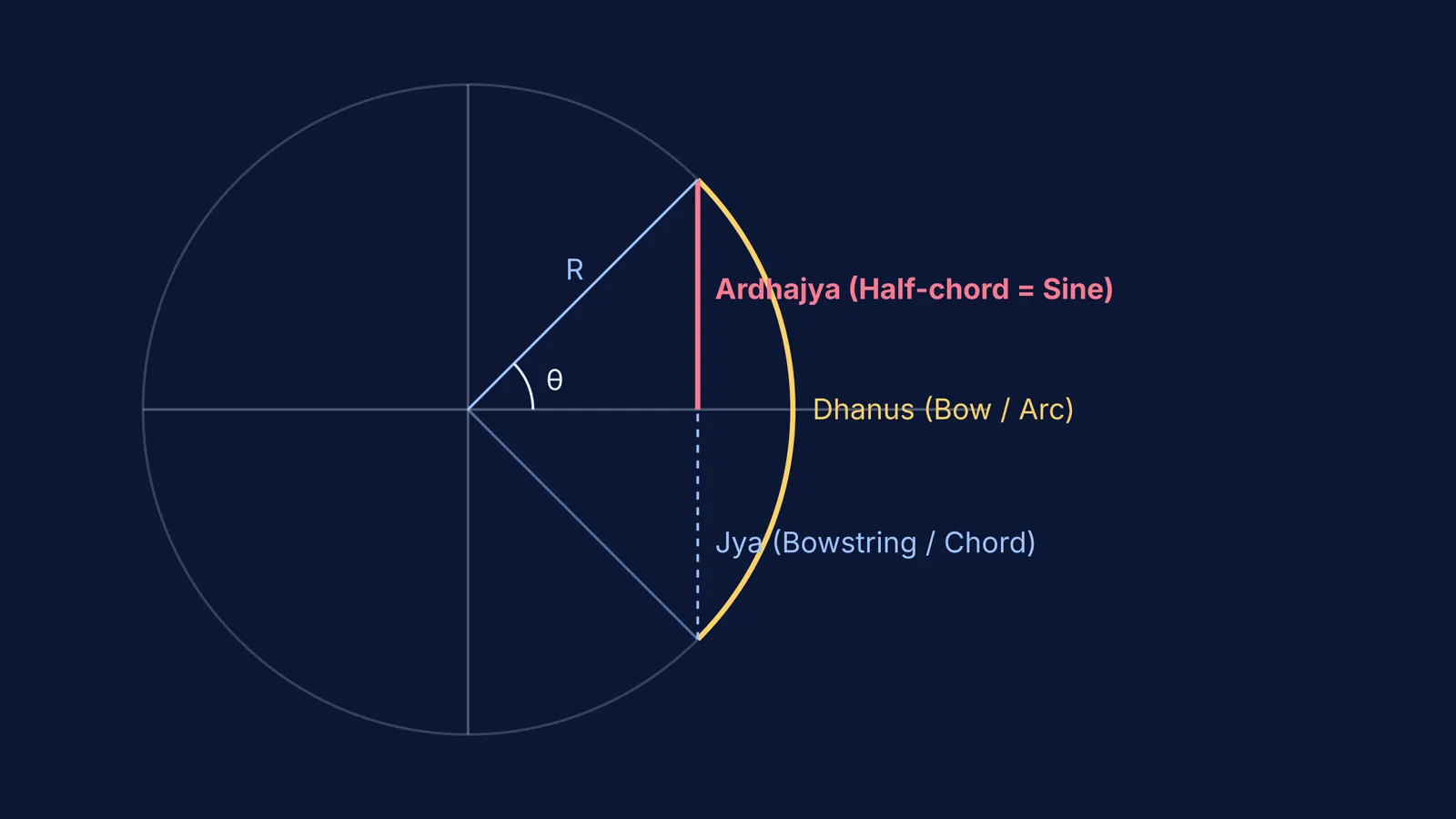
He pictured a circle as a drawn bow. An arc of the circle is the bow itself (*dhanus*). The straight line connecting the two ends of the arc is the bowstring, or *jya*. If you draw a perpendicular line from the center of the bowstring to the arc, you divide the string in half. Aryabhata called this half-chord the *ardhajya*, where *ardha* means half. Over time, Indian mathematicians shortened *ardhajya* to just *jya* or its synonym *jiva*.
If you are trying to picture how a chord relates to modern right-angled triangles, the Fermi Simulation Lab contains interactive simulations for the ideas that are easier to see than to read, connecting these circle properties directly to the y/r ratio you use in school today.
How did a bowstring become a sine?
The transformation of the word happened in three steps as mathematics crossed borders, according to the MacTutor History of Mathematics.
In the 8th century, Indian astronomical texts were brought to Baghdad and translated into Arabic. The translators phonetically wrote the Sanskrit *jiva* as *jiba* (جيب). In Arabic, *jiba* had no meaning of its own; it was just a technical loanword.
Because Arabic script often omits short vowels, the word was written simply with the consonants *jb*. Centuries later, when scholars from Al-Andalus and Europe read these texts, they did not know the Sanskrit origin. They read *jb* as the common Arabic word *jaib*, which means a bay, a cove, or the fold of a garment at the chest.
When European authors translated Arabic mathematical works into Latin, they translated the word *jaib* literally into the Latin word for a fold: *sinus*. In particular, Fibonacci's use of the term encouraged its universal adoption.
This Latin word eventually entered English as *sine*. The original geometric meaning—a bowstring—was completely lost.
How did Aryabhata's sine table work?
Aryabhata did not just name the function; he computed its values. The *Aryabhatiya* contains the first known table of sines in history, covering angles from 0° to 90° in steps of 3° 45' (or 225 arcminutes), as detailed in a 2023 analysis.
Unlike the modern sine, which is a ratio between 0 and 1, Aryabhata's sines were actual lengths. He chose a specific circle to work with: one where the radius R is exactly 3,438 units. He did this because a circle's circumference is 2πR. If you divide a circle into 21,600 arcminutes (360 × 60), setting R = 3438 makes the circumference nearly 21,600 units long (since 2 × 3.1416 × 3438 ≈ 21600).
This brilliant choice meant that for very small angles, the length of the arc and the length of the sine were practically the same number.
This focus on differences anticipated the calculus of finite differences by a thousand years. Other Indian mathematicians would later refine these tables. For instance, Parameshvara and the eclipse records that corrected Kerala's tables built on this trigonometric foundation to predict celestial events with astonishing accuracy.
How can you use this history?
When you first learn trigonometry, SOH CAH TOA (Sine is Opposite over Hypotenuse) feels like an arbitrary rule to memorize. Knowing that a sine is simply half of a bowstring gives it a physical shape. It connects the abstraction on the page to a real, drawn circle.
If you struggle to remember trigonometric identities, try stepping back to the geometry they come from. Fermi's AI tutor teaches these concepts by starting with the visual foundation—drawing the figure and showing how the ratios change as the angle grows—so you can see why the formulas must be true instead of just memorizing them. Understanding the geometric shapes that earlier mathematicians like Baudhayana and the rule of the diagonal worked with makes the equations feel inevitable. For a practical study habit, whenever you encounter a new trigonometry formula, try drawing it inside a circle before you plug in the numbers. Visualising the *jya* and the *ardhajya* directly on the paper can often reveal the answer faster than algebraic manipulation.


