On this page
Astronomy in India is Chapter 5 of NCERT's Knowledge Traditions and Practices of India textbook for Class 11 (Reprint 2026-27). Here are its marks, worked calendar and tithi examples, and practice questions.
How many marks is Astronomy in India in the CBSE KTPI exam?
The CBSE KTPI curriculum for 2026-27 orders chapters differently from the NCERT book, but the match here is direct: curriculum Chapter 1, "Astronomy in India", is NCERT Chapter 5.
Astronomy in India gets 25 periods, a 19% weightage and 13 of the 70 theory marks. Four other Class 11 chapters are for internal assessment only, which is worth 30 marks (project 20, portfolio 5, viva 5).
No cuts are listed, so read the whole text. Its learning outcomes stress reading a Panchangam, spotting nakshatras in the sky and comparing the 12 rashis with European zodiac signs. Class 11 has no CBSE sample paper, so our mark labels are a suggestion.
How does the Indian calendar keep lunar months in step with the Sun?
The NCERT chapter calls the Hindu calendar luni-solar: lunar months fix festivals, solar months run daily life. Key terms:
Rashi: one of 12 zodiacal constellations on a belt the book puts at around 8 degrees wide on both sides of the ecliptic.
Sankranti: the Sun's entry into a rashi; a solar month runs Sankranti to Sankranti, 29 to 32 days.
Nakshatra: one of 27 or 28 stars marking the Moon's place, since the Moon circles the earth against the stars in 27.3 days.
Paksha: the dark and bright halves of a lunar month, 15 days each.
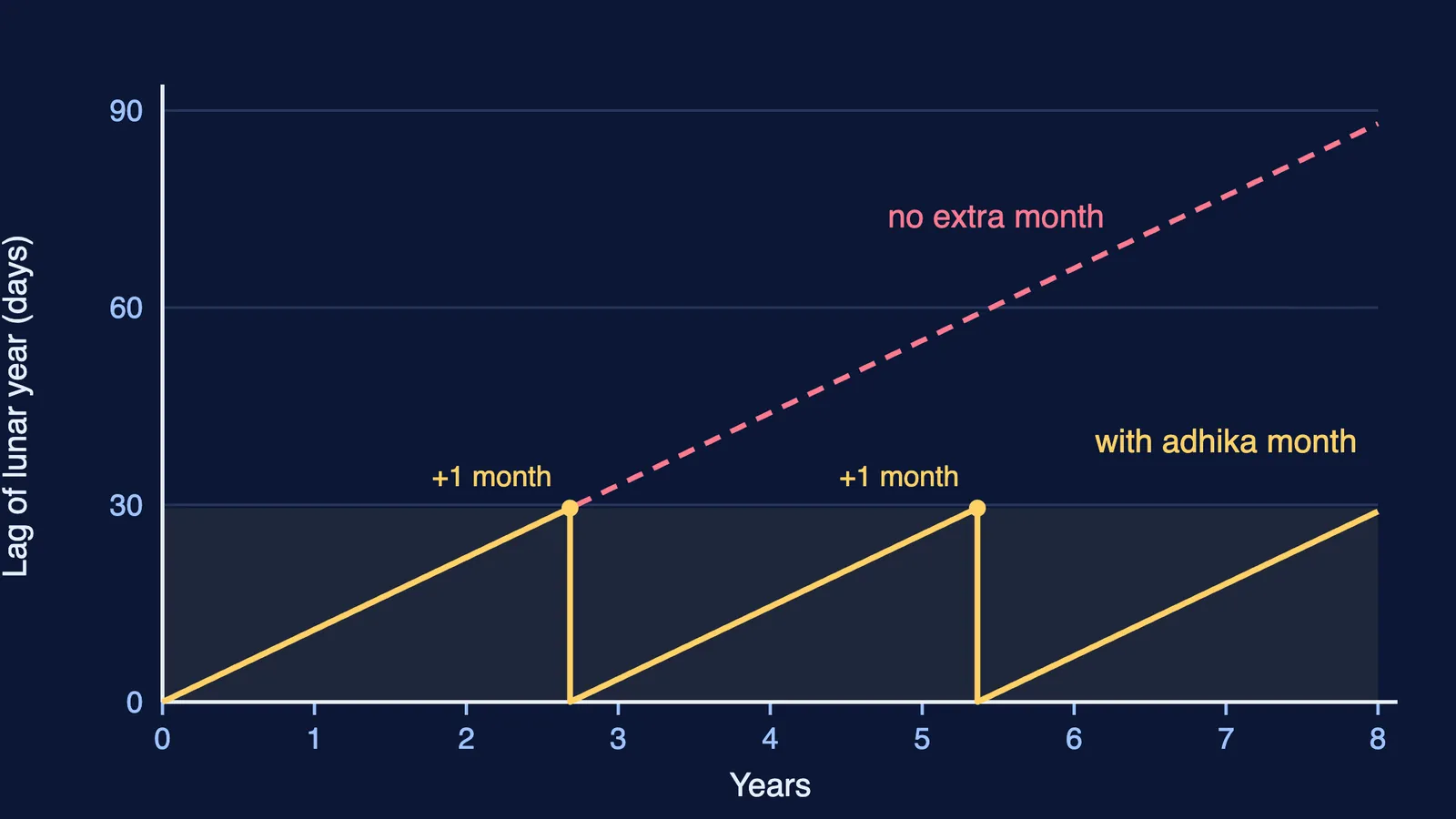
The book gives a solar year of about 365.25 days and a lunar year of about 354 days. An 11-day yearly gap makes up a 29.5-day month in 29.5 ÷ 11 ≈ 2.7 years, so an extra month, the adhika masa, is added about every three years.
The hero graph shows this: without an extra month the lag keeps growing; with one, it never passes a month. For an older scheme, read about Lagadha's Vedanga Jyotisha calendar.
What is a tithi, and why do some festivals fall on two days?
Per the NCERT chapter, a new tithi begins each time the Sun-Moon angle seen from the earth grows by 12 degrees, giving 30 tithis. Because the orbits are elliptic, a tithi lasts 19 to 26 hours.
Worked example 1 (our numbers): the Moon is 100 degrees ahead of the Sun. 100 ÷ 12 = 8.33, so eight tithis are complete and the ninth is running.
Worked example 2 (our numbers, sunrise always 6:00 AM): tithi 7 runs 25 hours, from 5:30 AM on day 1 to 6:30 AM on day 2; tithi 8 then runs 20 hours, to 2:30 AM on day 3.
Sunrise, day 1: tithi 7.
Sunrise, day 2: still tithi 7.
Sunrise, day 3: tithi 9.
One school keeps the sunrise tithi all day, so tithi 7 repeats and tithi 8 is skipped; the other counts the change during the day. The book says this is why a festival can land on two days.
Why do eclipses happen only on full moon or new moon days?
The NCERT chapter explains that the Moon's orbital plane is tilted to the earth's. The planes cross along the line of nodes, and an eclipse needs the Moon at a node so the three bodies line up. The nodes were named Rahu and Ketu.
Uttarayana and Dakshinayana describe the yearly north-south drift of the sunrise point. The book says precession has shifted Uttarayana from around 14 January some 2,000 years ago to around 23 December; the winter solstice usually falls on 21 or 22 December. Varahamihira is credited with a precession rate of 50.32 seconds of arc a year: 3600 ÷ 50.32 ≈ 71.5 years per degree.
Which astronomers and observatories does the chapter cover?
From the NCERT chapter:
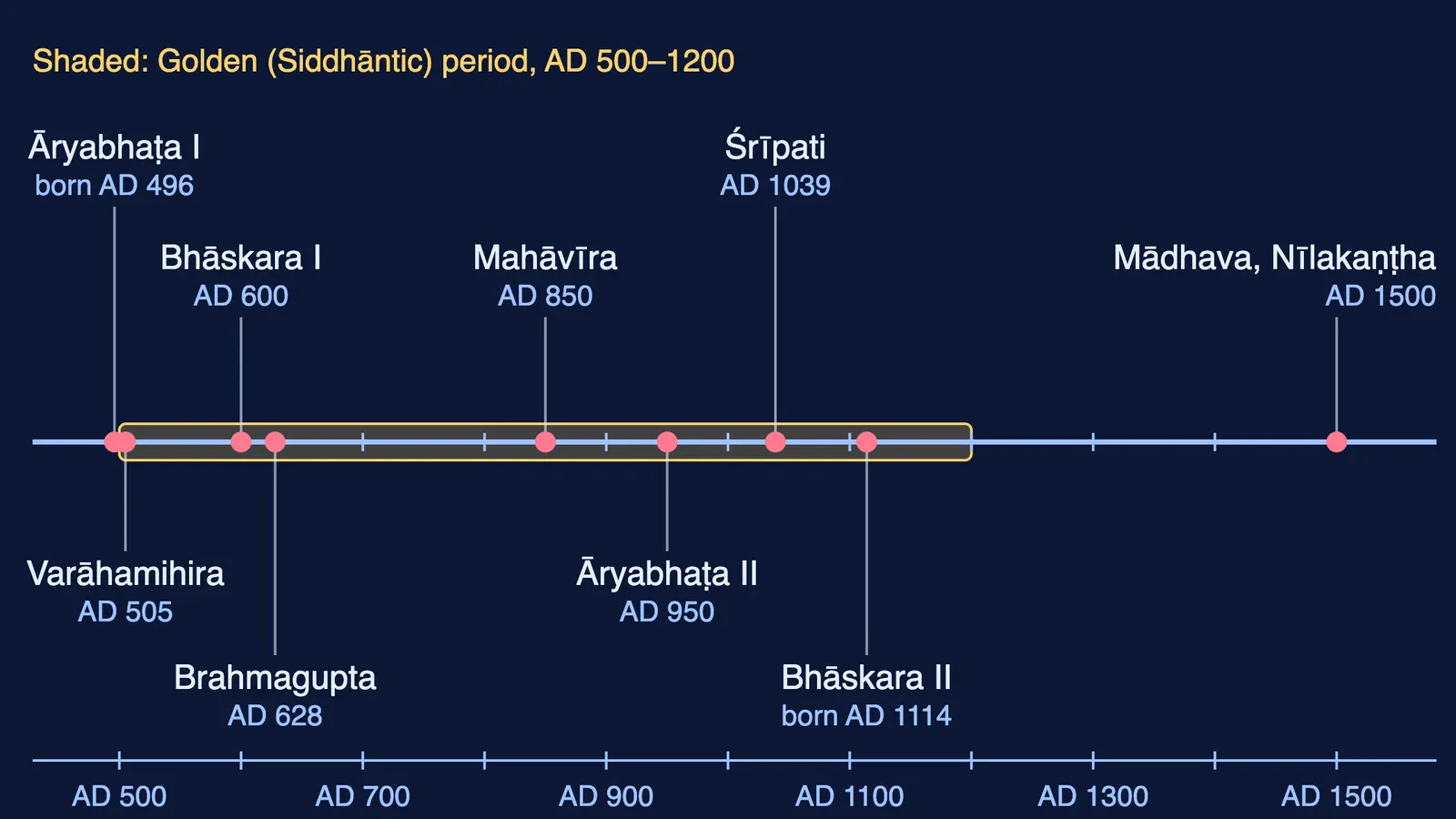
Aryabhata: celestial sphere, a rotating spherical earth, letters for large numbers, the adhika masa scheme; see our post on Aryabhata's Aryabhatiya.
Varahamihira: Pancasiddhantika, compiling five systems.
Bhaskara I (born 600 CE): a circle for zero.
Brahmagupta (7th century CE): zero as a number.
Bhaskara II (1114–1185 CE): headed the Ujjain observatory.
Kerala School (14th–16th century): Parameshvara's heliocentric idea, developed by Nilakantha around 1500 CE; sine and cosine series.
Jantar Mantar (1723–1735): Sawai Jai Singh's five observatories; see Jai Singh II's Jantar Mantar.
Modern India: GMRT near Pune (30 dishes, each 45 m), the 3.6 m Devasthal Optical Telescope, TMT, LIGO and SKA.
Practice questions (marks are our suggestion)
(1 mark) By how many degrees does the Sun-Moon angle change in one tithi?
(2 marks) The Moon is 150 degrees ahead of the Sun. Which tithi is running?
(2 marks) Why do festivals change season in a calendar with no extra month?
(5 marks) Tithi 3 starts at 5:00 AM and lasts 26 hours; tithi 4 lasts 19 hours. Sunrise is 6:00 AM. Give the sunrise tithi on each of the three days, then which tithi the sunrise school repeats and which it skips.
(5 marks) Using the line of nodes, explain why a solar eclipse does not happen at every new moon.
Stuck on tithi sums? Fermi's AI tutor works out what you already know and builds a plan for the session.