On this page
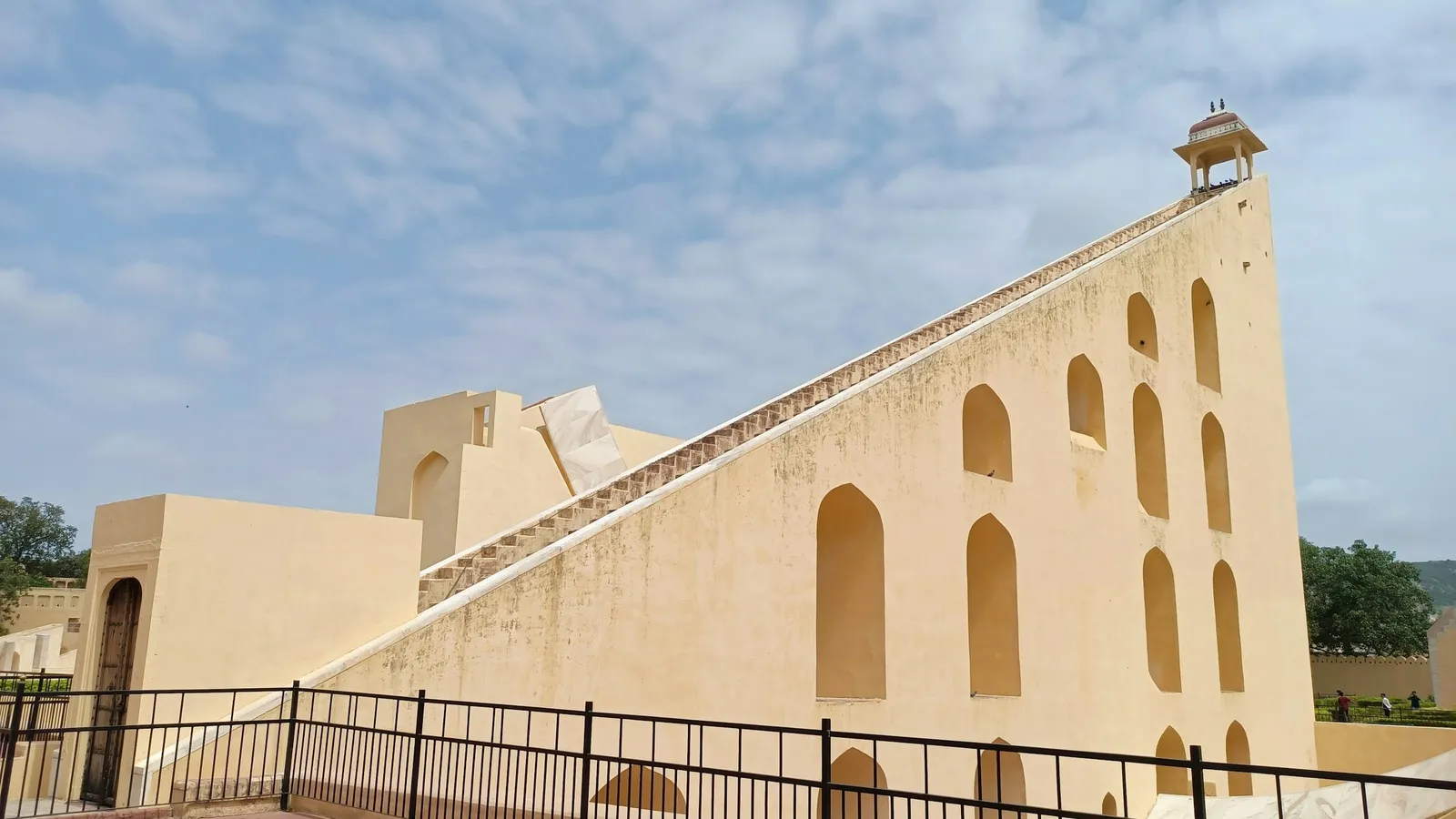
Walk into Jantar Mantar in Jaipur and you see staircases that lead nowhere, curved walls and bowls sunk into the ground. They are astronomical instruments, built of stone in the early 18th century by Sawai Jai Singh II. This post explains why he built them that way, how precise they were, and how to convert their time readings into angles, the same conversion you use for the Earth's rotation in geography and physics.
Who was Sawai Jai Singh II?
Virendra Nath Sharma, who studied the instruments on site in 1981-82, summarises his life in a review for an International Astronomical Union colloquium. Jai Singh (1688-1743) built observatories at Delhi, Jaipur, Varanasi, Ujjain and Mathura. He had his astronomers prepare new tables, the Zij-i Muhammad Shahi, completed between 1727 and 1735 and dedicated to the emperor Muhammad Shah. The tables open by describing their revision as a task which "since Mirza Ulugh Beg, no one had paid attention to". He also collected books, had texts translated into Sanskrit, and in 1727-28 sent a delegation to Europe that reached Portugal in January 1729.
Why build in stone instead of brass?
Sharma reports that Jai Singh first worked with brass instruments of the Persian-Arabic tradition and was disappointed: their axes wore down, shifting the centre and the planes of reference. He switched to stone and masonry instruments of his own design. An eyewitness wrote that the Raja prepared the models with his own hands. Altogether he built 13 types of instrument, from a few centimetres to 24 metres high.
Size buys precision. A scale on a huge instrument has its degrees spread far apart, so small angles can be read by eye.
What is at Jantar Mantar, Jaipur?
UNESCO's listing, inscribed in 2010, describes "a set of some 20 main fixed instruments", "designed for the observation of astronomical positions with the naked eye", some of them "the largest ever built in their categories". It calls the site the most significant and best preserved of India's historic observatories, and lists its coordinates as N26 55 29, E75 49 30.
They include twelve sundials called Rasivalaya. A 2025 study in the Journal of Astronomical History and Heritage found that, unlike an ordinary sundial whose gnomon points to the north celestial pole, each of these points to the pole of the ecliptic, so the set can follow the Sun, Moon and planets along the zodiac.
How precise were the instruments?
Sharma ranks the Samrat Yantra, a giant sundial, and the Sasthamsa among the high-precision instruments. The Jaipur Samrat was designed to measure time to ±2 seconds and declination to ±1 minute of arc. Because of construction defects, he found its actual time accuracy ranges from ±10 to ±90 seconds depending on which part of the scale is used. The Sasthamsa, he reports, still keeps its intended accuracy of ±1′.
Worked example: turning time into angle
The sky turns once in about 24 hours, so:
360° ÷ 24 h = 15° per hour.
15° per hour = 15 × 60′ ÷ 60 min = 15′ per minute of time.
15′ per minute = 15 × 60″ ÷ 60 s = 15″ per second of time.
Now apply it:
The design accuracy of ±2 s is 2 × 15″ = ±30″, half a minute of arc.
The worst real accuracy of ±90 s is 90 × 15″ = 1350″ = 22.5′, about two-thirds of the full Moon's width of 31.6′ given in the NASA Moon fact sheet.
And the tilt of an ordinary sundial's gnomon: it must point at the celestial pole, and the pole's height above the horizon equals your latitude. At Jaipur, latitude 26°55′ from the UNESCO coordinates, the gnomon must rise at about 26.9° to the horizontal. In Chennai it would be much flatter, in Srinagar much steeper.
Which mistakes does this help you avoid?
Mixing minutes of time and minutes of arc. Both are called minutes. Write ′ for arc and "min" for time.
Reading a sundial as clock time. A sundial shows local solar time, which differs from your time zone's clock time.
Using the same gnomon angle everywhere. The angle depends on latitude, which is why each observatory had to be laid out for its own city.
Did Jai Singh know about the telescope?
Yes. Sharma quotes the Zij-i Muhammad Shahi describing what a telescope shows, including that Saturn appears oval. But Jai Singh did not build his programme around it, and Sharma concludes that he "remained medieval, in the tradition of Ulugh Beg". Our post on Ulugh Beg's Samarkand observatory covers the tradition he looked back to.
What can a student learn from Jai Singh?
He tested his tools, found that brass wore out, and redesigned rather than accepting the errors. Sharma's own fieldwork, measuring how precise each instrument really is, is the other half of the lesson: an instrument is only as good as its measured uncertainty.
If converting between angle and time still feels slippery, the Fermi Concept Library covers every concept in physics and mathematics, including angular measure.
Try it now: find your city's latitude and work out the gnomon angle a sundial would need there.