On this page
Any calendar that follows both the Moon and the seasons has a problem. A lunar month, from new moon to new moon, averages 29.53059 days, according to NASA's eclipse website. The cycle of the seasons lasts about 365.2422 days, according to the US Naval Observatory. So twelve lunar months fall about 11 days short of a year.
The Vedanga Jyotisha, credited to Lagadha, is one of the oldest Indian answers to that problem. Subhash Kak calls it "the earliest astronomical text from India" in his Encyclopedia of India entry on the Vedanga Jyotisha.
What is the Vedanga Jyotisha?
In his survey of early Indian astronomy, Kak describes jyotisha as "the science of light and astronomy" (Kak, Birth and Early Development of Indian Astronomy). The Vedanga Jyotisha skips the planets, Kak notes, because "its concern is only the motions of the sun and the moon related to fixing the calendar".
The text survives in two versions, one attached to the Rigveda and one to the Yajurveda, and the Yajurveda version has eight extra verses (Wikipedia's summary of the text and its scholarship).
When was the Vedanga Jyotisha written?
Nobody knows. The text places the winter solstice at the start of the nakshatra Shravishtha (also called Dhanishtha) and the summer solstice at the middle of Ashlesha. Because the solstices slowly shift against the stars, you can work out when the sky looked like that: about 1370 BCE, in Sastry's 1985 calculation as quoted in Kak's survey. Kak's encyclopedia entry gives an internal date of about 1350 BCE.
But an old observation does not prove an old book. Kak himself warns that such dates "do not imply that the texts come from the corresponding period". The Sanskrit scholar Michael Witzel dates the composition to the last centuries BCE on grounds of style (Wikipedia). A 2025 note by Jaidev Dasgupta argues that earlier attempts overlooked the text's mathematics, and so dated it to a time before that mathematics was feasible (Dasgupta, arXiv). A fair summary: the sky it describes is old, and the surviving words may be much younger.
How did Lagadha's five-year calendar work?
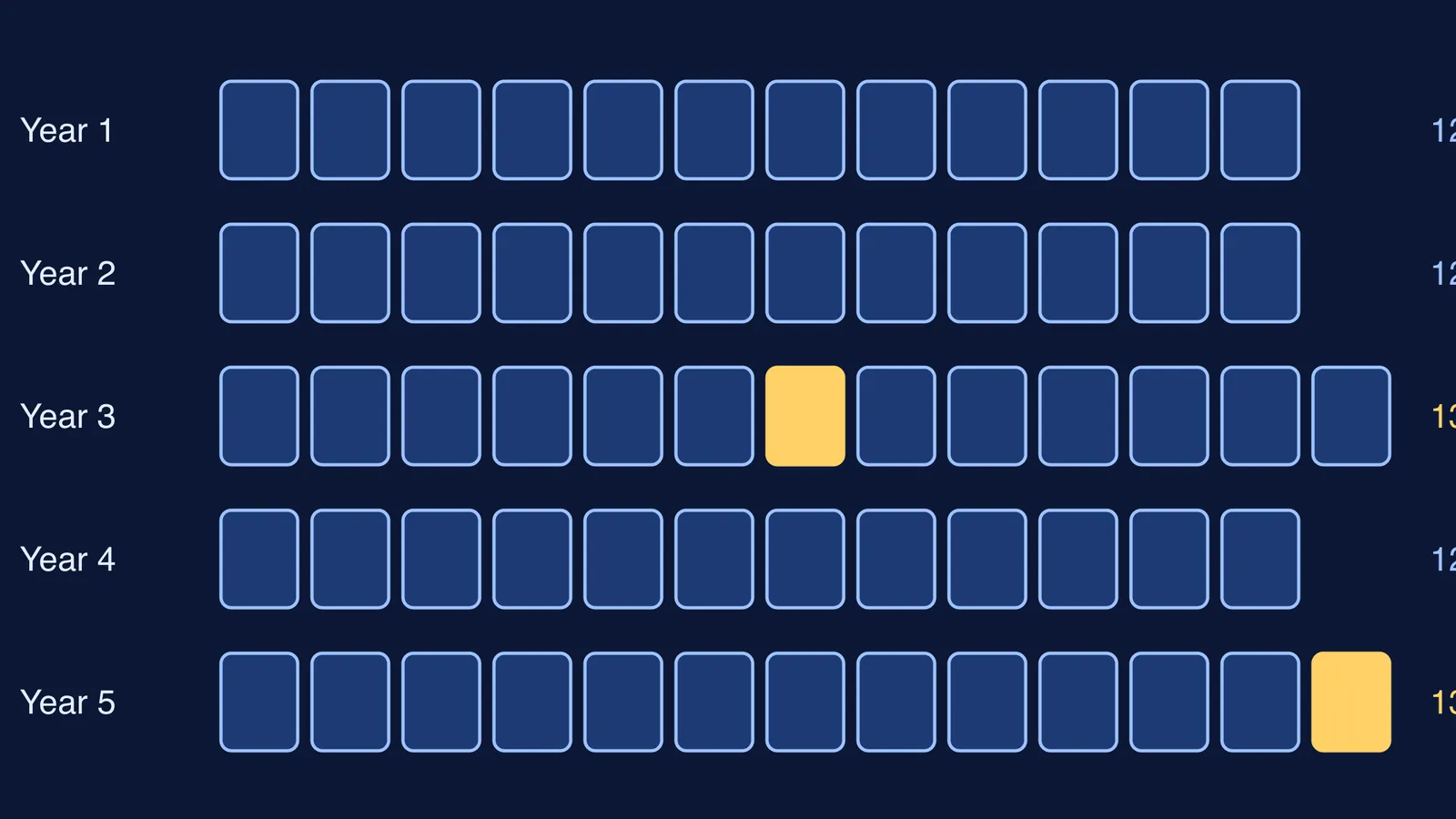
The calendar runs on a yuga, a cycle of five years. One yuga holds 1,830 civil days and 62 lunar months, according to Kak's Encyclopedia of India entry.
1,830 days divided by 5 gives a year of 366 days, as Kak's entry notes.
Five years of 12 months make 60 months, so 2 extra months are needed. They are added after every 30 months, in years 3 and 5 (Wikipedia). The idea was older than the text: Kak notes that Vedic ritual already spoke of a thirteenth month "interposed twice in five years to bring the lunar year in harmony with the solar year" (Kak, arXiv).
Each lunar month is split into 30 tithis, so a yuga has 62 x 30 = 1,860 tithis but only 1,830 days. To keep the two counts together, one tithi is dropped every 61 days (Wikipedia).
Time within a day was measured with a water clock, in nadikas of one sixtieth of a day (Kak's entry).
Its ratio of longest to shortest day, 3:2, fits northwestern India, Kak argues in the same entry.
How accurate was the Vedanga Jyotisha?
You can test it with two modern numbers: a lunar month of 29.53059 days (NASA) and a year of 365.2422 days (US Naval Observatory).
Months: 62 x 29.53059 = 1,830.90 days. Lagadha's 1,830 is less than one day off over five years.
Years: 5 x 365.2422 = 1,826.21 days. Lagadha's 1,830 is about 3.8 days too long per cycle.
Drift: 3.8 divided by 5 is about 0.76 days a year. After 40 years (8 cycles) the calendar would run about 30 days ahead of the seasons unless someone reset it by watching the sky.
So the yuga tracks the Moon closely and the Sun less so. Kak's entry also flags the gap, noting that the correct count for five years is 1,826 days.
What can you learn from Lagadha's method?
Use this checklist on any calendar or cycle:
Write the claim as numbers: days, months and years per cycle.
Look up modern values from a named source.
Find the error per cycle.
Turn it into error per year, then years to drift a whole month.
Ask which body the author tracked more carefully.
It is the same habit that saves marks in physics and maths: compare with a known value and ask whether the error makes sense. If the Moon's phases are hard to picture, the Fermi Simulation Lab has interactive simulations for ideas that are easier to see than to read. If a multi-step calculation like the drift above trips you up, the Fermi Problem Library has worked problems with a step-by-step solver that explains the reasoning.
Next, read about Aryabhata's Aryabhatiya and its spinning Earth, Varahamihira's Pancha Siddhantika and how Guo Shoujing measured the year in 1281.