

On this page
When Kublai Khan established the Yuan dynasty, the official calendar was drifting out of step with the seasons. In 1276, the imperial court commissioned astronomer and engineer Guo Shoujing to overhaul China's timekeeping. Rather than adjusting older cyclical tables, Guo anchored his reform in empirical measurement, building on the observational traditions that produced Su Song's water-driven astronomical clock tower. Completed in 1280 and adopted in 1281, Guo's Shoushi calendar fixed the tropical year at 365.2425 days. This value is identical to the year length adopted three centuries later by the European Gregorian calendar in 1582, as recorded in the MacTutor History of Mathematics Archive.
Why did the Yuan Dynasty need a new calendar in 1276?
An accurate calendar was essential for imperial legitimacy, agricultural planting, and predicting celestial phenomena. By 1276, earlier calendars that assumed a 365.25-day year had drifted significantly against the solar cycle. To rebuild the system from direct observations, Guo organized a network of 27 astronomical stations spanning from latitude 15°N to 65°N, as documented by the UNESCO World Heritage Centre. The central observations took place at the Gaocheng Astronomical Observatory in Henan province. The primary objective was measuring the tropical year: the exact duration between consecutive winter solstices.
How did Guo Shoujing eliminate the gnomon penumbra?
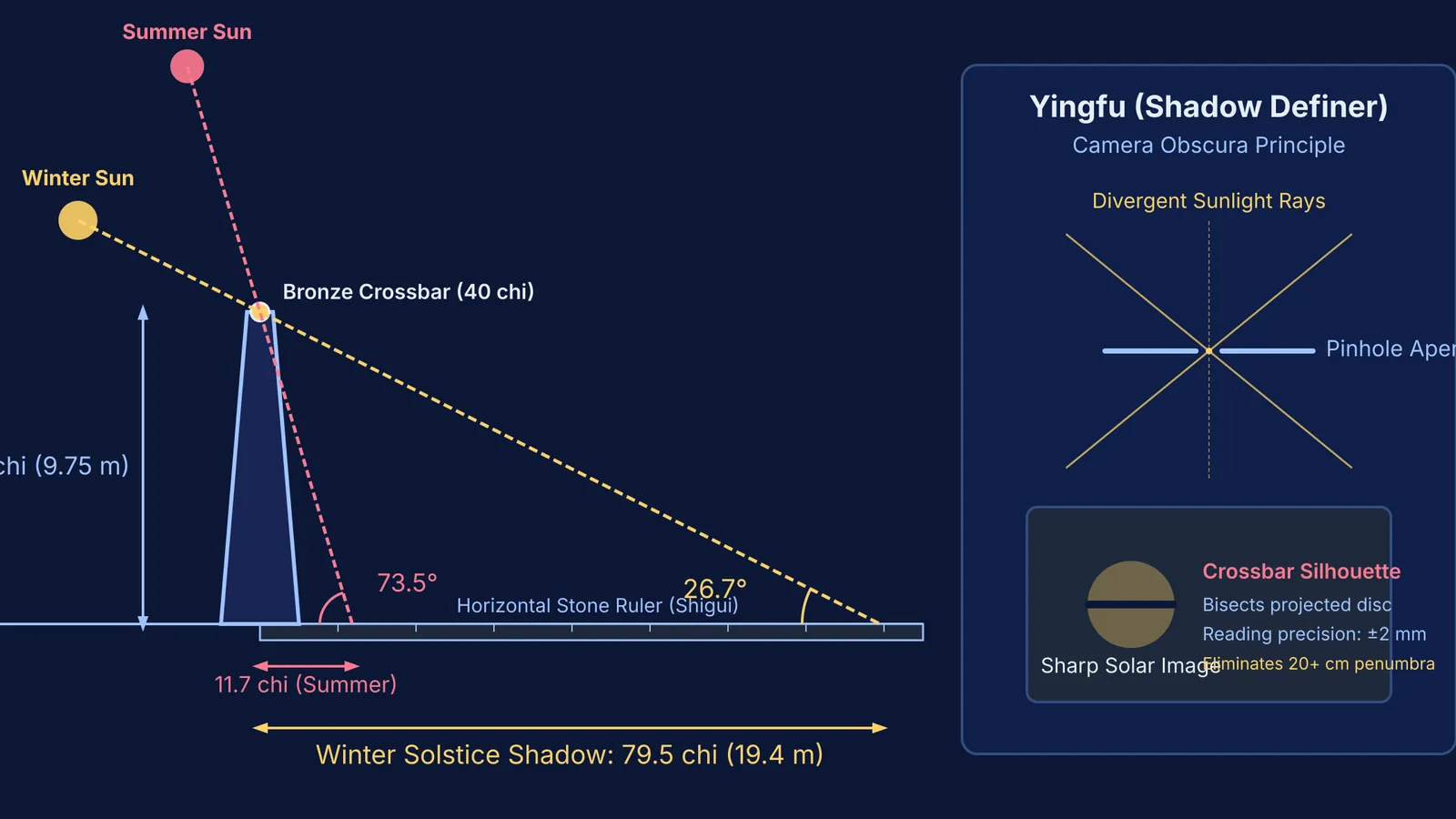
Traditional Chinese astronomers used an 8-chi (roughly 2 metres) gnomon to measure midday shadows. To improve precision, Guo built a 40-chi (approximately 9.75 metres) high gnomon at Gaocheng and Beijing, casting shadows onto a 31.19-metre horizontal stone ruler called the *Shigui*, recorded by the UNESCO World Heritage Centre.
At local noon on the winter solstice in Beijing (latitude ~39.9°N), the solar elevation drops to 26.7°. For a 40-chi vertical gnomon, this produced a shadow of roughly 79.8 chi (about 19.5 metres). However, because the Sun has an angular diameter of roughly 0.53°, light rays from opposite edges of the solar disc diverged. Across the 22-metre optical path from the crossbar to the ground, this spread created a fuzzy penumbra roughly 20 centimetres wide perpendicular to the beam, making naked-eye alignment impossible.
Guo solved this by inventing the *Yingfu* (Shadow Definer): a copper plate with a pinhole that slid along the stone ruler. Using pinhole camera optics, sunlight passing through the aperture projected a sharp, inverted image of the Sun, as detailed in the MacTutor History of Mathematics Archive. A horizontal bronze crossbar at the top of the tower cast a distinct shadow line directly across this projected circle, cutting reading uncertainty to within 2 millimetres.
How was the solstice time calculated using cubic interpolation?
Because the true astronomical solstice rarely coincides with midday, Guo recorded shadow lengths across consecutive days before and after the solstice between 1277 and 1280, producing solar observation records later analyzed in F. Richard Stephenson's historical astronomical research.
Plotting shadow lengths over time produces a parabolic curve near the solstice. Guo applied *zhao cha fa*—a third-order finite difference interpolation method—to determine the exact moment of the solstice to within minutes, as explained by the MacTutor History of Mathematics Archive. To refine the year length to four decimal places, Guo compared his solstices against verified records dating back over 800 years. Dividing the elapsed days by the elapsed years produced 365.2425 days. Similar long-baseline observations were later used across Asia to correct theoretical tables, such as Parameshvara's eclipse observations in Kerala and Samanta Chandrasekhar's naked-eye instruments.
Why is 365.2425 days such a remarkably accurate year length?
Modern orbital astronomy places the mean tropical year around epoch J2000 at 365.24219 days. Guo's value of 365.2425 days differs by just 0.00031 days—roughly 26.8 seconds per year—as noted in the MacTutor History of Mathematics Archive and documented at the UNESCO World Heritage Centre.
Over a 1,000-year period, this difference creates a stark contrast:
The Julian calendar (365.25 days) drifts by 7.81 days every 1,000 years (1 day every 128 years).
The Shoushi and Gregorian calendars (365.2425 days) drift by only 0.31 days every 1,000 years (1 day every 3,226 years).
Guo also recognized that the year length slowly contracts over millennia, incorporating a decrease of 0.0001 days per century (*xiao zhang fa*), documented by the MacTutor History of Mathematics Archive. Consequently, the Shoushi calendar governed Chinese timekeeping for 364 years without modification.
When students study coordinate geometry, solar angles, and optics, seeing the physics visually makes abstract equations concrete. For difficult-to-picture concepts in celestial motion, the Fermi Simulation Lab provides interactive simulations for ideas that are easier to see than to read. When tackling polynomial interpolation and spherical trigonometry, the Fermi Problem Library features worked problems with a step-by-step solver that explains the reasoning rather than printing an answer. For a complete view of how physics and mathematics link together, learners can explore the Fermi Concept Library, where every concept has its own lesson.


