On this page
Many Indian students know Aryabhata as the name on India's first satellite. Fewer have read what he actually wrote. His one surviving book, the Aryabhatiya, is short enough to read in an afternoon in translation, and several of its verses connect straight to school mathematics and science. This post goes through what the text says, checks one of its numbers, and draws out how he worked.
Who was Aryabhata?
Most of what we know comes from the book itself. In one verse he writes that when 3,600 years of the current age had passed, "twenty-three years of my life had passed". Walter Eugene Clark, whose 1930 English translation The Aryabhatiya of Aryabhata is free online, explains that this gives 499 CE as the date of the work. The MacTutor biography from the University of St Andrews therefore gives his birth year as 476, and says he worked at Kusumapura, thought to be near Pataliputra (modern Patna), then capital of the Gupta empire. His birthplace is uncertain; historians have proposed places from Kerala to Bengal.
MacTutor describes the Aryabhatiya as an astronomical treatise of 118 verses: a 10-verse introduction, 33 verses on mathematics, 25 on the reckoning of time and planetary models, and 50 on the sphere and eclipses. The rules come in compressed verse, without proofs.
How does the Aryabhatiya use place value?
The second verse of the mathematics section, in Clark's translation, lists the names eka (one), dasa (ten), sata (hundred), sahasra (thousand) and so on up to vrnda (a thousand million), and says they "are from place to place each ten times the preceding". That is the rule behind the number system you use every day: a digit is worth ten times more for each place it moves to the left.
Aryabhata also invented an alphabetic notation for large numbers, giving values to consonants. MacTutor quotes the historian Georges Ifrah's argument that this, and his methods for square and cube roots, would have been impossible without place value and zero. The verses do not show a symbol for zero, so this is an inference by historians, not a statement in the text.
What value of pi did Aryabhata give?
Verse 10 of the mathematics section reads, in Clark's translation: "Add 4 to 100, multiply by 8, and add 62,000. The result is approximately the circumference of a circle of which the diameter is 20,000."
Work it through:
100 + 4 = 104
104 × 8 = 832
832 + 62,000 = 62,832
So a circle of diameter 20,000 has a circumference of about 62,832, and the ratio is 62,832 ÷ 20,000 = 3.1416. The modern value is 3.14159265..., so his figure is too large by about 0.0000073, an error of roughly 2 parts in a million. Notice the word "approximately": he presented the value as an approximation. MacTutor notes that in practice he often used √10, about 3.162, instead, and that how he arrived at 3.1416 is still debated.
Did Aryabhata say the Earth rotates?
Verse 9 of the section on the sphere reads: "As a man in a boat going forward sees a stationary object moving backward just so at Lanka a man sees the stationary asterisms moving backward (westward) in a straight line." Lanka is a reference point on the equator in Indian astronomy, and asterisms are star groups. Clark comments that the natural reading is an Earth that rotates eastward under fixed stars, and that a later commentator who argued otherwise misrepresented Aryabhata. MacTutor agrees that he explained the apparent turning of the heavens by the Earth's rotation on its axis.
The text is not entirely tidy. The very next verse speaks of the circle of stars being driven westward by a wind, and commentators have argued over how the two verses fit together. Reading a primary source means living with that kind of uncertainty.
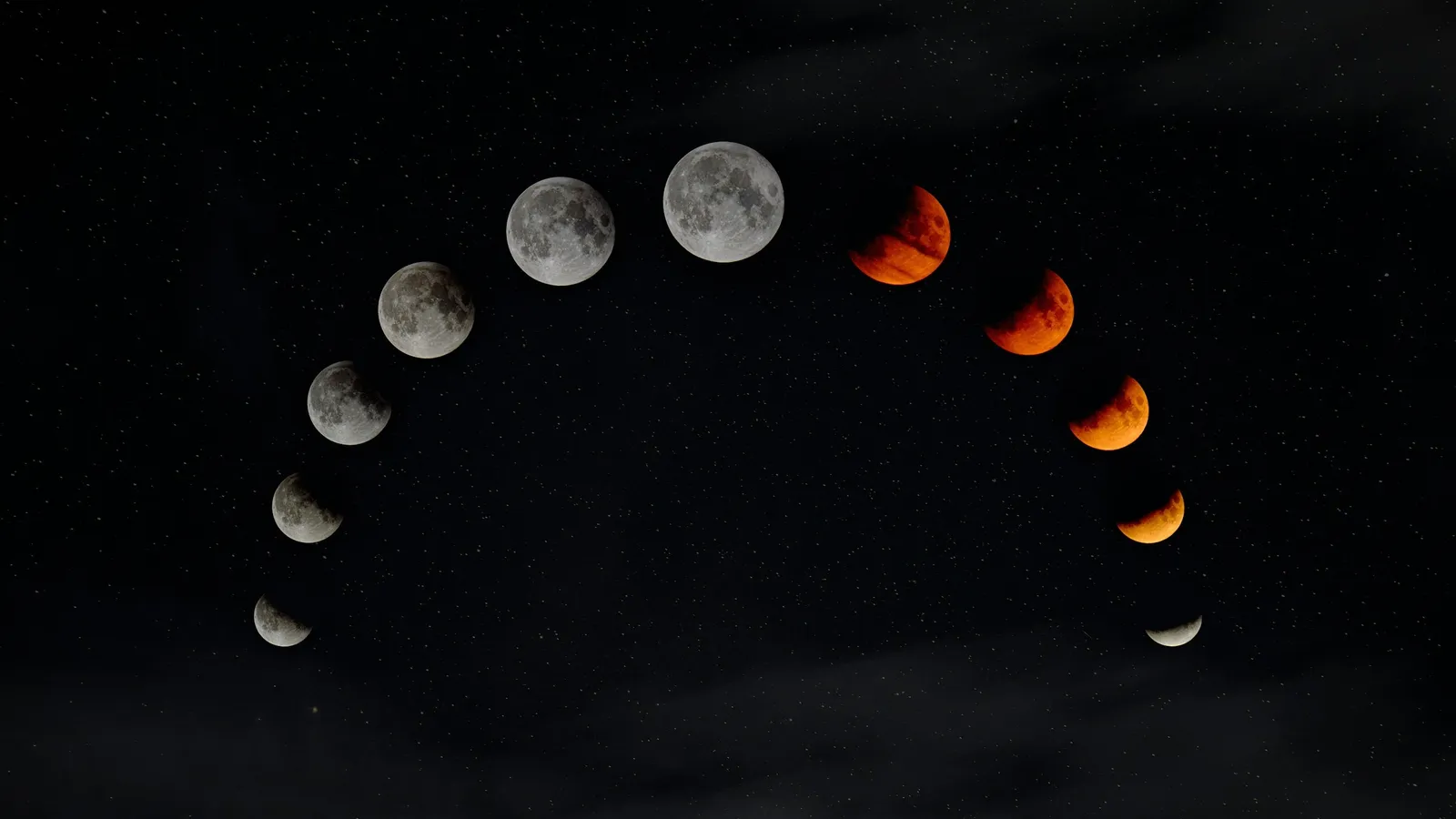
On eclipses, verse 37 of the same section says: "The Moon obscures the Sun and the great shadow of the Earth obscures the Moon." Verse 5 says that half of the Earth, the planets and the stars is dark, and half, "being turned toward the Sun, is light". These are the explanations taught in school today.
Not everything in the book is right. MacTutor notes that most historians read his formulas for the volume of a pyramid and of a sphere as incorrect, and that his length of the year, 365 days 6 hours 12 minutes 30 seconds, is too long, since the true value is less than 365 days 6 hours.
What can a student take from how Aryabhata worked?
Compress, then expand. His verses pack a method into a line. When you revise, write each rule as a single sentence, then check that you can expand it back into a worked example.
Say how exact you are. He called 62,832 "approximately" the circumference. When you round an answer, keep track of how large the error is.
Prefer a reasoned model to appearances. The sky looks as if it turns around us. The boat analogy explains the same observation with a turning Earth, which is the kind of reasoning you use when you choose a frame of reference in physics.
Read the primary source. Clark's translation is free. Ten minutes with the verses teaches you more about what Aryabhata did than a list of quiz facts.
India's first satellite carried his name. ISRO's page on the Aryabhata spacecraft says it was designed and built in India and launched on 19 April 1975; our post on U. R. Rao and India's first satellite tells that story. For place value as it appears in school, see our guide to number systems in Class 9. If eclipses or a rotating Earth are hard to picture, the Fermi Simulation Lab has interactive simulations for ideas that are easier to see than read.
A short practice routine
Use 3.1416 to find the circumference of a circle of diameter 14 cm, then compare with the answer from 22/7. (Answers: about 43.98 cm and 44 cm.)
Explain the boat verse to a friend in two sentences, using the phrase "frame of reference".
Read verses 37 and 38 of the section on the sphere in Clark's translation and sketch the Sun, Earth and Moon for each type of eclipse.
Open Clark's translation tonight and read the verse on pi in Aryabhata's own wording.