On this page
Chapter 7 opens Theme C, "Our Cultural Heritage and Knowledge Traditions", of *Exploring Society: India and Beyond*, the new Class 6 Social Science book (NCERT code fees1, First Edition June 2024, reprinted February 2026). Chapter 8 follows it (NCERT textbook contents).
CBSE publishes no separate 2026-27 curriculum for Classes 6 to 8; they follow the NCERT book, and the chapter is assessed by the school.
What is India's Cultural Roots in Class 6 about?
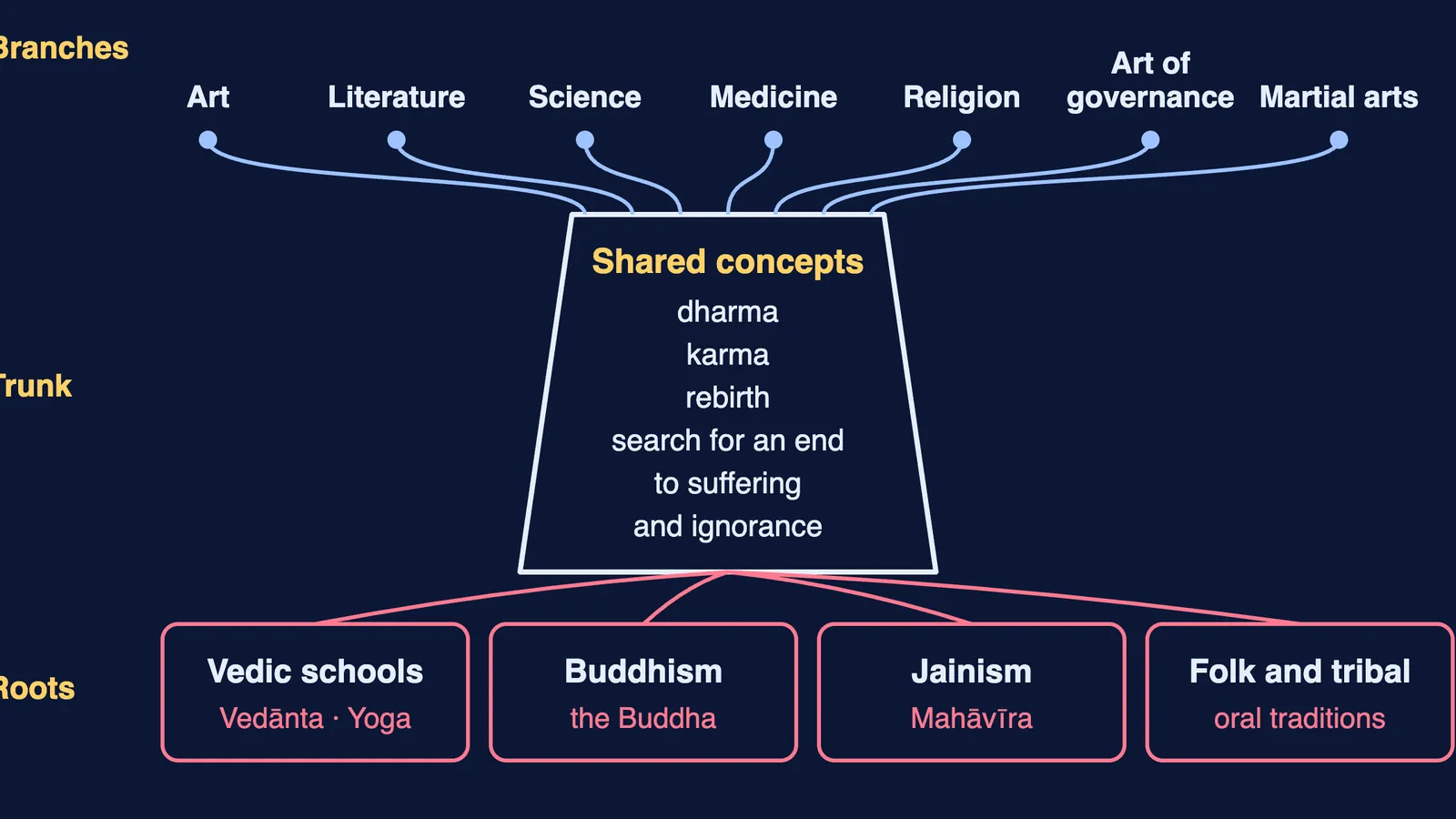
One picture runs through the chapter: Indian culture as an ancient tree (NCERT Chapter 7). Many roots nurture one trunk; the branches are expressions of the culture, such as art, literature, science, medicine, religion, the art of governance and martial arts.
Many scholars, the book notes, trace some roots to the Harappan civilisation. The chapter mostly covers "schools of thought", groups of thinkers or seekers with shared ideas. It prefers that term, and "belief systems", to "religions", because these traditions have philosophical, spiritual, religious, ethical and social aspects.
What are the Vedas and what do they teach?
From the chapter (NCERT Chapter 7):
"Veda" comes from the Sanskrit vid, "knowledge". The four Vedas, Ṛig, Yajur, Sāma and Atharva, are India's most ancient texts.
They are thousands of hymns, recited orally, not written. Proposed dates for the Ṛig Veda range from the 5th to the 2nd millennium BCE, and UNESCO recognised Vedic chanting in 2008.
The hymns were composed by rishis (male seers) and rishikas (female seers) to deities such as Indra, Agni and Varuṇa.
The Upaniṣhads introduced rebirth, karma and ātman (the Self). The school known as Vedānta holds that everything is one divine essence, brahman. Yoga developed methods to realise brahman in one's consciousness. The book says these schools became the foundations of what is today called Hinduism.
Upaniṣhad stories, such as Nachiketa questioning Yama, show the value of asking questions.
What new schools of thought emerged, and what are their core ideas?
Some schools did not accept the Vedas' authority and built their own systems (NCERT Chapter 7).
Buddhism. Prince Siddhārtha Gautama was born in Lumbini (in today's Nepal). Scholars differ on the year; Chapter 4 of the book uses 560 BCE as an approximation. At 29 he gave up palace life. Meditating under a pipal tree at Bodh Gaya, he realised that ignorance (avidyā) and attachment cause human suffering. "Buddha" means the enlightened or awakened one. He taught ahimsa (originally "non-hurting") and founded the Sangha of monks and, later, nuns.
Jainism. It spread at the same time; the book adds its roots are said to be far older. Prince Vardhamāna, born near Vaiśhālī in the early 6th century BCE, left home at 30 and after 12 years of ascetic discipline became known as Mahāvīra, "great hero". "Jain" comes from jina, "conqueror" of ignorance and attachments. Its teachings include ahimsa, anekāntavāda (truth has many aspects) and aparigraha (non-possession).
Chārvāka. Also called Lokāyata, it held that only the material world exists, so there is no life after death.
What do folk and tribal traditions add?
Folk and tribal traditions pass on through everyday practice, not written texts (NCERT Chapter 7). Citing official figures, the book gives 705 tribes in 2011, about 104 million people.
The book describes exchange in both directions: tradition holds that Jagannath at Puri was originally a tribal deity, while some tribes keep their own versions of the Mahābhārata and Rāmāyaṇa. In folk, tribal and Hindu belief systems alike, elements of nature are regarded as sacred: the Todas of the Nilgiris see over thirty peaks as homes of a god or goddess. Many tribal groups also have a supreme being, such as Singbonga for the Munda and Santhal.
Worked example: which tradition does this idea come from?
Name the tradition and the book's reason. The statements are ours:
"No single sentence can capture every side of the truth." Answer: anekāntavāda, a Jain teaching: truth has many aspects.
"The river, the forest and I are, at bottom, one divine essence." Answer: Vedānta: everything is one divine essence, brahman.
"Not knowing, and clinging, are why people suffer." Answer: the Buddha's realisation that ignorance and attachment cause suffering.
"This material world is all there is; nothing follows death." Answer: the Chārvāka or Lokāyata school.
"We never point a finger at those peaks." Answer: the Toda tradition; the peaks are sacred homes of deities.
Describe each tradition in the book's terms, ranking none above another. For the older syllabus, see our guides to the Buddha, Mahavira and the sangha and the Rigveda as a source; Class 9 State and Society up to 1000 CE returns to this period.
Practice questions (marks are our suggestion)
What does "Veda" mean, and how were the Vedas passed on? (1 mark)
Name two concepts the Upaniṣhads introduced and explain one. (2 marks)
What does "jina" mean, and what is conquered? (2 marks)
Why does the book prefer "schools of thought" to "religions"? (2 marks)
Give two examples of exchange between tribal traditions and Hinduism. (3 marks)
Mixing up the ideas? Fermi's AI tutor works out what you already know and builds a plan for the session.