

On this page
This Class 6 chapter asks how we know about people who left no diaries. It uses two kinds of evidence: a book, the Rigveda, which carries words people composed and remembered, and burials, from southern megaliths to houses at Inamgaon, which carry the objects people left behind.
What does the Rigveda tell us?
The Rigveda is the oldest of the four Vedas, according to the UNESCO Memory of the World nomination by India's National Mission for Manuscripts and the Bhandarkar Oriental Research Institute. The same nomination states that the text has 1,028 hymns, called suktas, divided into 10 books called mandalas, a word that means "circles".
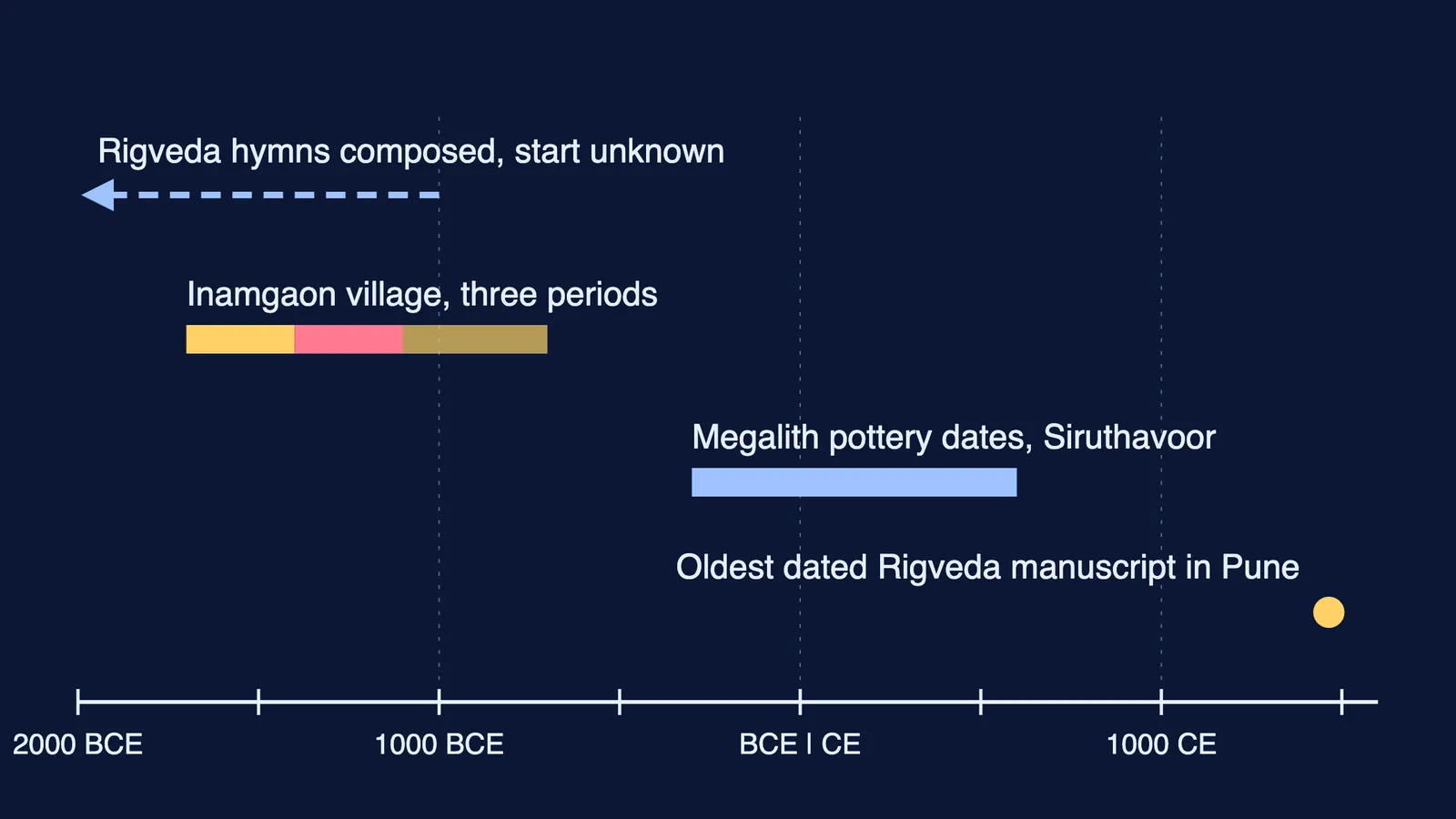
The hymns were not written down at first. The nomination says the Rigveda "has been orally transmitted through the ages with little change in its language and intonation". Written copies came much later: the oldest dated manuscript among the 30 Rigveda manuscripts at the Bhandarkar Oriental Research Institute in Pune is from 1464 CE, and one of the 30 is on birch bark in the Sharada script.
Most hymns sit in books 2 to 7, the "family books", each traditionally linked to one family of sages, so the Rigveda is a collection, not one author's work.
From the hymns you can read prayers, the gods people praised, chariots used in battle, and words for people such as the dasa. The chapter's exercises pair sukta with "well said", yajna with "sacrifice" and dasa with "slave" (exercise answers). The limit: the hymns record the views of the people who composed them, not of everyone who lived then.
What are megaliths, and what do they tell us?
A megalith is a burial marked by big stones; the chapter's exercises gloss the word as "stone boulder". The megalithic burials of southern India include dolmens, cairns and cists, as a 2013 paper in Antiquity by Smriti Haricharan and colleagues describes them.
The same paper shows why reading burials takes care. These monuments "have long needed a chronology", and a pilot study using luminescence dating of pottery at one site, Siruthavoor in Tamil Nadu, gave dates ranging from 300 BC to AD 600. Even at one site the dates spread over about 900 years, so similar-looking graves need not be the same age.
Objects inside a grave hint at status: the exercise answers above name the variety of objects and the size of the burial space as the clues to social differences.
What did archaeologists find at Inamgaon?
Inamgaon sits on the right bank of the Ghod river, and its excavators H. D. Sankalia, Z. D. Ansari and M. K. Dhavalikar dated it to three periods from about 1700 to 700 BC (Expedition magazine, Penn Museum).
From the same report:
In the later two periods, child and adult burials were found under house floors.
Children were usually buried in two or more pots; adults were laid out extended.
Almost every one of the 53 burials was oriented north-south.
Nearly all burials had funerary vessels, numbering from two to twelve.
The excavators noted that the number and quality of grave offerings varied a lot from burial to burial, which may point to social differences.
People grew barley, wheat, horse gram, lentil and pea, and bones of deer, goat or sheep, nilgai and pig were found.
Gold and copper objects were found, but no iron tools or weapons.
How do historians read books and burials?
Use these four questions on any source in the chapter:
What is it, and who made it?
What does it plainly show? (only what you can see or read)
What can we infer from that?
What can it not tell us?
Worked example: two Inamgaon graves, one with two pots and one with twelve.
Burials under house floors, made by the villagers themselves.
The graves differ in how many vessels they hold.
Some families could give more to their dead, so the village may have had richer and poorer households.
It cannot tell us the person's name, what they believed, or whether pots meant wealth or something else, such as a family custom.
Run the Rigveda through the same steps and you get a neat contrast: rich in words and beliefs, silent on how ordinary houses looked. Burials are the reverse.
How should you revise this chapter?
Make a two-column sheet: "Books tell us" and "Burials tell us".
Learn five terms with one line each: sukta, mandala, yajna, dasa, megalith.
Answer one exercise question using the four steps above, out loud, in under two minutes.
Check your textbook edition first; this guide on how to check the rationalised NCERT syllabus shows how.
For the chapters on either side, read our guides to the Harappan civilisation: cities, drains, seals and trade and to kingdoms, kings and an early republic.
If you find it hard to start a revision session, Fermi's AI tutor works out what you already know and builds a plan for the session, so you sit down to a clear next step.


