

On this page
If your Class 6 book is the new NCERT *Exploring Society: India and Beyond*, the Harappans are in Chapter 6, "The Beginnings of Indian Civilisation". This guide follows the NCERT chapter itself and ends with a 20-minute revision plan and a model answer.
What is the Harappan civilisation in Class 6?
NCERT's chapter uses four names for one civilisation: Indus, Harappan, Indus-Sarasvatī and Sindhu-Sarasvatī. Villages in the Indus and Sarasvatī region grew into towns from about 3500 BCE, and towns became cities around 2600 BCE, the "First Urbanisation of India". The people are called Harappans because Harappa, in Pakistan's Punjab, was the first of its cities to be excavated, in 1920–21.
The chapter defines a civilisation by seven features: government, urbanism (including water management and drains), crafts, trade, writing, cultural ideas, and enough farming to feed cities. Learn this list first; the rest of the chapter is evidence for it.
How were Harappan cities planned?
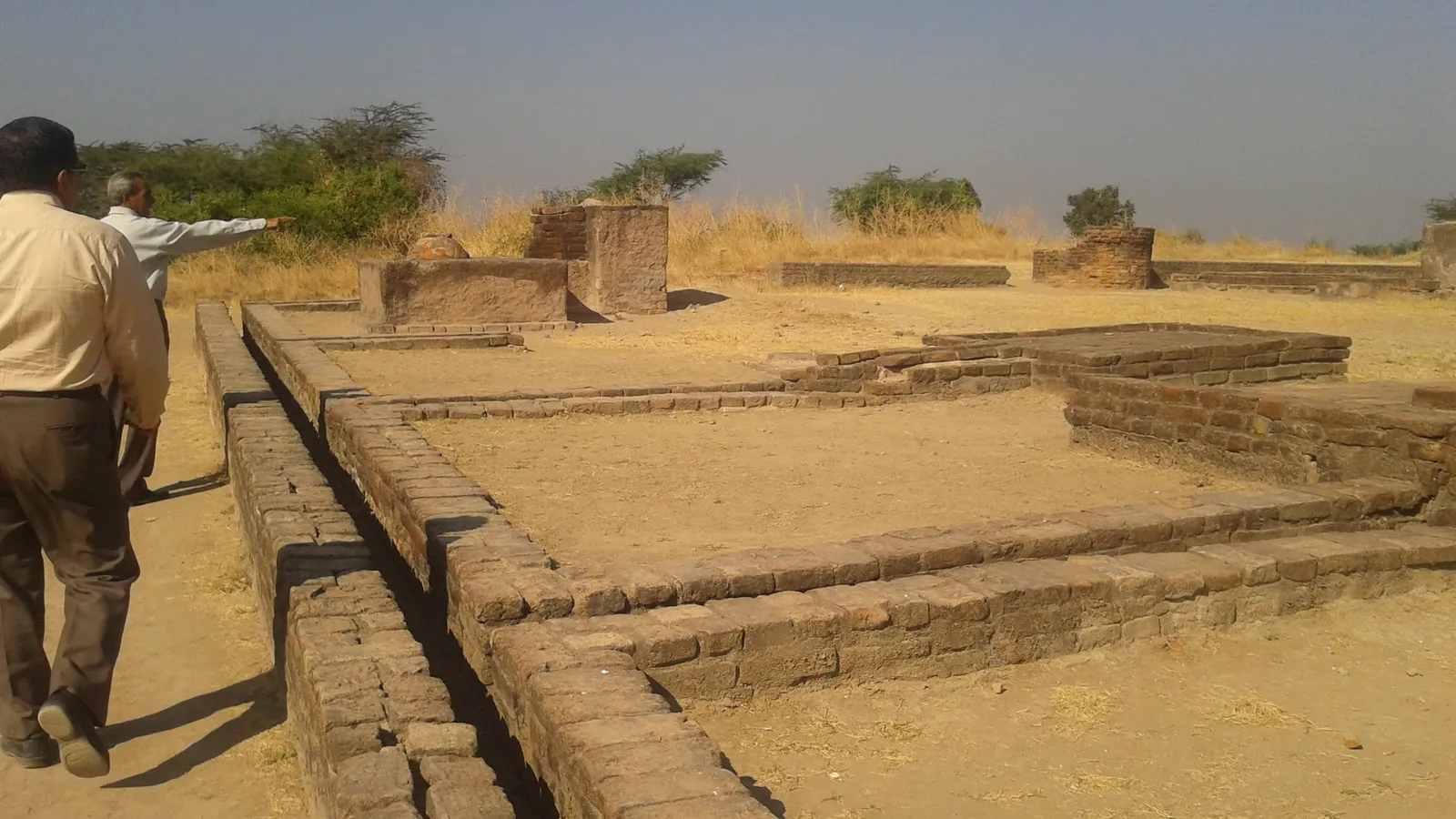
According to NCERT, the larger cities followed precise plans, with wide streets often aligned to the cardinal directions. Most seem to have been surrounded by fortifications and had two parts: an upper town, where the elite probably lived, and a lower town for common people. Dholavira in Gujarat had three zones instead of two, and most of its buildings stood on stone foundations.
A detail worth using in long answers: construction quality was the same for small and big houses, and buildings were generally of brick.
How did Harappan drains and water work?
Harappan homes often had bathing areas connected to drains that generally ran below the streets and carried waste water away, the chapter says.
In Mohenjo-daro, about 700 brick wells have been counted, according to the NCERT chapter's questions. Dholavira, in the Rann of Kutch, stored water instead: at least six large reservoirs, built of stone or cut into rock and mostly joined by underground drains, the largest 73 metres long.
The Great Bath at Mohenjo-daro was a tank of about 12 × 7 metres, waterproofed with natural bitumen, with a drain in one corner for emptying and refilling.
What did Harappans trade, and what were the seals for?
The Harappans traded by land, river and sea, NCERT explains. Their most favoured ornaments were beads of carnelian, a reddish stone found mostly in Gujarat; such beads turned up at Susa in present-day Iran, and a Harappan ivory comb was found on the coast of Oman. They probably imported copper.
Lothal in Gujarat has a basin 217 metres long and 36 metres wide, which the book says must have been a dockyard. Trade also explains the seals: thousands of small seals, generally of steatite and a few centimetres across, usually showing an animal with a few written signs above it. That script is yet to be understood.
What do archaeologists still debate?
Your teacher may ask you to argue a side. Four open questions:
The Great Bath. A public bath is ruled out because most Mohenjo-daro houses had their own bathrooms, says NCERT. A royal bath or a ritual tank are both still proposed.
The script. Nobody can read it, so no text settles the other questions.
Lothal's basin. In 1968 Lawrence S. Leshnik argued in *American Anthropologist* that it could have been an irrigation tank for a rural village rather than a port.
Why the cities ended. From around 1900 BCE they were abandoned one by one, with no trace of warfare. NCERT names two factors currently agreed upon: a drier climate from 2200 BCE, and the Sarasvatī drying up in its central basin.
How do you revise this chapter in 20 minutes?
5 minutes: write the seven features of a civilisation from memory, with one Harappan example beside each (drains for urbanism, seals for writing, carnelian beads for crafts).
5 minutes: make two columns, "what was found" and "what it might mean". The 12 × 7 metre tank is a find; "ritual bath" is an interpretation.
5 minutes: turn the dates into a chain: villages, towns, cities, drier climate, abandonment. Our guide to making a cause-and-effect chart for a history chapter shows the layout, and if an AI tool gave you dates, check them against NCERT.
5 minutes: answer one book question aloud, like the model below.
For more ancient engineering, see how Machu Picchu's drains and Angkor's water systems solved similar problems. And when a science chapter feels hard to start, Fermi's AI tutor works out what you already know and builds a plan for the session, so you begin with a clear next step.


