

On this page
If your Class 6 history book is *Our Pasts – I*, the chapter "Kingdoms, Kings and an Early Republic" tells one story: rajas, janapadas, mahajanapadas that needed taxes and armies, and a gana where many rulers decided together. Everything below comes from the NCERT chapter text (archived copy of the rationalised 2023-24 edition). NCERT's current Class 6 social science book is Exploring Society: India and Beyond, so ask your teacher which book your exam follows.
What are janapadas and mahajanapadas?
Learn these definitions, all from the NCERT chapter:
About 3000 years ago, some men became recognised as rajas by performing big sacrifices such as the ashvamedha, or horse sacrifice.
The word janapada literally means the land where the jana set its foot and settled down.
About 2500 years ago, some janapadas became more important than others and were known as mahajanapadas.
Most mahajanapadas had a capital city, and many of these were fortified with huge walls of wood, brick or stone.
NCERT gives three likely reasons for the forts: people were afraid of attacks from other kings, some rulers probably wanted to show how rich and powerful they were, and land and people inside the walls could be controlled more easily by the king.
How did Magadha become the most powerful mahajanapada?
Magadha became the most important mahajanapada in about two hundred years, according to the NCERT chapter. Learn its advantages as three resources:
Rivers: the Ganga and the Son gave transport, water supplies and fertile land.
Forests: elephants could be captured and trained for the army, and wood went into houses, carts and chariots.
Iron ore: mines in the region could be used to make strong tools and weapons.
Two very powerful rulers, Bimbisara and Ajatasattu, used all possible means to conquer other janapadas. Mahapadma Nanda, another important ruler, extended his control up to the north-west part of the subcontinent. The capital was Rajagriha (present-day Rajgir) for several years and later moved to Pataliputra (present-day Patna).
More than 2300 years ago, Alexander of Macedonia reached the banks of the Beas. His soldiers refused to march further east because they had heard that Indian rulers had vast armies of foot soldiers, chariots and elephants.
Why did the rajas of mahajanapadas collect taxes?
Forts and big armies needed more resources, and officials to collect them, so rulers moved from occasional gifts to regular taxes (NCERT chapter). Soldiers were paid regular salaries throughout the year, some probably in punch-marked coins. Who paid what:
Farmers paid taxes on crops.
Craftspersons paid taxes.
Herders paid in animals and animal produce.
Traders paid taxes on goods.
Hunters and gatherers gave forest produce to the raja.
The chapter also notes two farming changes, iron ploughshares and transplanting paddy, that raised production. When it asks why kings would encourage them, link the ideas: more grain meant more crops to tax.
How was the Vajji gana different from a kingdom?
Vajji, with its capital at Vaishali in Bihar, was a gana or sangha: not one ruler but many, each called a raja, who performed rituals together and decided matters in assemblies through discussion and debate (NCERT chapter).
The chapter quotes the Digha Nikaya, a Buddhist book written down about 2300 years ago. Ajatasattu sent his minister Vassakara to ask the Buddha about attacking the Vajjis. The Buddha replied that the Vajjis would prosper as long as they held full and frequent public assemblies, met and acted together, followed established rules and respected their elders, among other conditions.
Kings tried to conquer the sanghas, but they lasted until about 1500 years ago, when the Gupta rulers conquered the last of them.
A 25-minute plan to revise this chapter
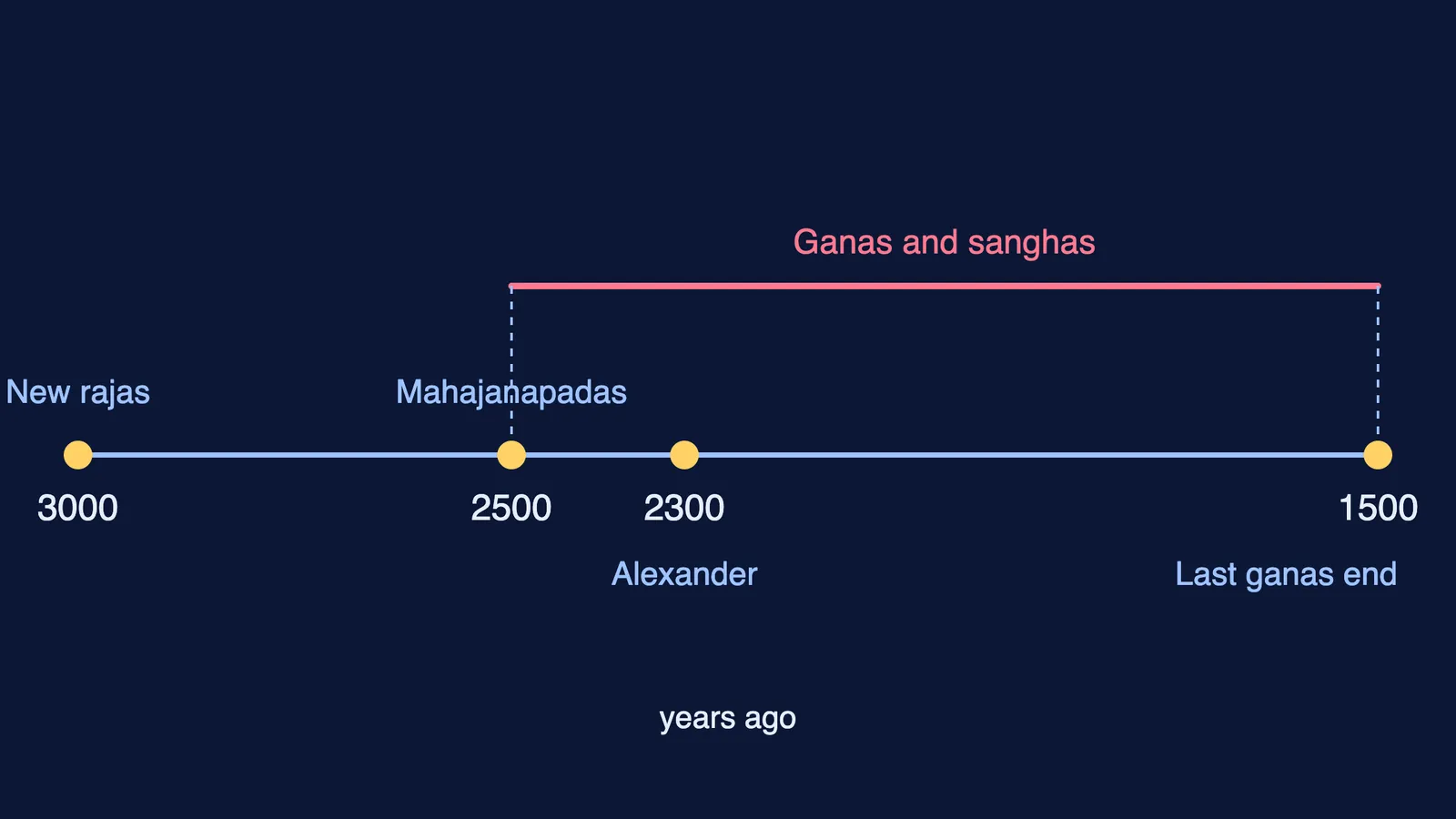
Five minutes, timeline. From memory, draw a line with four marks: new rajas (about 3000 years ago), mahajanapadas (about 2500), Alexander and the Digha Nikaya (about 2300), end of the ganas (about 1500). Then use this guide to checking a history date in NCERT.
Ten minutes, Magadha versus Vajji. Write four lines for each: who ruled, how decisions were made, the capital, and what happened later. These give you the "three differences" answer.
Ten minutes, one cause-and-effect chain. Forts and armies, so more resources, so regular taxes, so officials. A cause-and-effect chart for a history chapter shows how to lay it out.
Worked example, "Why did the rajas of mahajanapadas build forts?" A three-mark answer: "Rajas built forts because they feared attacks from other kings. Some rulers also probably wanted to show their wealth and power through tall walls. Finally, people and land inside the walls were easier for the king to control."
If you revised the Harappan civilisation chapter, with its cities, drains and seals, compare its cities with these fortified capitals. If you are unsure where to start across subjects, Fermi's AI tutor works out what you already know and builds a plan for the session.
Start with the timeline tonight: four dates, one line, five minutes.


