On this page
"Understanding the Weather" is Chapter 2 of NCERT's new Class 7 Social Science book, Exploring Society: India and Beyond, Part 1 (book code gees1, first edition April 2025, reprint 2026-27) (NCERT chapter PDF; book prelims). CBSE publishes no separate 2026-27 curriculum for Classes 6 to 8 (its 2026-27 curriculum page starts at Class IX), so Class 7 follows the NCERT book and is assessed by the school.
What is weather, according to Class 7 NCERT?
In the chapter, weather is the condition of Earth's atmosphere at one place and one moment. Almost all of it happens in the troposphere, the lowest layer, which the book says is 6 to 18 km thick: thinner over the poles, thicker over the tropics.
The book lists five elements of weather:
Temperature: how hot or cold the air is.
Atmospheric pressure: the push of the air overhead on the ground below.
Wind: moving air, described by its speed and direction.
Precipitation: water falling from the sky as rain, snow, sleet or hail.
Humidity: how much water vapour the air holds.
Why measure? "Chilly" means one thing in Chennai and another in Kashmir, but a reading in degrees Celsius means the same everywhere.
Which instruments measure the weather?
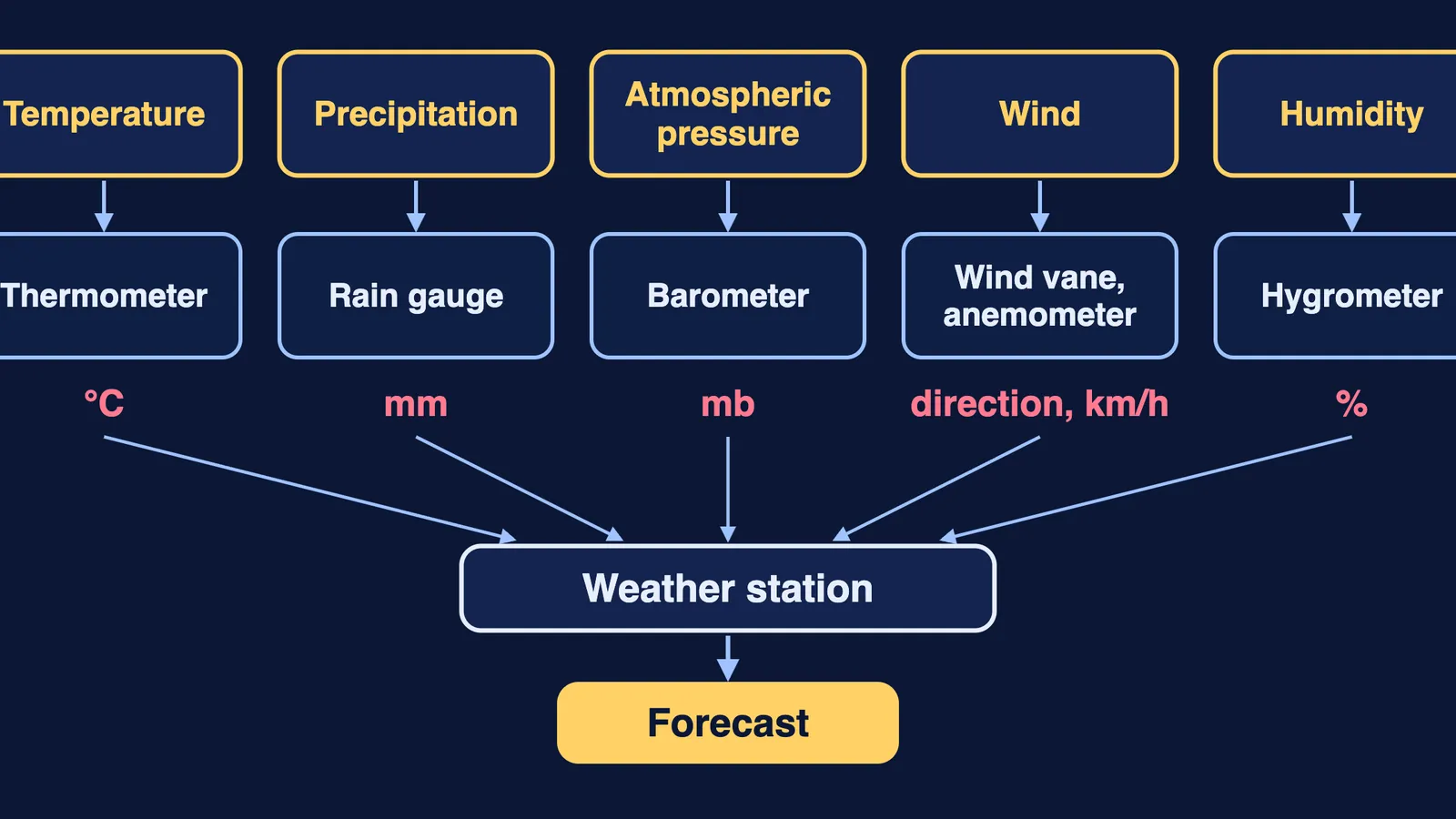
The hero diagram pairs each element with its instrument and unit, all from the NCERT text:
Thermometer for temperature, in °C. Daily readings give the range (maximum minus minimum) and the mean daily temperature (maximum plus minimum, divided by two).
Rain gauge for precipitation: a funnel feeds a measuring cylinder, and the depth collected, in mm, is the rainfall.
Barometer for atmospheric pressure, in millibars (mb). The book gives about 1013 mb as normal at the coast; below 1000 mb signals a depression, which can grow into a storm or cyclone. Pressure falls with height: Khardung La in Ladakh, over 5600 m up, is at about 650 mb.
Wind vane and anemometer for wind. The vane shows direction; the anemometer's spinning cups give speed in km/h.
Hygrometer for humidity, as relative humidity in per cent. The book puts dry weather at roughly 20 to 40% and humid weather at roughly 60 to 80%.
A weather station brings these instruments together. The book also describes Automated Weather Stations, which record data with no one present, such as the one the National Disaster Management Authority set up in 2023 at a glacial lake in Sikkim, above 4800 m. The India Meteorological Department (IMD) dates from 1875.
Worked example: how do you find range and mean temperature?
A made-up five-day record (our numbers, not the book's):
Monday: maximum 34°C, minimum 22°C, rain 0 mm
Tuesday: maximum 36°C, minimum 23°C, rain 0 mm
Wednesday: maximum 35°C, minimum 25°C, rain 0 mm
Thursday: maximum 31°C, minimum 24°C, rain 18 mm
Friday: maximum 33°C, minimum 21°C, rain 4 mm
Daily range: 12, 13, 10, 7 and 12 degrees.
Mean daily temperature: 28, 29.5, 30, 27.5 and 27°C. For Tuesday, (36 + 23) ÷ 2 = 29.5°C.
Range for the period: highest maximum 36°C minus lowest minimum 21°C = 15 degrees.
Rainfall: 18 + 4 = 22 mm in five days, an average of 4.4 mm a day.
Here the rainy Thursday has the smallest range.
Why do weather forecasts matter?
Meteorologists study long records of data to predict the weather. The chapter says this matters more now that climate change is making droughts, floods and cyclones more frequent. Warnings keep fishermen ashore before a storm and let a coast be evacuated before a cyclone. The book's activity uses an IMD warning map from 19 May 2024, with a No Warning, Watch, Alert, Warning legend; to read it, see our guide to IMD yellow, orange and red alerts.
How does this chapter connect to the rest of the book?
It sits in Theme A, "India and the World: Land and the People", between "Geographical Diversity of India" and "Climates of India" (contents). It closes by linking weather to climate, the subject of Chapter 3, and builds on Grade 6 Science (Curiosity) for thermometers and evaporation.
For the layers above the troposphere, see layers of the atmosphere for Class 7; the ideas return in Class 9 in atmosphere and climate.
Practice questions to test yourself
Marks are our suggestion.
A weather report reads "pressure 1008 mb, wind 20 km/h". Name the instrument behind each reading. (2 marks)
A town records a maximum of 27°C and a minimum of 15°C. Find the range and the mean daily temperature. (2 marks)
A coastal barometer reads 996 mb. What might this suggest, and who should be warned? (3 marks)
A town records 22% relative humidity in March and 78% in July. Using the chapter's ranges, which month has dry weather and which humid weather? (3 marks)
Why might people near a high glacial lake want an Automated Weather Station? (2 marks)
Answers: Q2, range 12 degrees, mean 21°C; Q4, March dry, July humid.
Not sure where to start revising? Fermi's AI tutor works out what you already know and builds a plan for the session.