On this page
Chapter 4 of NCERT's *Knowledge Traditions and Practices of India* for Class 11 (chapter PDF, Reprint 2026-27) runs from rock-shelter paintings to Chola temples. It has four strands: old texts on art and building, painting, sculpture in stone and bronze, and architecture.
Is Indian Art and Architecture in the CBSE Class 11 KTPI exam?
Not as a named chapter. The CBSE KTPI curriculum for 2026-27 lists nine Class 11 chapters, and none is on art and architecture. Its list does not follow the NCERT book's titles or order, so no curriculum unit matches this chapter.
The written paper is 70 marks across five curriculum chapters: Astronomy in India (13), Indian literature part I (15), Indian philosophical systems (14), Ayurveda for life, health and well-being (15) and the historical evolution of medical tradition (13). Chemistry, environmental conservation, Mathematics in India, and Theatre and Drama are for internal assessment only. Internal assessment is 30 marks: a research project (20), a portfolio (5) and a viva voce (5).
So this chapter carries no marks of its own in Class 11, and it is not one of the four listed project topics. Read it as background. The same curriculum lists "Architecture: A Survey" in Class 12, for internal assessment only. Ask your teacher how your school uses the chapter.
What does the chapter cover?
All facts below are from the NCERT chapter.
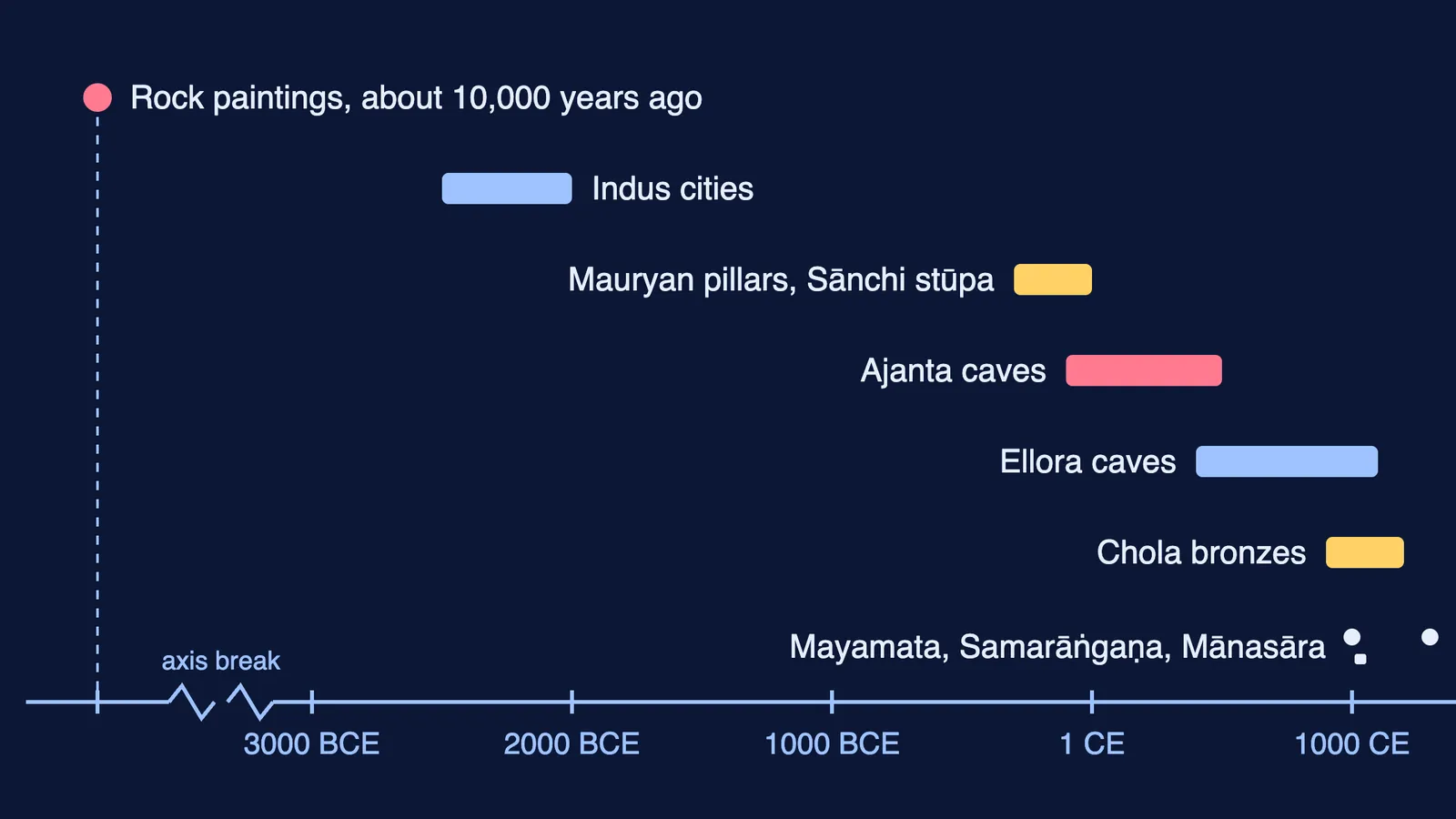
Texts. The book calls the science of architecture vāstuvidyā or śilpaśāstra. The Samarāṅgaṇasūtradhāra, by King Bhoja (1010–55 CE), covers site and soil checks, measurement and the qualifications of the sthapati, or architect. Mayamata (1000 CE) and Mānasāra (1300 CE) describe the southern drāviḍa style. Vātsyāyana's Kāmasūtra (second century CE) lists the ṣaḍaṅga, six limbs of painting, from rūpabheda (telling forms apart) to varṇikabhaṅga (analysing colour).
Painting. The richest rock paintings, in the Vindhyas, are almost 10,000 years old, and Bhimbetka has up to 20 layers in places. Murals start around the second century BCE: Ajanta's 29 caves, Bagh (five of nine caves survive), Panamalai, Kanchipuram and Sittanavasal. Pala palm-leaf manuscripts close the strand.
Sculpture. Indus busts, the lost-wax bronze "Dancing Girl" and steatite seals; Mauryan sandstone pillars 30 to 40 feet high; the Bharhut, Mathura and Sarnath styles; and bronzes from Chausa in the Kushana period to the Chola Naṭarāja.
Architecture. Indus grid towns with drains, and Dholavira's reservoirs; stūpas such as Sanchi; rock-cut caves at Ajanta, Ellora, Guntapalle and Udayagiri-Khandagiri; then temples, from small Gupta shrines to the nagara types (latina, phamsana, valabhi), Odisha's three orders, and the walled drāviḍa temple with its gopuram and vimāna.
For the temple styles in more depth, read our Class 11 Fine Arts guide to temple architecture. For wall painting after Ajanta, see later mural traditions.
How do you revise a chapter full of sites?
Use clue cards. On each card write a site, its century and three facts from the book, with the name on the back. Read the clues, say the site, then place the card on a timeline like the one above.
Try this set before checking the answers:
Island in the Rann of Kutch; stone fortifications; huge reservoirs.
32 caves; Buddhist, Brahmanical and Jain; guilds from Vidarbha, Karnataka and Tamil Nadu.
Jain monastery of the seventh century; mineral colours in fresco-secco on walls and ceiling.
Circular caitya cave with a stūpa in its hall; Eluru district; caves cut alongside built monasteries.
Buddha image with plain, see-through robe over both shoulders; a halo with little ornament.
Answers: Dholavira, Ellora, Sittanavasal, Guntapalle, Sarnath.
What questions should you practise?
CBSE has no Class 11 KTPI sample paper, so these are our own questions and the marks are our suggestion.
Who is the sthapati in the Samarāṅgaṇasūtradhāra? (1 mark)
Name two limbs of the ṣaḍaṅga and explain each in one line. (2 marks)
What does Bhimbetka show about how rock art built up over time? (2 marks)
Compare Sarnath and Mathura Buddha images of the fifth and sixth centuries on robe and halo. (3 marks)
A town has streets on cardinal lines, standard bricks and house bathrooms joined to drains. Which civilisation does this match? Give three more kinds of evidence the chapter offers. (5 marks)
Not sure where to start your revision? Fermi's AI tutor works out what you already know and builds a plan for the session.