On this page
Chapter 6 of NCERT's *An Introduction to Indian Art, Part I* (Reprint 2026-27) tours temples region by region, from small Gupta-period shrines to star-shaped Hoysala temples, and closes with Buddhist and Jain sites. The CBSE curriculum does not name a textbook, so this guide follows the NCERT chapter and maps it to curriculum Unit 2(A).
What does Chapter 6 cover, and how many marks is it?
The CBSE Fine Arts curriculum for 2026-27 sets a 30-mark, 2-hour theory paper, "History of Indian Art", for Class 11 Painting, and gives Graphics, Sculpture and Applied Art the same theory syllabus. Unit 2 carries 15 marks, but that covers three parts together: (A) temple sculpture from the 6th to the 13th century CE, (B) bronzes and (C) Indo-Islamic architecture. No separate figure is printed for Part (A).
How do Nagara, Dravida and Vesara temples differ?
First learn the book's basic Hindu temple: the garbhagriha (sanctum) for the main image, a mandapa (hall) for worshippers, a tower over the sanctum, and the deity's vahan with a standard pillar in line with the sanctum.
Nagara (north): usually on a raised stone platform with steps, rarely with big boundary walls. The curving shikhara ends in an amalaka and kalasha, and the tallest tower always stands over the garbhagriha. Sub-types: latina (rekha-prasada), phamsana and valabhi; Odisha's deul is a regional sub-style.
Dravida (south): inside a compound wall entered through a gopuram. The tower, called a vimana in Tamil Nadu, rises like a stepped pyramid; "shikhara" means only the crowning stupika. Fierce dvarapalas guard the door, and the sanctum tower can be the smallest because it is the oldest part.
Vesara (Deccan): a hybrid of the two orders that, the book says, seems to have caught on after the mid-seventh century. Karnataka's Chalukyan temples are its boldest experiments. Hoysala temples, with star-shaped plans and dense carving, are sometimes called vesara.
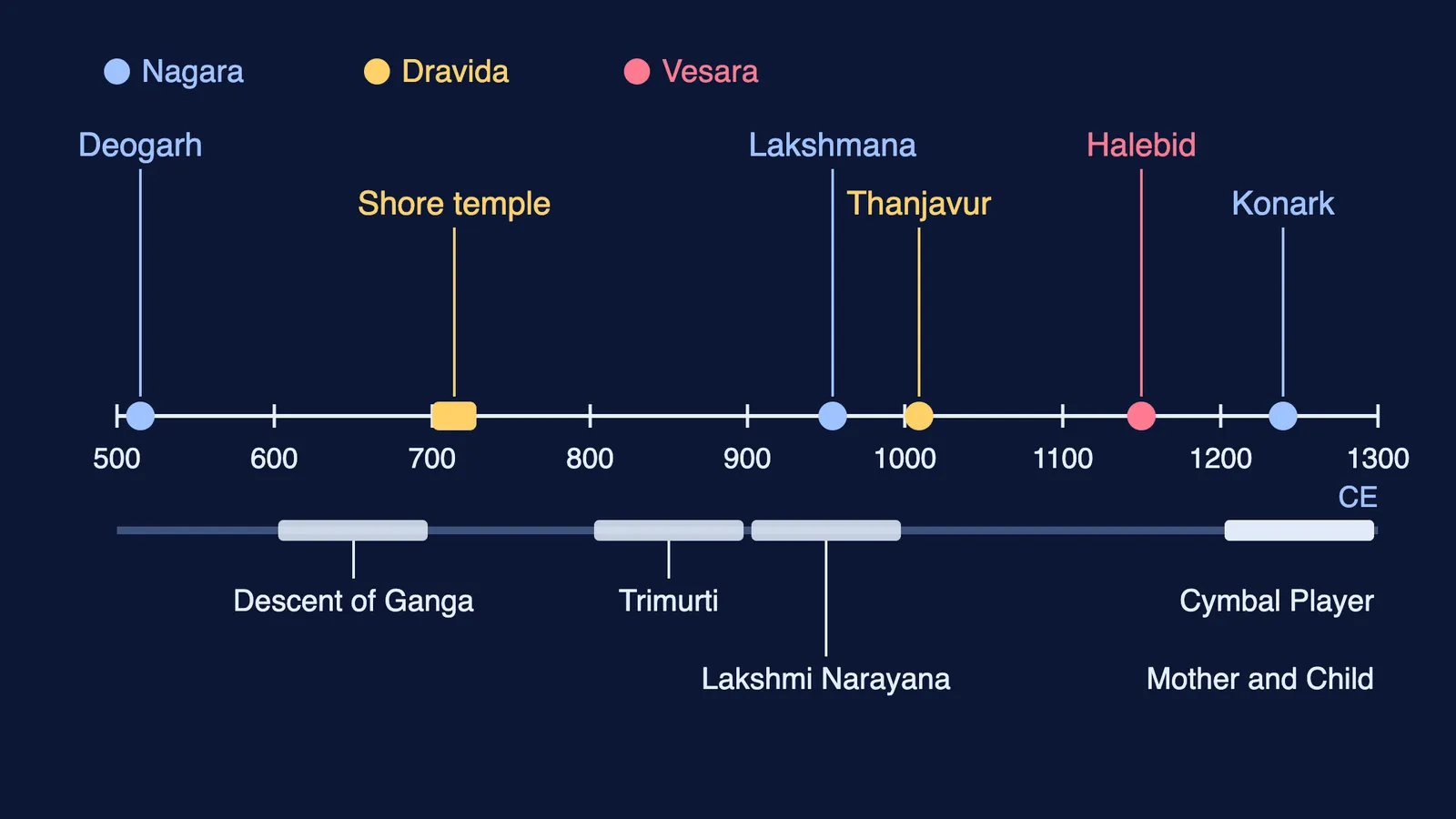
Dated anchors from the chapter: Deogarh, early sixth century; the Shore temple, Mahabalipuram, probably under Rajasimha (reigned 700–728 CE); Lakshmana temple, Khajuraho, 954; Brahadeeshwarar, Thanjavur, around 1009, with a 70-metre vimana; Hoysaleshvara temple, Halebid, 1150; Konark, around 1240.
What should you know about the five sculptures in the curriculum?
Learn the curriculum's period, dynasty, material and place for each, then add the book's notes.
Descent of Ganga, Mahabalipuram (c. 7th century CE, Pallava, granite). A relief nearly 30 m long and 15 m high; a natural cleft carries water. Scholars read it as the Ganga's descent, as Arjuna's penance from Bharavi's *Kiratarjuniya*, or as a prashasti praising the king. Look for the ascetic on one leg and the cat among rats.
Trimurti, Elephanta (curriculum: c. 9th century CE, stone). Chapter 4 of the same book discusses this Elephanta image as Maheshmurti and dates it to the early sixth century CE, with a central Shiva head flanked by Bhairava and Uma. Learn both dates and ask your teacher which to write.
Lakshmi Narayana, Khajuraho (c. 10th century CE, Chandela, stone). The curriculum places it at the Kandariya Mahadev temple (the book spells it Mahadeo). The book does not describe a Lakshmi Narayana sculpture; its Khajuraho feature is the separate Lakshmana temple, so keep the two apart. For style, use the book's Khajuraho traits: almost full relief, sharp noses, prominent chins, long slanting eyes.
Cymbal Player, Konark Sun temple (c. 13th century CE, Ganga dynasty, stone). The book describes the temple as a stone chariot: twelve pairs of wheels, seven horses.
Mother and Child, Vimal-Shah temple, Dilwara (c. 13th century CE, Solanki, white marble). The book notes the plain exteriors and deeply undercut marble interiors of the Mount Abu Jain temples, which it places in the tenth to twelfth centuries; the curriculum dates this sculpture c. 13th century.
What practice questions should you try?
Our own questions; the marks are our suggestion.
Name four basic parts of a Hindu temple and say what each is for. (2 marks)
A temple stands inside a walled compound entered through a gopuram, and its main tower rises in steps. Name its order and the figures you would expect beside the sanctum door. (3 marks)
Appreciate the Descent of Ganga: period, dynasty, material and two readings of its story. (6 marks)
Draw a labelled outline of a nagara temple showing garbhagriha, shikhara, amalaka and kalasha. (4 marks)
How should you revise this chapter?
Fill a three-column sheet (Nagara, Dravida, Vesara) from memory, then check it against the book. Make one card per sculpture: curriculum facts on the front, book notes on the back. Related reading: our Class 9 introduction to the history of arts, how the Konark wheel tells time and BFA admission after Class 12.
Not sure where to start your revision? Fermi's AI tutor works out what you already know and builds a plan for the session.