On this page
Chapter 1 of Madhurima, NCERT's Class 9 Arts textbook (First Edition, April 2026) is the one chapter every Art Education student studies, whatever art form they pick. It puts Theatre, Music, Dance and Visual Arts on one timeline and sets India beside the wider world.
How many marks is History of Arts in Class 9?
The CBSE Art Education curriculum for Class 9 (2026-27) makes the subject 100% school-based: 40 marks for theory and 60 for practical work. The 2-hour theory paper gives History of Arts 20 marks, then 4 marks each to Visual Arts, Music, Theatre and Dance, and 4 marks to an integrated note on an unseen image. History of Arts is a single common chapter, with 30 suggested hours, so its 20 marks belong to this chapter. There is no board exam: the curriculum calls it a 100% school-based internal assessment.
One small mismatch: the curriculum says the chapter runs to the late 11th century CE, but the book's timeline and closing line go up to the twelfth century (1200 CE). Ask your teacher where your school's paper stops.
What is tangible and intangible cultural heritage?
The book follows UNESCO in splitting heritage into two kinds (Madhurima, Ch 1):
Tangible heritage is anything physical you can hold or visit: monuments, artworks, manuscripts, instruments, masks, jewellery, tools.
Intangible heritage is living practice handed down through generations: oral traditions, performing arts, rituals, festivals and the skills behind traditional crafts.
A quick test: a Chhau mask is tangible, but the skill to make it is intangible.
The chapter also explains two ways knowledge travelled. Śhruti, meaning "that which is heard", is learning by careful listening, as the Vedas were passed from guru to śhiṣhya. Smṛiti links to memory-based retelling of the epics and Purāṇas. Music is traced to Sāmaveda chanting, which grew from one note to three (udātta, anudātta, svarita) and then to seven.
What happened in each of the four periods?
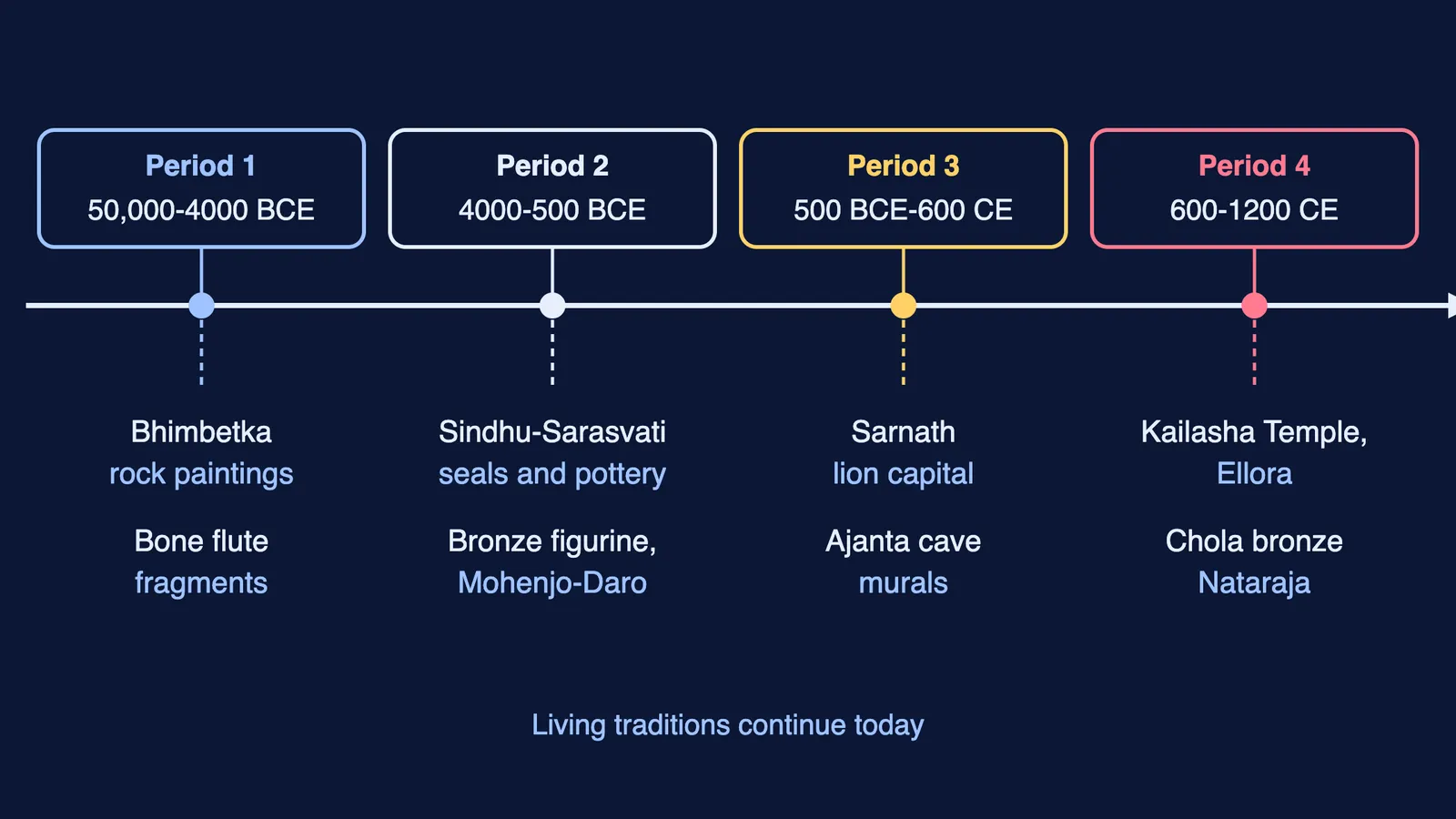
50,000 to 4000 BCE. No writing, so evidence is archaeological. Bhimbetka in Madhya Pradesh has paintings of animals, hunts and a group dancing with linked arms, made from earth pigments with water and a binder in red, white, yellow and green. Elsewhere: Altamira, Chauvet, Lascaux and Sulawesi, plus bone flute fragments.
4000 to 500 BCE. River-valley cities. The Sindhu-Sarasvatī civilisation left seals with the subcontinent's earliest script, painted pottery, and the Mohenjo-Daro bronze figurine (about 2600 BCE) cast by the lost-wax method. Abroad: Sumerian cuneiform, the Giza pyramids and Egypt's Ikhernofret stela.
500 BCE to 600 CE. Stūpas, chaityas and vihāras spread from the third century BCE; Sanchi's four carved gateways show episodes from the Buddha's life and Jātaka stories (our Class 12 guide to Sanchi and stupas goes deeper). The Sarnath lion capital gets its shine from mirror polish. Ajanta murals used a blue from lapis lazuli; see how the Ajanta paintings were made. Greek theatre and Roman amphitheatres are the global parallel.
600 to 1200 CE. From the seventh century, Tamil Bhakti poets (Āḻvārs and Nāyanārs) shaped music and dance. The ninth-century Chera ruler Kulaśhekhara Varman is credited with reconstructing Kūdiyāṭṭam. The Kailāśha Temple at Ellora was cut downward from one basalt rock; historians estimate 18 years of work and about 4,00,000 tonnes of rock removed. Chola bronzes made Naṭarāja in a ring of fire iconic. For the political setting, read our Class 9 guide to State and Society up to 1000 CE.
Learn the three sculpture centres as a set: Sarnath (Chunar sandstone, idealised and serene), Mathura (red spotted sandstone, rounded bodies, expressive eyes) and Gandhara (grey schist, Greek-Roman realism).
Which ancient texts on the arts should you know?
Nāṭyaśhāstra (Bharata Muni): drama, dance, music and visual arts; rasa theory, with eight bhāvas behind eight rasas.
The Viṣhṇu-dharmottara Purāṇa's Chitra-sūtra: painting conventions.
Silappadigāram (Iḻaṅgo Aḍigaḻ): third key treatise listed for 500 BCE to 600 CE.
Saṅgīta-makaranda (Nārada, 7th to 8th century): rāgas, some named after regions.
Bṛihaddeśhī (Matanga, 8th to 9th century): mārga versus deśhī, and a colour for each svara.
Abhinavabhāratī (Abhinavagupta): commentary carrying rasa theory forward.
Daśharūpaka (Dhanañjaya, 10th century): ten types of drama.
Abhinaya-darpaṇam (Nandikeśhvara, 11th century): hand gestures and body positions, still used by dancers.
How should you revise? Practice questions
Draw your own four-column timeline with one Indian and one world example per period, then list undated living traditions from your state. Original questions (mark labels are our suggestion):
(1 mark) Which treatise contrasts mārga and deśhī music? Answer: Bṛihaddeśhī.
(1 mark) Classify: a palm-leaf manuscript; a lullaby sung at home. Answer: tangible; intangible.
(2 marks) Give the stone used at Sarnath, Mathura and Gandhara. Answer: Chunar sandstone, red spotted sandstone, grey schist.
(3 marks) Why is the Kailāśha Temple called monolithic, and why could a cutting error not be fixed later?
(4 marks) A carved panel shows a dancer beside drummers. Using this chapter, explain how sculpture can be evidence for the history of music and dance.
Not sure which period to revise first? Fermi's AI tutor works out what you already know and builds a plan for the session.