On this page
Chapter 11 of the new Class 9 arts book is about how a dancer tells a story through movement, sound and costume.
What does "dance as visual storytelling" mean in Class 9?
The chapter sits in the Dance section of NCERT's Madhurima, Chapter 11 (First Edition, April 2026). It calls Indian dance dṛiśhya-kāvya, which the book translates as visual poetry. Its examples include Kālidāsa's Abhijñāna-Śhākuntalam, a Kathak Romeo and Juliet, a dyūta-krīḍā scene from the Mahābhārata in Kathakali, the farming year from sowing to harvest, and scenes from daily life.
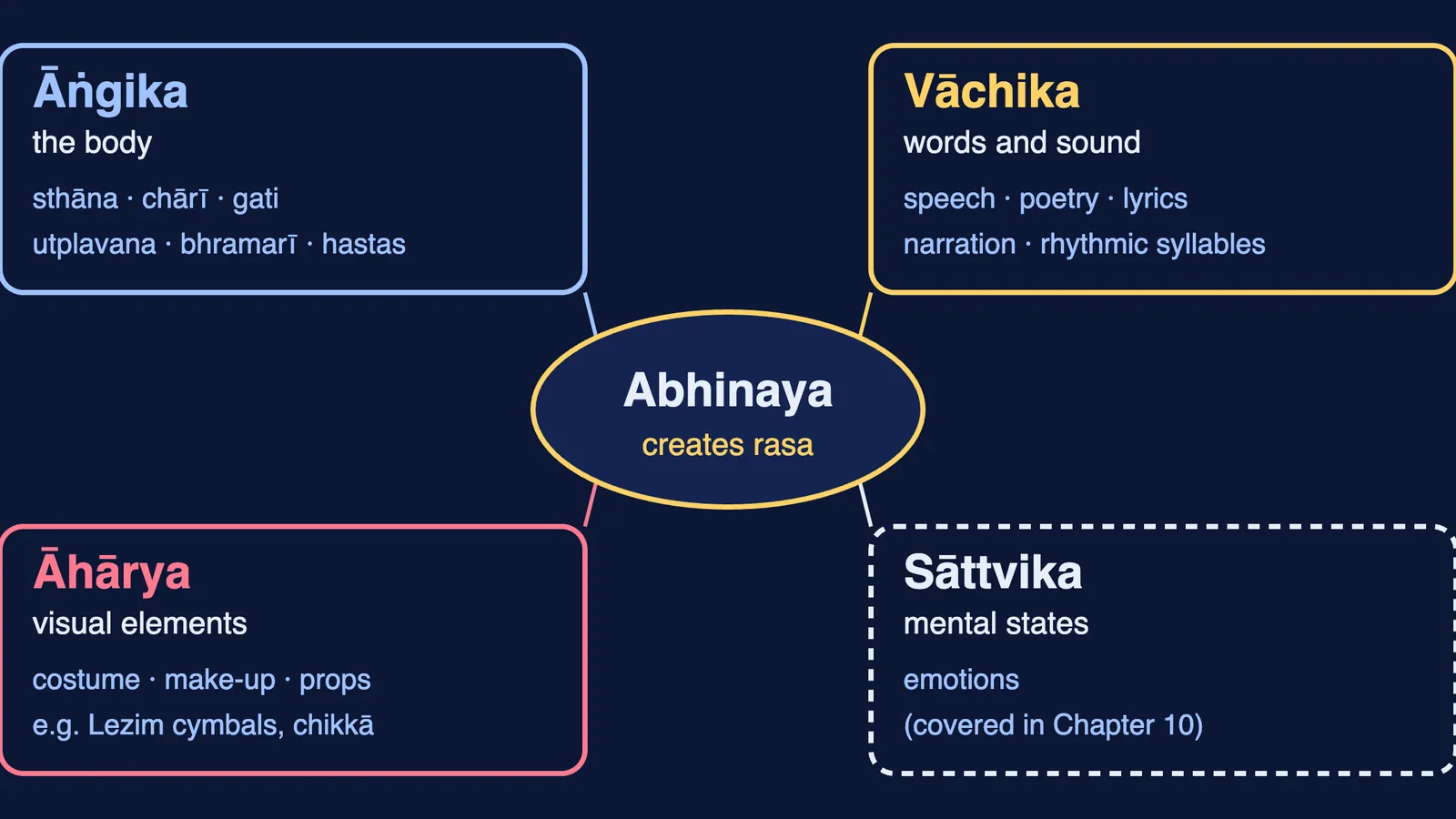
The tool that carries these stories is abhinaya. The opening page of the book's Dance section (page 135, in the Chapter 10 PDF) quotes the Nāṭyaśhāstra (Chapter 6, verse 38): abhinaya has four forms, āṅgika, vāchika, āhārya and sāttvika. Chapter 10 then explains all four. Chapter 11 then puts three of them into practice: āṅgika, vāchika and āhārya. Sāttvika, showing inner emotion, belongs to Chapter 10.
What are āṅgika, vāchika and āhārya abhinaya?
Āṅgika (the body). Āṅgika abhinaya means communicating through the body. Every style has signature moves that set it apart from other styles. Its stylised movements, recalled from earlier grades, are sthāna, chārī, gati, utplavana, bhramarī and hastas.
Activity 11.1 uses the sixth-century CE Dancing Śhiva sculpture at Badami. The book says it shows 18 hands, and that combining those hand positions gives 81 dance poses. You try some poses, then add walks, jumps or spins to make a short story sequence.
Vāchika (words and sound). Vāchika abhinaya is everything you hear: speech, poetry, lyrics, narration, dialogue and spoken rhythm syllables. Examples include Kuchipudi and the Bauls of West Bengal, who sing Bhakti songs, narrate and dance.
Activity 11.2 asks you to dance three ways and compare them:
To instrumental music only, with claps or syllables such as dha, ta, ka: Tārpā (Maharashtra), Diṁsā (Andhra Pradesh), Kaikoṭṭikaḻi (Kerala), Rāut Nāchā (Chhattisgarh).
To songs with lyrics: Bihu (Assam), Ghoomar (Rajasthan), Dhamāl (Haryana), Rāuf (Kashmir).
To your own singing of a regional song.
Āhārya (what you see). Āhārya abhinaya is the visual layer: costume, make-up and props. Costume often identifies a form at a glance because it reflects a region's textiles and jewellery. Props can add rhythm. The Lezim dance of Maharashtra uses the lezim, an instrument with metal cymbals, and Bhangra from Punjab uses the chikkā, a wooden clapper. Harvest dances often copy farm work.
Activity 11.3 asks you to match pictures to eight forms by their costume: Lāvaṇī, Cheraw, Kullu Nāṭī, Baigā, Pūjā Kunitā, Siddi Dhamāl, Bastar and Phāg. (Activity 11.3 prints "Chattisgarh" for Bastar's state; the correct spelling, which Activity 11.2 uses, is Chhattisgarh.)
How can you plan a short dance with the abhinayas?
Take a story the chapter suggests, the farming year. Our worked example plans a 40-second piece.
Āṅgika: a slow bend forward with scooping hand gestures for sowing; a turn (bhramarī) for the wind; small jumps (utplavana) as the rain arrives.
Vāchika: start with claps on "dha ta ka" at a slow tempo, speed up for the rain, then sing two lines of a harvest song you know.
Āhārya: a cloth seed bag and a stick tapped to keep the beat.
Sāttvika: worry while you wait for rain, then joy at harvest, shown in the face.
In your write-up, name each abhinaya and what it added. The chapter's learning outcomes ask you to compare the abhinayas and use them creatively.
How is Chapter 11 assessed in 2026-27?
The CBSE Art Education curriculum for Class 9 (2026-27) makes the subject a fully school-based internal assessment out of 100: 40 for theory and 60 for practical. There is no board exam.
Theory: Dance carries 4 marks. That covers all four Dance chapters (10 to 13); there is no separate figure for Chapter 11.
Practical: the Dance section is marked out of 60. It includes "Presentation of Abhinaya" for 10 marks and a 10-mark viva whose listed topics include hand movement, pad sanchalan and abhinaya in different types of dance. The final practical score averages all four art-form sections.
Suggested teaching time: 4 hours (5 periods) for this chapter.
For how Class 9 results are used, see do Class 9 marks matter.
Practice questions
Mark values are our suggestion.
Name the abhinaya that uses costume, make-up and props. (1 mark)
Give one example of a prop that adds sound as well as a visual element to a dance, and name its state. (2 marks)
How is vāchika abhinaya different from āṅgika abhinaya? Use one example of each. (2 marks)
Plan a short dance about a local festival with one idea each for āṅgika, vāchika and āhārya. (3 marks)
Turn a short scene from daily life, such as buying vegetables at a market, into a dance. Say which moments you would show through āṅgika alone and where you would add vāchika, and why. (4 marks)
Revising four art forms at once? Fermi's AI tutor works out what you already know and builds a plan for the session.
If dance matters beyond school, read about balancing classical dance training with studies and BA or BPA routes in dance.